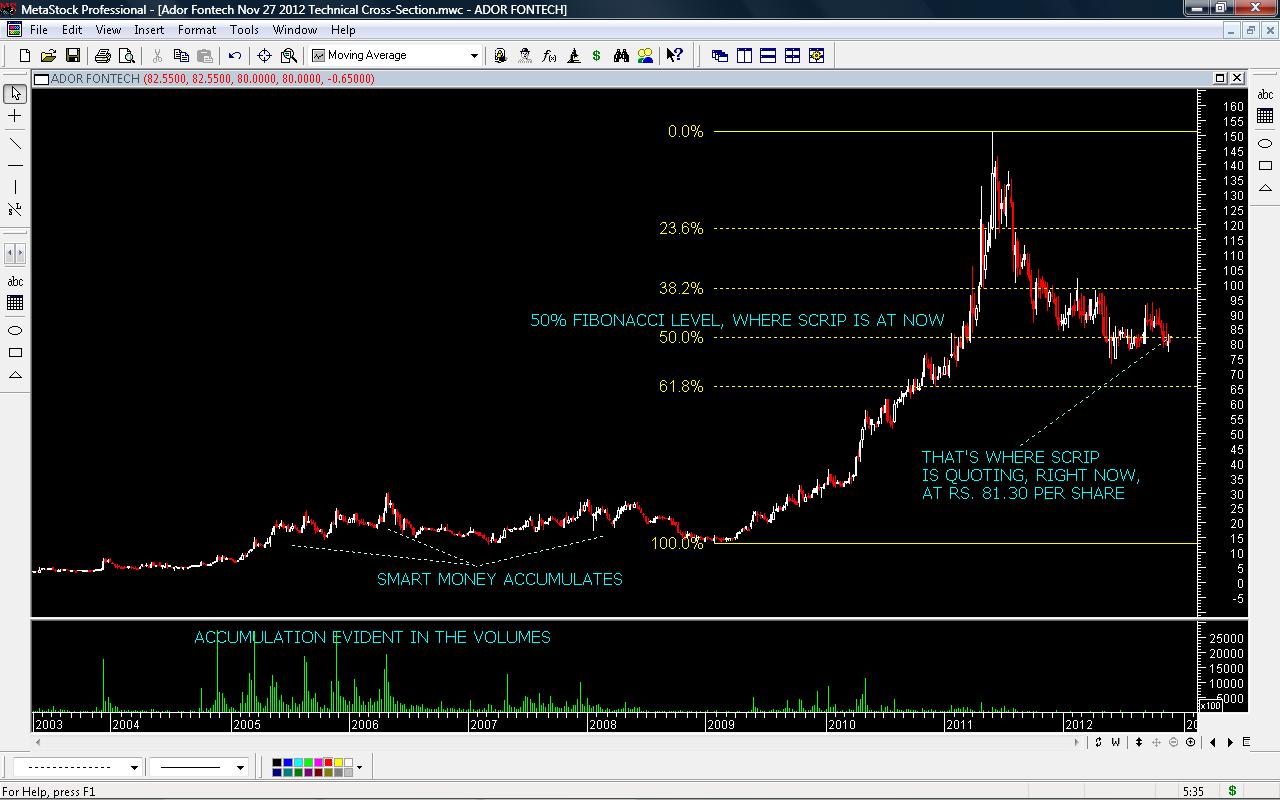
The Line

In the world of applied finance, you will meet the “line”.

Though the line is an abstract phenomenon, it is very real.

Whenever you connect to Mrs. Market, you do so through the line, which comes into existence (you guessed it) when you put your money “on the line”.

Please be aware of the capabilities of the line. If you allow it to, it grabs hold of the emotional switches of your brain. When the price of the scrip you’re trading plunges, the line can turn on your depression switch. As the loss multiplies, the line makes you go into freeze mode. On the other hand, it can also make you go on a spending spree with your notional profits, if your scrip is doing well. If you allow it to, the line then controls how you interact with your family and for that matter with everyone else.

Why give it so much power? Let’s keep the line in its boots. When you’re flying a kite with strong winds prevailing, and the kite plunges downwards and out of control towards some electricity wires, what do you do? Obvious answer, let the string go. Well, not so obvious when you’re holding the string (substitute string for “line” if you wish). You could try and save your kite, or for that matter, your trade, at the cost of being electrocuted, or, in trading jargon, burnt.

When you’re holding the line, common-sense often goes out the window. You start thinking emotionally. Our society doesn’t teach us to embrace failure. We are taught to win. Thus, we want to turn every trade into a winning trade. Big mistake. We are not able to let the line go while any loss is still bearable.

Wins come. The fact remains, that in applied finance, many transactions will be failures. You’ve won if you can then let your line go at a digestible failure level.

When a win does come along, again one is completely misled by the teachings of modern society. “Book your success now, put it on your resume”. An even bigger mistake in applied finance.

A winning trade needs to be allowed room to win some more. After struggling with failures, you’ve finally identified a winning horse. Aren’t you going to let it win more (races)? Aren’t you going to continue holding the line to let a multibagger emerge, instead of letting the line go while you’re showing a small profit which doesn’t even cover your failed trades?

The line is an enigma concerning the discernment of befitting moments for attachment and detachment.

We need to let it go when it threatens to burn us. Also, we need to hold on to it, contrary to any public opinion, that “XYZ can’t possibly go any higher”.

There’s no way we’re playing the line according to public opinion or society rules.

Also, there are times when it doesn’t make sense to get a line going, because the kite just doesn’t take off. At other times, you need to put out one line after another into the sky, because your kites start to soar, one after another.

In the world of applied finance, you need to put your money on the line. There’s no other way to connect to Mrs. Market.

The “when” is up to you, when to get it going, when to let it go, when to hold on, when to scale it up.

And at that level, trading becomes an art.

Is This Blood?

When there’s blood on the streets, that’s when you should go out and invest.

That’s an ancient proverb.

The 64 million dollar question is, IS THIS BLOOD?

I’m going to focus on India, because that’s my playground.

So ICICI Bank breached the 700 mark, did it? The 2009 low was around 250 bucks. At 700, it’s not blood. True, the banking sector is down. However, we are nowhere near blood levels. State Bank of India might have fallen around 50 % this year, but it’s still double the price of its 5 year low.

The Sensex shows an average price to earnings ratio of around 14. Remember 2008 and 2009? Average PE of about 9? Well, in my opinion, those are blood levels. These aren’t.

True, the mid-cap segment has taken a hammering. Let’s take Sintex Industries. At 75 levels, this stock has fallen big. Nevertheless, it’s still double the price of it’s 2009 low. At 98 rupees, Jain Irrigation has really fallen too. The PE ratio has come down from 35+ to around 14, and this looks attractive. Even Sintex’s sub-5 PE ratio looks very attractive, also because the company is aggressively pursuing water-purification and “green-innovation”. Agreed, attraction to invest is present, especially in the mid-cap arena, where you’re likely to find quality in management too, as opposed to the small-cap area, where this is less likely. However, to say that there’s overall mayhem here would be going too far.

The BSE small-cap index has halved since late 2010, but is again at double the 2009 low. Many small-cap stocks are bleeding badly, though. Most small-caps haven’t proven their pedigree yet. Thus, people are letting them bleed.

Then there are stocks like Karuturi Global and KS Oils, that have been hammered down to penny-stock levels. One has problems getting into such stocks, because the underlying story can be shady. With penny stocks, there’s always the danger of oblivion, i.e. they might cease to exist down the line. Such stocks need to be traded at best, with small amounts and for the short-term. In their present conditions, they are not investment-grade stocks.

The picture that emerges is that there are selective attractive bets being offered by Mrs. Market. There are good investments to be made for long-term investors, if you possess patience and holding-power. I’m short on patience, so I like to trade India. That should not deter you. If you are a long-termer, and have what it takes, well, then you are a long-termer. And this market is offering you some good bets, so be very selective and go for it, but don’t bet the farm, since we’re not seeing all-out blood on the street yet.

As Ponzi as it Gets

Charles Ponzi didn’t dream that he’d become one of the most copied villains in the History of mankind.

Ponzi was a financial villain. His ideology was so simple, that it was brilliant.

Lure the first set of investors with promises of huge returns. Transfer the first few return payouts. Lure more and more investors as the news spreads about the scheme with great returns. Transfer few more return payouts to old investors from the investment principal of new investors. Lure a peak level of investors ultimately. Then vanish with all the collections.

As Ponzi as it gets.

I hardly read the financial newspapers. Technical trading finds news to be more of a burden. Earlier, I used to gauge sentiment from the news. Now, my Twitter-feed is an excellent gauge for sentiment. Also, with time, one starts to gauge sentiment in the technicals. Candlesticks are a great help here.

Yesterday, in a loose moment, I picked up the Economic Times. Normally, it’s not delivered to our house. Yesterday, a supplement of the ET was included in our normal newspaper. Probably a sales gimmick. Anyways, I glanced through it. Was shocked to find that 25 recent Ponzi schemes had been unearthed in India alone.

What is it about us? Can we not understand what greed means?

The sad fact was that all the investors who were trapped were retail small timers.

Education, people, education. Are you financially literate? If not, please don’t enter the markets. No amount of regulation can save you from being duped if you are financially illiterate.

When you’re putting your money on the line for the long term, you’re looking for quality of management. A track record is something you want to see. Average returns are great returns if they promise safety of the principal.

Where there’s promise of huge rewards, there are also proportionate risks. If you really want the thrill of very high returns, all right, fine, go ahead and risk a miniscule percentage of your portfolio size in a risky, high yielding scheme. Tell yourself that the principal might or might not come back, and for heavens sake, don’t bet the farm here.

These financial times are as Ponzi as it gets, people, so TREAD CAREFULLY.

When Cash is King

I don’t like crowds.

The last thing I ever want to do is to conform to crowd behaviour.

That’s one goal defined.

What does this mean?

Very clearly, for starters, it means singing one’s own tune, i.e. defining one’s own path.

It also means not listening to anyone. That requires mental strength, and the power to resist. Very tough.

In life, generally, one likes to be in tandem with the Joneses. And then, smart cookies that we are, we like to go one up on the Joneses, which would be the cue for the Joneses to catch up and then overtake us. Hypothetically, this is how the Joneses and the Naths could blow up all their cash.

It doesn’t stop there. To keep up, the average citizen doesn’t think twice before leaping into debt.

Bottomline is, when cash is king, hardly anybody has cash. In fact, most people owe money at that time.

This is the age of black swans. Crisis after crisis, then a bit of recovery, then another crisis, then some recovery, followed by a mega-crisis.

When a master-blaster crisis ensues, cash becomes king. Quality stuff on the Street starts to sell so cheap, that one needs to pinch oneself to believe the selling prices. Margins of safety are unprecedented. Now’s the time one can salt away a part of one’s cash in Equity, for the long-term.

That’s if one has cash to spare. This is report card time. How have you done in your REAL investment exam? Have you learnt to sit on cash? Have you learnt to buy with margin of safety? The Street doesn’t care for your college degree, in fact, it vomits on your college degree. Your college degree has no value on the Street, it’s just a piece of paper.

Learning on the Street happens everyday, with every move, every investment, every trade, every observation. Unless and until your own money is on the line, this learning is ineffective.

Get real, wake up, so that when cash is king, you feel like an emperor!

An Elliott-Wave Cross-Section through a Crowd Build-Up

At first, there’s smart money.

Behind this white-collared term are pioneering investors who believe in thorough research, and who are willing to take risks.

Smart money goes into an underlying, and the price of this underlying moves up. Wave 1.

At the sidelines, there are those who have been stuck in this underlying. As the price moves above their entry level, they begin to off-load. There’s a small correction. Wave 2.

By now, news of the smart money has perforated through the markets. Where is it moving? What did it pick up? Who is behind it? Thus, more investors following news or fundamentals (or both) enter. The price moves past the very recent short-term high of Wave 1, accompanied by a surge in volume.

This is picked up on the charts by those following technicals, who enter too. By now, there are analysts speaking in the media about the turn-around in company so and so, and a large chunk of people following the media do the honours by entering. Wave 3 is under way.

Technical trend-followers latch on, and soon, we are at the meat of Wave 3, i.e. the middle off the trend.

Analysts on the media then speak about buying on dips. All dips are cut short by a surge of entrants seeking to be part of the crowd.

The first feelings of missing the bus register. The pangs of these cause more people to enter.

Meanwhile, the short community has been getting active. Large short positions have been in place for a while, and they are bleeding. Eventually, the short community throws in the towel, and there’s massive short-covering, causing a further surge in price.

Short-covering is sensed by gauging buying pressure despite very high price levels. It is the ideal time for smart money to exit. That’s exactly what it does, without any dip in the price of the underlying whatsoever.

Short-covering is over. Smart money starts boasting about its returns of X% in Y days, openly, at parties, in the media, everywhere. This causes pangs of jealousy and intense feelings of missing the bus in those still left out. Some enter, throwing caution to the wind.

The price has reached a level at which no one has the guts to enter. Demand dries up. With no buying pressure, the price dips automatically. Bargain hunters emerge, and so do shorters. The shorters sell to the bargain hunters right through a sizable dip. This dip happens so fast, that most of the crowd still remains trapped. Wave 3 has ended, and we are now looking at the correcting Wave 4 in progress.

At this stage, technical analysts start advising reentry upon Fibonacci correction levels. Position traders buying upon dips with margin of safety enter, and so does the second-last chunk of those feeling they’d missed the bus. The price edges up to the peak of Wave 3 and past it. That’s the trigger for technical traders to enter.

We now see a mini-repeat of Wave 3. This is called Wave 5. Once Wave 5 crosses its meat, the last chunk of those still feeling they’d missed the bus makes a grand entry with a sharp spike in the price. These are your Uncle Georges, Aunt Marthas and Mr. Cools who know nothing about the underlying. They cannot discern a price to earnings ratio from an orangutan. They desperately want to be a part of the action, since everyone is, at whatever the price. And these are the very people that traders sell to as they exit. With that, the crowd is at its peak, and so is the price. There are no more buyers.

What’s now required is a pin-prick to burst the bubble. It can be bad news in the media, the emergence of a scandal, a negative earnings report, anything.

The rest, they say, is History.

Dealing with Distraction

I’m a huge Sherlock Holmes fan.

The stand-out quality I admire about Holmes, apart from his mastery in observation and deduction, is his ability to switch off.

In the midst of the most engrossing case, Holmes will switch off for half a day or more, and will visit the museum, or will play the violin. While having switched off, there will not be a single thought on his mind concerning the ongoing investigation. He will be fully and totally involved in the recreational activity. Of course he switches off at a juncture where he knows that nothing of consequence is happening for the next so many hours, but that’s not the point.

The ability to switch off is a huge asset to the trader. It allows the trader’s mind and body to recuperate. Also, it does away with overtrading. If a position is showing good profit, the trader who installs a trailing stop, and then switches off, opens the window for still larger profits.

At many times, one is distracted. It is potentially dangerous to trade while distracted, just as it is dangerous to drive while communicating on the cellphone. While distracted, the trader needs to switch off. As long as it takes. Till the source of distraction is nullified, at least in the trader’s mind.

Just a minute, forget about the trader. Investors need to be experts at switching off too, after having entered into an investment. If they don’t have this ability, they’ll be thinking about their investment day in, night out, for years at a stretch. The investment will eat into their life. If we’re looking at the average investor with 10 to 20 investments and without the ability to switch off, we’re also looking at a mental and emotional wreck.

Traders and investors both need to learn how to switch off from Sherlock Holmes.

Is Commodity Equity Equal to Commodity?

Rohit likes Aarti, but has no access to her.

Priya wants to be friends with Rohit. Priya looks a bit like Aarti and behaves like her too, at times.

Rohit and Priya become friends.

Is Priya = Aarti?

Can this question be answered with a resounding yes or no?

Of course Priya is not equal to Aarti. Priya is Priya and Aarti is Aarti. Ask Rohit about it during one of Priya’s temper tantrums.

And, at other times, Priya is just like Aarti. At still other times, Priya is as calm as the Pacific Ocean. Even calmer than Aarti. At those times, Rohit feels he is even better off with Priya than he would have been with Aarti.

After this short diversion into human relationships, let’s study the correlation between commodities and commodity equity.

The average working individual does not have access to commodities as an asset class. He or she is not a farmer, and doesn’t have the time or the nerve to play futures and options, in an effort to put some money in commodities.

Is there any avenue such a person can access, to invest a piece of his or her pie in commodities.

It’s time to study the world of commodity equity.

For example, we are talking about agriculture stocks, precious and non-precious metal mining stocks, oil and natural gas stocks etc. etc.

Do such stocks always behave as their underlying commodity?

Can one put one’s money in commodity equity, and then feel as if one has put the money in commodities?

These questions can be answered in terms of correlation.

There are times when Gold moves x%, and Gold equity also moves x%, in the same direction. At such times, the correlation between Gold and Gold equity is 1:1.

At other times, the levels of movement can be mismatched. For example, the correlation can be 0.8:1, or 1.2:1. Sometimes, there is even a negative correlation, when Gold moves in one direction, and Gold equity in the other. At still other times, one moves, and the other doesn’t move at all, i.e. there is no correlation.

You see, Gold equity first falls under the asset class of equity. It is linked to the mass psychology of equity. When this mass psychology coincides with the mass psychology towards commodities, here specifically Gold, there is correlation. When there is no overlap between these psychologies, there is no correlation. When the public just dumps equity in general and embraces commodities, or vice-versa, there is negative correlation. These relationships can be used for all commodities versus their corresponding commodity equity.

What does this mean for us?

Over the long-term, fundamentals have a chance to shine through, and if there is steady and rising demand for a commodity, this will reflect in the corresponding commodity equity. Over the long term, the discussed correlation is good, since truth shines forth with time. That’s good news for long-term investors.

Over the medium-term, you’ll see correlation at times. Then you’ll see no correlation. You’ll also see negative correlation. Position traders can utilize this information to their benefit, both in the long and the short direction.

Over the short-term, things get very hap-hazard and confusing. It would be wrong to look for and talk in terms of correlation here. In the short-term, for trading purposes, it is better to treat commodity as commodity and commodity equity as equity. If you are trading equity, a gold mining stock or any other commodity equity stock might or might not come up in your trade scan. When such a stock does get singled out for a trade as per your scan, well, then, take the trade. Don’t be surprised if at the same time your friend the commodities trader is trading oil futures instead, or is just sitting out. That’s him or her responding to his or her scan. You respond to your scan. In the world of short-term trading, it is hazardous to mix and correlate commodities with commodity equity.

Phew, that’s it for now. It’s taken me a long time to understand commodity equity, and I thought that I’d share whatever I understood with you.

A Fall to Remember (Part 2)

Part 1 was when Silver fell almost 20 $ an ounce within a week. Like, 40%. Swoosh. Remember? Happened very recently.

And now, Gold does a Silver, and falls 20 % in a few days. These are the signs of the times. “Quick volatility” is the new “rangebound move”. Put that in your pipe and smoke it.

The wrong question here is “What’s a good entry level in general?” Why is this question wrong?

When something new becomes the norm, there is too little precedence to adhere to. It becomes dangerous to use entry rules which were established using older conditions as a standard.

I believe there is one way to go here. The correct question for me, were I seeking entry into Gold or Silver, would be “Is this entry level good enough FOR ME?” or perhaps “What’s a good enough entry level FOR ME?”

Let’s define “good” for ourselves. Here, “good” is a level at which entry doesn’t bother YOU. It doesn’t bother you, because you are comfortable with the level and with the amount you are entering. You don’t need this sum for a while. It is a small percentage of what you’ve got pickled in debt, yielding very decent returns. If the underlying slides further after your entry, your “good” level of entry still remains “good” till it starts bothering you. You can widen the gap between “not-bothering” and “bothering” by going ahead with a small entry at your “good” level, and postponing further entry for an “even better” level which might or might not come.

If the”even better” level arrives, you go ahead as planned, and enter with a little more. If, however, your “good” level was the bottom, and prices zoom after that, you stick to your plan and do not enter after that. This would be an investment entry strategy, which sigularly looks for a margin of safety. Entry is all-important while investing, as opposed to when one is trading (while trading, trade-management and exit are more important than entry).

Trading entry strategies are totally different. Here, one looks to latch on after the bottom is made and the underlying is on the rise. Small entries can be made as each resistance is broken. It’s called pyramiding. Trading strategies are mostly the complete opposite of investing strategies. Please DO NOT mix the two.

Sort yourself out. What do you want to do? Do you want to invest in Gold and Silver, or do you want to trade in them? ANSWER this question for yourself. Once you have the answer, formulate your strategy accordingly. U – good level – how much here? U – even better level – how much there? U – no more entry – after which level?

Life is so much simpler when one has sorted oneself out and then treads the path.

Blowing up Big

Derivatives are to be traded with stops. Period.

Stops allow you to get out when the loss is small.

Common sense?

Apparently not.

Who has common sense these days?

Also, the human being has embraced leverage as if it were like taking the daily shower. Bankers and high-profile brokers have free flowing and uncontrolled access to humongous amounts of leverage.

Apart from that, the human being is greedy. There’s nothing as tempting as making quick and big bucks.

Combine humongous amounts of leverage with large amounts of greed and brew this mix together with lack of common sense. That’s the recipe for blowing up big.

Every now and then, a banker or a high-profile broker blows up big, and in the process, at times, brings down the brokerage or the bank in question. In the current case at hand, UBS won’t be going bust, but its credibility has taken a sizable hit.

Bankers are to finance what doctors are to medicine. Where doctors manage physical and perhaps mental health, bankers are supposed to manage financial health. Bankers are taught how to manage risk. Something’s going wrong. Either the teaching is faulty, or the world’s banking systems are faulty. I think both are faulty. There exists a huge lack of awareness about the definition of risk, let alone its management.

Trained professionals lose respect when one of them blows up big. Such an event brings dark disrepute to the whole industry. Most or all of the good work to restore faith in the banking industry thus gets nullified to zilch.

A doctor or an engineer is expected to adhere to basics. I mean, the basics must be guaranteed before one allows a surgeon to perform surgery upon oneself. A surgeon must wash hands, and not leave surgical instruments in the body before stitching up. Similarly, an construction engineer must guarantee the water-tightness or perfection of a foundation before proceeding further with the project.

Similarly, a banker who trades is expected to apply stops. He or she is expected to manage risk by the implementation of position-sizing and by controlling levels of leverage and greed. Responsibility towards society must reflect in his or her actions. A banker needs to realize that he or she is a role model.

All this doesn’t seem to be happening, because every few years, someone from the financial industry blows up big, causing havoc and collateral damage.

Where does that leave you?

I believe that should make your position very clear. You need to manage your assets ON YOUR OWN. Getting a banker into the picture to manage them for you exposes your assets to additional and unnecessary stress cum risk.

In today’s day and age, the face of the financial industry has changed. If you want to manage your own assets, nothing can stop you. There exist wide-spread systems to manage your assets, right from your laptop. All you need to do is plunge in and put in about one hour a day to study this area. Then, with time, you can create your own management network, fully on your laptop.

Your assets are yours. You are extra careful with them. You minimize their risk. That’s an automatic given. Not the case when a third party manages them for you. Commissions and kick-backs blind the third party. Your interests become secondary. Second- or third-rate investments are proposed and implemented, because of your lack of interest, or lack of time, or both.

Do you really want all that? No, right?

So come one, take the plunge. Manage your stuff on your own. I’m sure you’ll enjoy it, and it will definitely teach you a lot, simultaneously building up confidence inside of you. Go ahead, you can do it.

The Power of Compounding

At first, the power of compounding is a slow and steady trickle. Then, it starts gathering momentum. Finally, after a long time, it reaches epic proportions.

If you make the power of compounding work for you from as early an age as possible, you could well achieve financial freedom in your early- to mid- 40s. How does that sound?

Let’s say that your investment gives you a steady 8% per annum compounded. In 25 years, it us up almost 7 fold.

If the investment is giving 12% per annum compounded, in 25 years it will be up 17 fold.

15% per annum compounded – will be up almost 33 fold in 25 years.

20% per annum compounded – 95 fold.

27% (Warren Buffett’s average lifetime return per annum compounded, calculated some years before he donated his fortune to charity) – almost 394 fold.

42% (Rakesh Jhunjhunwala’s average lifetime return per annum compounded, that’s what they say) – 6415 fold.

What do you say to that? Don’t the figures speak for themselves and prove to you the power of compounding? Wouldn’t you like to start harnessing this power from like right now?

Let’s do another exercise. We are now looking at an investment term of 30 years. Other conditions remain the same.

An investment yielding 8% per annum compounded, in 30 years, will be up 10 fold, or a 1000%.

If the investment is giving 12% per annum compounded, in 30 years it will be up almost 30 fold.

15% per annum compounded – will be up 66 fold in 30 years.

20% per annum compounded – up 237 fold in 30 years.

27% – 1300 fold.

42% – 37038 fold.

Don’t the figures just blow you away? (They are so startling, that I have to ask myself if I’ve made some mathematical error. Why don’t you check these figures for me and inform me if there is an error).

The harnessing of this power of compounding is primarily the domain of the long-term investor. Nevertheless, the prudent trader uses it too. Such a trader ties up vast sums of money in fixed income investments for long periods of time, and then just trades on part of the yielded income, using the rest to live well and reinvesting what is still left.

It’s really time you start making use of the power of compounding. If not for yourself, then at least harness it for the futures of your children.

What are We, Really?

One bout of torrential rainfall and our infrastructure comes to a stand-still.

What are we, really?

Is India a golden investment?

Not with the current state of governance.

Is India an investment?

Yes, but only at single-digit price to earnings ratios.

Why?

Because while investing in India, one needs to factor in very bad governance, terrorism, and fragile infrastructure. That’s why the margin of safety required is huge.

Is India a good trade?

Yes.

Why?

Because of the pull and push between the shining private sector versus the apathetic government sector. This contrast causes big moves, both up and down. Ideal for trading.

So how should one play India?

Again, up to you. Invest in it at single digit PEs. Cash out when PEs hit the early 20s. Or, just sheer trade it. Suit yourself.

Is it Over for the Long-Term Investor?

Long-term portfolios are getting bludgeoned.

I can feel the pain of the long-term investor.

Is it over for this niche segment?

I really wouldn’t say that.

It’s not over till the fat lady sings, as somebody said.

What if someone trained hard so as to not allow the fat lady from starting her performance in the first place?

Well, for this breed, it’s not over by a long way. In fact, things are just getting started.

And what are the areas of training?

First and foremost, for the millionth time, one needs to understand what margin of safety is. In this era of black swans, one can fine-tune this area with the word “large”. So, simple and straight-forward: the long-term investor needs to buy with a large margin of safety.

This is a game of PATIENCE. Patiently wait for entry. Entry is the most important act while investing. If you cannot learn to be patient, change your line. Be a trader instead.

However scarce the virtues of honesty and integrity have become, keep looking. When you finally find them in a company, ear-mark the company for a buy. For you, managements need to be intelligent and shareholder-friendly too. They need to be evolved enough to take you into account as a shareholder. Keep looking for such managements, and you’ll be amazed at the unfolding potential of diligent human capital.

Before you enter this arena, answer another question please? Have you learnt to sit? If you don’t even know what this question means, you are by no means ready for the game.

So, when is one capable of sitting through some serious knocks, like now? If the money you’ve put on the line is not required for the next 5 to 10 years, you’ve totally helped your cause. Then, your risk-profile should fit the pattern. If a knock causes you an ulcer, just forget about the game and look for another game that doesn’t cause you an ulcer. Your margin of safety will help you take the knock. Knowing that your money has bought a stake with honest and diligent people who can work their way around inflation will help your cause even more.

If you are taking a very serious hit right now, you need to decide something. Are you gonna sit it out? Can you afford to, age-wise and health-wise? Yes? Fine, go ahead. I sat it out in 2008. If I could do it, so can you. It did take a lot. Taught me a lot too. I now know so much more about myself. Was a rough ride, is all I can say. Nevertheless, it’s a good option if age and health support you. If you decide to sit it out, please train yourself, from this point onwards, to do it right. Needless to say, don’t make the same mistakes again. Let’s be very clear about this point. If you are feeling pain at this point, it’s because you have made one or more investing mistakes. Don’t blame the market, or the times. This is your pain, because of your mistakes. Take responsibity for your actions. Do it right from here onwards.

If you can’t take the hit anymore, age-wise or health-wise, then you need to reflect. It’s none of my business to tell you to sell out. That would be inappropriate. All the same, as a friend, I would like you to ask yourself if you feel you are cut out for this niche segment. There are other very successful niche-segments. I know highly successful traders who started out as miserable long-term investors. So, just this one thing, get the questioning process started. Now. Then, listen to your inner voice and decide what you want to do.

There’s this one other point. Some people feel they can focus on both these segments simutaneously. You know, trade in one portfolio and maintain another long-term portfolio. Possible. People are doing it. I’m not about to start a discussion on focus versus diversification just now, because I’m leaving it for another day. Not because I don’t possess the mettle, but because I’m a little tired just now.

Wish you safe investing! 🙂

US Treasury Bonds, Anyone?

Panic is something I felt during 2008.

It was actually good that I did, because now I know what it feels like.

Meaning that if a similar situation starts to arise again, now there are internal warning signals in my system.

Investors learn from mistakes. That’s the good thing about mistakes.

It will not take a Moody’s rating agency to tell even an average investor that US treasury bonds don’t deserve a AAA rating. Most investors I know have shunned any investment product with US treasury bond exposure since 2008.

Didn’t such ratings agencies give CDOs a AAA rating? Frankly, I don’t even feel like acknowledging the existence of ratings agencies. I’d much rather just use my common sense.

So, one’s learning curve freed one up from dangerous exposure after 2008. Are one’s investments still going to be unaffected from the ongoing and critical developments in the US?

Globalization is in. Decoupling seems to be out for the moment. If the US economy crumbles, investments worldwide are going to be affected for the worse. To lessen such shocks, God created hedges.

The best known hedge to mankind over the last 100 years has been Gold. After 2008, central banks worldwide started scrambling to find an alternative to the USD to hold their wealth in. Only Gold is standing their test. More and more central banks have started converting their USD holding to Gold.

Much as I don’t feel like acknowledging the existence of ratings agencies, unfortunately, I have to. If there’s a ratings downgrade in the US, Gold purchases by central banks are going to escalate. The astute investor will need to position him- or herself accordingly if he or she has not done so yet, starting right now.

As we bathe in the glory of Gold, let’s not forget that it is just a safe haven, a crisis-hedge. If economic stability returns to the world this or next decade (or whenever), Gold is going right back to where it came from.

Something else used to enjoy the safe-haven status till a few years ago. I think one calls them US treasury bonds.

Seasons change. If Gold is the flavour now, it’s possibly a temporary flavour.

Keep your eyes open, and keep using your common sense.

Wishing you safe investing.

Face-Off

Markets are about returns.

Just as many roads lead to Rome, so do multiple paths lead to returns.

The two basic approaches in this game are investing and trading. We are keeping things basic, and are not even going to talk about scalping, arbitrage etc. We are looking at paths taken by most players.

So who has got it better, the investor or the trader?

Markets have this characteristic of collapsing. Unless the investor has bought with a decent margin of safety, he or she can be sitting on a huge loss. This can lead to irritability, sleepless nights, ill-health and family problems. An investor needs to slay these demons before-hand. Allowed to grow, these demons can wreck havoc.

The nimble trader on the other hand treads lightly. Technicals alert him or her well before a collapse, and when the collapse comes, the trader is ideally already fully in cash. Such a trader has no professional reason for a sleepless night.

However, when the bulls roar, the investor’s entire portfolio adds to the roar, and very soon the investor is sitting on huge gains. The trader on the other hands builds up positions slowly, and might miss a large portion of the up-move during the staggered entry process. To be fair, the investor’s exposure (risk) has been large in comparison to the trader, and thus the reward in good times will be proportionately large too. Given a choice, I’d personally take the comfortable nights throughout the year.

Then there’s active and passive playing. Investing is a passive play. One doesn’t need to man one’s portfolio on a daily basis, and can focus on other things instead. Trading, on the other hand, is very much an active play, and needs to be attended to on a daily basis.

So, unless the investor likes action, this is a favourable scenario. Unfortunately, the majority of long-term investors mess up their long-term portfolios owing to the need for action.

Trading can lead to action overload. A bad day’s result can cause mood swings. The trader needs to be in control of emotional machinery and ready to withstand a pre-determined level of loss. Unfortunately, most traders fail badly in the emotional and stop-loss department. On the whole, I feel this particular round is won the by the investor. So, it’s 1 round each.

The last round in today’s discussion is about life-style. The bored investor can either use the spare time for constructive activities, which is a great scenario, or for useless ones, like surfing adult sites. The point I’m trying to make is that a bored investor is a prime candidate for sowing wild oats.

The sensible trader uses non-market hours to finish research for the next day and then to give the mind and body relaxation and rest. However, all the action makes most traders less sensible and more flambuoyant, and equally likely candidates for sowing wild-oats during non-market hours. I think this round is a tie.

So who’s got it better, the trader or the investor?

This is actually a trick question.

What’s the proper answer?

The answer is that YOU have got it better if you fit into the profile of a sensible trader or a balanced investor, and that YOU have got it bad if you fit into the profile of a reckless / flambuoyant trader or a bored and thus trigger-happy investor.

Both investing and trading are about YOU.

You need to see how good or bad YOU have it, and forget about the rest.

Financial Academia and the Street – A Comprehensive Disconnect

1994 AD.

My friends in the Physics Department of the University of Konstanz, Germany, were busy trying to increase the number of holes on a silicon strip.

This was nanotech research in its advanced stage.

Nanotech saw successful implementation in the real world, though the explosion is yet to come. Nevertheless, the key words here are successful implementation.

Successful implementation on the street is only possible when a research model is practical.

Financial academia time and again delivers impractical models and is then surprised when they meet with failure on the street.

Let’s take the case of the Long Term Capital Management hedge fund. Nobel laureates ran it. They did not incorporate the possibility of a sovereign debt default in their model. So sure were they of themselves, that they went on to buy billions of dollars worth of derivatives, leveraging themselves to the hilt. Their total leverage in the end stood at 250:1. The sovereign debt default by the Russian government in 1998 triggered the LTCM fund to go belly up, and with it disappeared the life-savings of thousands of trusting investors. The ripple effects of this disaster almost knocked the world’s financial system off its platform. Talk about disconnect.

Currently, we are seeing the effects of another disconnect in action.

The Euro was conceived on the basis of hundreds of PhD theses and tons of post-doctoral research. What the researchers couldn’t possibly incorporate in their models were some basic human and emotional facts.

For starters, let’s try the Greeks. They like to retire early and work lesser than their Eurozone colleagues. Their bankers are gullible and not too street-smart, and have made some really bad bets.

Italians like to take short-cuts. They like to over-price and under-cut.

Germans like to go the whole hog. They are punctual and more environment-conscious. They do not like subsidizing those who don’t work for it.

French farmers want to sell their milk for its proper price. They and the majority of their nation dislikes subsidizing others who might not deserve subsidy.

One could go on. The list is endless.

How does one incorporate such realistic “human” stuff in mathematical models?

One can’t.

Mathematics doesn’t possess the language to reflect such human and emotional factors.

So what do these theses contain, upon which the Euro has been built. Other, disconnected stuff, no realistic, street-related emotional / human factors of value.

What we’re seeing is real disconnect in action. Financial academia is way out of its depth on the European street or for that matter on any other street. It should lay off from the street so that further disasters are prevented.

Let’s hope and pray that the Euro-chapter does not meet with a harmful end.

A Balancing Act Called Time

Why am I so obsessed with the phenomenon called time?

Because time is the long-term investor’s secret weapon.

I believe that a portfolio comes into its own after 7 years of being built drop by drop.

In this initial period, the portfolio tries to find balance. Losers get established, but so do winners.

Once it has been established that a scrip is a loser, the portolio tells you to get rid of it every time you look at the portfolio. It’s the red ink on the losing portion of the porfolio that speaks to you. And the passage of time can even give you the opportunity to sell a loser for a lucrative price.

Eventually, winners stand out. Their black ink on the winning side of the portfolio asks you to buy into them again. And once again your dear friend time gives you the opportunity to buy into a winner at a reasonable price.

Finally, the portfolio has excreted all losers and now consists of candidates you’d consider rebuying into at the right price during the passage of time.

This is called a balanced winning portfolio. It is balanced because some winners are cheaply priced in it and some are expensive. You currently want to be buying into the cheap winners.

The moment your criteria point out that a winner is turning into a loser, you look for the next exit opportunity for this scrip. And time will give you this, i.e. a chance to sell this scrip at a great price.

So, use your secret weapon. Everyone knows about time but almost nobody uses it like a weapon. That’s why it’s a secret weapon. Use it.

While building up your portfolio and navigating it through, take your time.

Is the Middle-person History?

Motivations…

are the propellors of life.

One can’t be an expert at everything. So one hires others to do stuff for one.

Of course one has to make it worth the other person’s while.

And the person you’ve hired needs to do the best possible job for you.

This used to be the pattern in the business of money. After the turn of the century, things started going haywire.

The middle-person in the business of money used to be a long-term wealth enhancer. His or her primary motivation was the creation and appreciation of your wealth.

Now, his or her focus is on the commissions generated by maximal short-term churning of your portfolio. This is dangerous for you.

I don’t know any wealth-manager who will share your loss with you. If earlier the loss would be felt only emotionally / morally by your wealth manager, even that is gone. So now, there’s nothing that’s stopping investment advice from becoming a function of the commission offered to the wealth manager. If a product offers more commission, that’s the product being recommended.

Where does that leave you?

Frankly, I feel that one is better off without an investment advisor. The web offers enough information on any and every investment product in existence. All you need to do is invest your time.

No time, you say? Who’s money is it? Yours, right? Then you need to jolly well take out the time. Only you can do justice to the proper, balanced and judicious investment of your funds.

So come on, snap out of any laziness. One hour a day to carve out a trajectory for your hard-earned money is all that’s required. If for nothing else, do it for your kids.

Are you a Pig?

Pigs get slaughtered.

Are you a pig?

Don’t know the answer?

See if you fit into what the market defines as a pig. Be honest to yourself.

A pig is a crowd-follower. He (for convenience purposes, I’m using “he”) doesn’t use his God-given brain. A pig generally enters into an investment in the late stages of a trend. What pushes him into entering is that nagging feeling of missing the bus.

The pig is most interested in knowing what others are doing, and gets swayed by flashy headlines. He doesn’t have a market outlook and blindly follows tips. He panics at the bottom and sells for maximum loss. The pig doesn’t exercise any holding power, even if he might possess it.

If you find yourself fitting into any of these patterns, please get a grip on the situation before it’s too late. Slow down. Start getting to know yourself. Do your own research. Slowly build a market-view. And then invest according to this newly found but solid perspective.

There are many ways to limit risk. The stop-loss and the systematic investment plan are two, for starters. Incorporate such risk-limiting factors into your trading style. Slowly build up an indestructable approach through trial and error.

Yes, make mistakes, because they are the only teachers in this game. Make mistakes with small amounts. A mistake should not be able to slaughter you, because now you are not a pig anymore.

Enemies of the State

What’s with me?

Why am I coming up with titles of songs or movies as headings for my blogposts?

Well, I need to grab your attention. It’s the age of minute attention-spans. I need to catch whatever window I have to make u interested in reading this stuff.

If investing is your territory, then hurry (which spoils the curry) is the enemy of your state. Innately, you will feel an urge to get into a winning investment. If you can overcome this urge, you’ll have come a long way. You’ll actually make proper investments, at pivotal points on the price versus time axis.

If trading is your territory, the enemy of your state is to be found within too. Here, it’s the lack of willingness to get out of a losing trade. If you can train yourself to cut a losing trade after a stop is hit, again you’ll have come a long way, and your account will reflect good trading profits soon enough.

Slowly, it’s becoming clear that trading and investing are two ends of a spectrum, mirror images with opposite domain rules.

Please don’t mix trading with investing, or vice-versa, or you’ll ruin whatever you are doing.

I’m not saying don’t do both. It’s a free world. Do both. Fine. But confined within separate portfolios please, both physically and in the mind. And slowly, one after the other, till you can handle both ends of the spectrum simultaneously.

Or do you think that you can build Rome in one day?

Investing in the Times of Pseudo-Mathematics

First, there was Mathematics.

Slowly, Physics started expressing itself in the language of Mathematics with great success. Chemistry and Biology followed suit.

The subject of Economics was feeling left out. Its proponents wanted the world to start recognizing their line of study as a natural science. So they started expressing their research results in the language of Mathematics too.

Thousands of research papers later, it was pointed out that what mathematical Economics was describing was an ideal world without any anomalies factored in.

The high priests of Economics reacted by churning out a barrage of research papers which factored in all kinds of anomalies in an effort to describe the real world.

Where there’s money, there’s emotion. The average human being is emotionally coupled to money.

Either Economics didn’t bother to factor in the anomaly called emotion, or it couldn’t find the corresponding matrix in which it could fit human emotions like greed and fear.

And Economics started getting it wrong in the real world, big time. The Long-Term Capital Management Fund (run by Economics Nobel laureates as per their pansy and sedantry office-table cum computer-programmed understanding of finance) collapsed in 1998, with billions of investor dollars evaporating and the world’s financial system coming to a grinding halt but just about managing to keep its head above water. It was a close brush with comprehensive disaster.

The human being forgets.

The last leg of the surge in dotcoms in 1999 and the first quarter of 2000 did just that. It made people forget their investing follies.

What people did remember though was the high of the surge. Investors wanted that feeling again. They wanted to make a killing again. Greed never dies.

And Economics rose to the occasion. This time it was not only pseudo, but it had gotten dirty. Its proponents were not researchers anymore, they were investment bankers, who had hired researchers to develop investment products based on complex pseudo-mathematical models that would lure the public.

Enter CDOs.

For just a few percentage points more of interest payout, investors worldwide were willing to buy this toxic debt with no underlying and a shady payout source. People got fooled by the marketing, with ratings agencies joining the bandwagon of crookedness and giving a AAA rating to the poisonous products in question.

All along, the Fed (with the blessing of the White House) had been encouraging citizens to “tap their home equity”, i.e. to take loans against their homes and then to invest the funds in the market. (The Fed creates bubbles, that’s what its real job is). And the Fed, the White House, the leading investment banks, the ratings agencies and the toxic researchers were all joint at the hip, a very powerful conglomerate creating financial weather.

So, from 2003 to 2007, there was liquidity in the world’s financial system, and a lot of good money was invested in CDOs. Nobody really understood these products properly, except for the researchers who came up with them. Common sense would have said that something with no base or underlying will eventually collapse as the load on top increases. And there was no dearth of load, because the same investment banks that sold the CDOs to the public were busy shorting those very CDOs (!!!!!), with Goldman Sachs taking the lead. So a collapse is exactly what happened.

This time around, the now pseudo and very, very dirty economics (almost)finished off the world’s financial system as it stood. It was revived from death through frantic financial-mathematical jugglery and a non-stop note-printing-press, with the Fed looking desperately to bury the damage by creating the next bubble which would lure good money from new investors in other parts of the world which were less affected for whatever reason.

That’s where we stand now. Certain portions of the world’s finance system are still on the respirator. Portions are off it, and are trying to act as if nothing happened, shamelessly getting back to their old tricks again.

I get calls reguarly from Merrill Lynch, Credit Suisse, StanChart and other investment banks. The only reason why Goldman hasn’t called is probably because my networth is below their cold-call limit. Anyways, it doesn’t matter who let the dogs out. Point is, they are out. And they are trying to sell you swaps, structures, forwards, principal protected products, what-have-yous, you name it. I remain polite, but tell them in no uncertain terms to lay off.

As a thumb rule, I don’t invest in products I don’t understand.

As another thumb rule, I don’t even invest in products which I might eventually understand after making the required effort.

As the mother of all thumb rules, I only invest in products that I understand effortlessly.

That’s the learning I got in the 2000s, and I’m happy to share it with you.