Side-Hustling

You’ve started a…

…side-hustle…

…and are still thinking it through.

As in, why go through the rigmarole of starting a new thing, …

…when you’ve gotten another – main thing – going, …

… and, the main thing is lucrative, engrossing, sizable, and on auto.

Right.

What’s the key phrase here?

On auto.

Yes.

You said it yourself.

Why disturb the peace?

Let it remain on auto.

That’s what it likes best.

An important big-wig did say, that the most money was made by sitting.

Think the big-wig was right.

Boils down to what you are doing while sitting.

Don’t wonder why.

Just do your side thing.

Distract yourself away.

That’s the purpose of your sideology.

What, you thought you would make money out of your side-o-nomics?

Hmmm.

Not a bad thought.

Not going to happen in a jiff, though.

You’ll need to refine away, and play it without any pressure.

A side game that demands quasi constant attention, as in three odd hours a day, cumulative, and enough captivity of your interest, such that you don’t feel like looking at the main-frame during market hours – that’s what would solve your purpose.

The side stuff has now allowed your main stuff to compound unimpeded.

Isn’t that a big thing?

What, you want more? Right, thought so.

You want this constant-attention-captivator to yield an income.

Knew it.

You couldn’t just let it go, right?

Knew you’d react like this.

Compounding wasn’t enough, now that you’ve had your cake, you want to eat it too.

Just keep it at distraction, no?

No.

Ok. Let’s work on how. Hone. Fine-tune. Start slow. Paper-trade first. One year. Two years. I know, not the same thing. No actual money involved makes the effect negligible. However, your AI keeping ledger of your paper trades makes it feel more real. You see graphs and numbers go up and down, coloured flags flaring, and you port into a whole new world.

Losses translate into small profits. System versions bump up weekly on the AI. Eventually, consistency, the holy grail that your system seeks, is achieved.

Hurray, your system is profitable. Happy now?

I knew you wouldn’t be.

I knew what you were going to say.

Now you want the sideH to scale up, right?

Overtake the main cash cow, right?

Possible, possible, but why? Be happy. Enjoy your ride. Mains working, sides working, brilliant sunshine, 22 degrees, mild breeze, what more can you ask for?

Once the sides become the mains, life will have no breathing space.

So…

…careful.

Distraction

Fooling the people…

…all the time?

For how long?

What’s the historical precedent?

Did anyone get away with such behaviour…

…forever?

No.

No one…

…ever…

…has gotten a free pass…

…to indulge in reckless actions, …

…insulting the entire world’s intelligence, …

…obstructing the earning power of all but self, …

…the king with no clothes, …

…with obnoxiousness at its peak…

… ad nauseam.

Since nothing seems to be happening, as in there seems to be no change in the situation, and things keep taking a turn for the worse after showing some signs of healing, what’s the recourse?

We bide our time.

Time turns the table.

We hone our skills.

Silently implementing our long-term work, we dabble with the new kid on the block, AI, to create new systems. We work at seamlessness. Connectivity. Automation. We’re working at 25x. Thanks to AI. From a complete skeptic, these last seven weeks have turned my tide towards areas which were but a dream.

There was a pinpointed trading system I wished to implement. I’ve spent my years learning many skills, but not the languages and infrastructures to create such trading systems. Not required now. I don’t need to know anything about programming languages and such infrastructures. Creation is now about dialogue. A sincere dialogue with Claude, over seven weeks, has resulted in a multi-layered, automated trading system, semi-seamless, in that order yes or no is still in the hands of my human self. I can make the system completely seamless, have kept it semi out of sheer choice, just saying. Even things like app to app connectivity are completely handheld by the AI, till successful completion and implementation.

System will not go live till required success rate is hit consistently. Tracking and understanding performance has now become a breeze. Fine-tuning, almost daily, is a religion. All thanks to the AI. One must give credit where it’s due.

Now, why, for a long-term investor like me, does the question even arise?

Why even create a trading system?

Income?

That’s one reason. Main reason for me?

No.

So, if income is not the main reason, then what?

Distraction.

Distraction?

Yes. I wish to take my attention away from my long-term portfolio. Perhaps open this once a month, on a weekend. Operate through GTTs only. No interaction at all during market hours. Forget. Switch off. Out.

Why?

No focus means no action. That’s the space where we want to be. We will act once a month, and that should be good enough. Give the long-term a chance to become very long-term.

So you’re saying that your attention remains on the video game action.

Yeah. Working life is punctuated by the video game action of trading. Seamlessly, with max automation except actual buy and sell implementation. In fact order is fed into trading account through the AI itself. The implementation angle is the money loading from my end. Without fuel, the order is rejected by the trading platform.

Wow.

Yeah.

A whole new world.

Yeah.

25x seems right.

Yeah.

So a lot of people could be doing the same thing as you right now, right?

Yeah.

Where’s your edge?

It’s how you handle after entry. That’s where the edge is. How you manage. How you exit.

And how?

Hey, that’s the edge, remember. Not going to give that away. That’s my hard earned edge over more than two decades. Earn your own edge. There’s no substitute for diving in.

Could somebody replicate your edge through AI discussion and development?

Others could develop an edge, yes, through AI. It won’t be my edge though. I don’t care what others develop. I’ll just keep honing my edge and making it sharper day by day, trade upon trade, tirelessly. My edge will keep adapting.

What’s the end outcome for you, from this exercise?

Well, ideally, for me, the tool that I’m creating for the sheer purpose of distraction, shall then go on to yield…

…regular income.

A Tale of Two Worlds

Like the plus…

…to the minus…

…and day to night, …

…like forwards to backwards, …

…like North to South, …

…so is…

…investing to trading…

…or trading to investing…

…spin it any way around, like you’d like to.

These two worlds have their own tales, and, you guessed it, each is…

…diametrically opposite to the other.

In the one, you average down. In the other, you pyramid.

In the one, you buy low. Ideally, you don’t sell for a long time, and when you do, you sell high.

In the other, you buy high and sell higher, or sell low and buy back lower, ideally sooner than later.

In the one, you welcome notional losses in high conviction bets, so you can put in more at lower cost.

In the other, you abhor the sight of notional losses, and cut these beyond small thresholds.

In the one you are not glued to the screen, and can even choose to operate completely from after hours.

In the other, especially while taking big positions, significant screen-time is important.

In the one, you have time for other things in life, many other things.

In the other, perhaps not as many.

In the one, emotional and nervous overhang can be reasonably manageable with lifestyle and mental training.

In the other, management and mental training required is tougher.

One could go on.

That’s not the point though.

What do we take from this?

We want something concrete.

There’s a potent and vital point where the two worlds meet.

Let’s say you engage in the one world.

You then need the other – one way or another.

How?

Let’s say you are a trader.

You need to divert some profits to long-term holds, to build wealth, to secure yourself and your family.

Let’s say, on the other hand, you are a long-term investor.

Where does the world of trading fit in, for you?

To control your gambler’s instinct.

To not allow passage to your repeated inclination towards opening up your long-term portfolio, again and again.

Trading gets your trigger-happiness out of the way.

You tire mentally.

Perhaps take a few small losses. Wins are a small bonus.

Bottomline is, you don’t open your long-term portfolio to fiddle with it, unnecessarily. That action is grounded by a rule imposed by you yourself. Once a week. Once a month. Half-yearly. Annually. Whatever suits. At that time, open, fiddle, rearrange, do what you wish, but then close till next window. In the meantime, satisfy your need for action with some mild trading.

Even better if your small trading operation only shorts the market.

With that, you’d automatically be hedging your long-term portfolio.

Elegant.

Symmetrical.

Purposeful.

For a long-term portfolio in a growth market, …

…very…

…winning.

Throw-Offs

Hey.

Stumbled upon a concept.

Calling it the throw-off, and…

…sharing it with you.

How many times have you booked too early?

Booked late?

Gotten in early?

Late?

Not risen to required action?

Made a bad decision?

Lost faith in the market?

In yourself?

These are results of throw-offs.

Something has thrown you off your game.

This something is the ongoing market action at the time.

Action has been such, that it has thrown one off one’s track.

It’s not your fault. Action is such.

Price hits a stop, for eg. You take the stop. Price resumes in same direction.

Price hits a target. You get out. Price resumes.

Price falls just short of the stop, resuming. You double down. Price then breaches stop and a down-trend starts.

Price shoots past target, not giving you time to act. You then define a new target. Price nose-dives beneath old target, just as fast, eating up a good portion of your original profits.

Examples can be many. Common factor is market action throwing you off your profits, or throwing you out in loss.

Where do we stand?

Is this cause for alarm?

Is there something we can do about it?

First up, market action is a sum resultant of all market behaviour put together, and is perhaps impossible to defy. Our pockets are not deep enough by miles.

We don’t fight market action.

We use it.

Yes, since we can’t defy it as such, we make it work for us. Also, if market action alarms you, do something else which doesn’t. That’s where we stand.

It’s ok to be thrown off while following one’s trading plan.

It’s not ok to be thrown off, having been psyched into altering one’s trading plan mid-trade.

Meaning that it’s not ok to book below target owing to adverse market action above one’s stop.

Also, when a trade is going against us, again, it’s not ok to exit owing to adverse market action above one’s defined stop.

One exits at stops, not above. Sticking to this one rule will nullify throw-offs above stops. Defining is easy. Doing is difficult. Over time, with practice, we define and do. Period.

Now we tackle targets.

How do we knock-out throw-offs here?

Another day, another defining rule… 🙂 … .

Don’t exit at targets.

If you don’t exit at targets, no one can throw you off before a target.

Ok, so what’s the exit strategy whilst in profit?

Have a target.

When it comes, it triggers your stop into existence, which you have defined x% below this target.

So, we now stop using the word target. We use ‘trigger’ instead.

In other words, your stop gets activated, or triggered into existence, once a certain profit-threshold is crossed.

This stop, which has just come alive, is dynamic in nature, towards the profit-side only.

It moves in the same direction as the price, in a proportion defined by you.

As price keeps moving, your stops keeps locking in more and more profit.

You’ve knocked out the throw-off, since your exit is completely rule based, and no one else knows the parameters (numbers) you are feeding in for exit.

Eventually, price action makes you exit rule-based, when price reverses above the ‘trigger’ and hits your dynamic stop. Market action hasn’t succeeded in throwing you off your game.

Notice one thing?

You’ve been in control of your trade all along.

Your head is sane, your emotions are stable. You have set yourself up to take some very profitable decisions.

Wishing for you lots of profits…

… 🙂

.

Playing Over-hot Underlyings with the Call Butterfly

A call butterfly is a fully hedged options trade …

… with an upwards bias.

It consists of four call options.

2 buys…

…and 2 sells.

One can play any overtly rising underlying with the call butterfly, without batting an eyelid.

Why?

Firstly, and most importantly, one is fully hedged.

Meaning?

At first look, the call butterfly seems market neutral as far as basic mathematics is concerned, that is +1, -2, +1, net net 0.

So, net net, one isn’t looking at a large loss if one is wrong.

When is one wrong here?

If the underlying doesn’t move, or if it falls, in the stipulated period, then one is wrong,…

…and one will incur a loss.

However, the loss will be relatively small, because of the call butterfly’s structural market neutrality.

And that’s magic, at least to my ears.

Method to enter anything flying off the handle with the chance of a small loss?

Will take it.

Then, also very importantly, the margin requirement is relatively less, when one uses the following chronology.

One executes the buys first.

Then come the sells.

Upon the upholding of this chronology, the market regulator is lenient with one on margin requirement, as long as the trade-construct is market neutral.

Typically, for one butterfly, total margin requirement is in the range of 50 to a 100k.

Now let’s talk about what one is looking to make.

5k per single-lot trade-construct, if it’s fast, as in execute today, square-off tomorrow, or even intraday, if expiry is close.

10k if slow, as in 7 to 10 days.

If the butterfly is not yielding because the underlying is not moving, then one is looking to exit, typically with a minus of under 3k.

Just do the math. Numbers are great.

What kind of a maximum loss are we looking at, if things go badly wrong, as in if the underlying sinks?

5k to 10k.

Can the loss be more?

If the trade construct is such that the butterfly can even give 40 odd k till expiry, one could even be looking at a max loss of about 15k too.

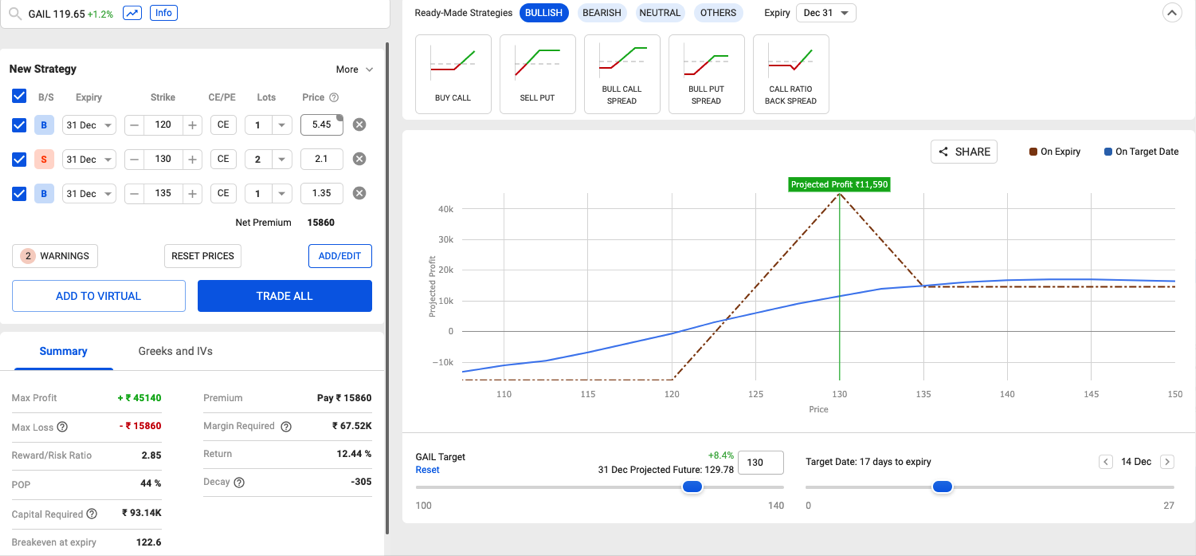
Here’s an example of a call butterfly trade that can lose around 15-16k, but has the potential to make upto around 45k till expiry. The graphical representation is courtesy Sensibull.

GAIL Call Butterfly Dec 31 2020 Expiry

I mean, it’s all still acceptable.

Tweaks?

Let’s say one is losing.

Sells will be in biggish plus.

Square-off the sells. Yeah, break the hedge.

Margin gets returned. Premium pocketed.

Buys are exposed, though.

They are losing big.

With some time to go till expiry, if the underlying goes back up, the buys gain.

What one makes off the trade is proportional to how much the underlying goes up.

It’s riskier. Correspondingly, profit potential is higher.

Money risked here will be up to double of the fully hedged version of the trade, and one could lose this amount if the underlying does not come back up appropriately and in time. Pocketed premium of the squared-off sells softens the hit.

Therefore, it makes more sense to pull this tweak with at least ten days to go before expiry, giving the underlying time to recoup.

Got another tweak.

This one’s intraday, though.

Underlying’s on a roll, and you want to make the most possible off the opportunity.

Square-off the sells at a huge loss.

Let the buys, which are winning big, run for some part of the day.

Chances of them yielding more are very high.

Square-off the buys before close of trade.

If the underlying promises to close on a high, square-off the out-of-the-money buy before close of trade, and take the in-the-money buy overnight.

Risky, though.

You could lessen your risk, and increase your chances of taking most profits off the table by squaring off the in-the-money buy and taking the out-of-the-money buy overnight.

Square-off the overnight buy next morning on a high, or wherever feasible.

With this particular tweak, the trade becomes somewhat more like a lesser exposed futures transaction, at least for some time, after the hedge is broken.

There’s another thing one can do with the call butterfly.

One can adjust it as per the level of perceived bullishness.

If -1 and -1 are set at the same level, one trades for averagely perceived bullishness.

If one -1 is closer to the lower +1, and the other -1 is above this first -1, then one trades for below average perceived bullishness.

If one -1 is closer to the upper +1, and the other -1 is below this first -1, then one trades for above average perceived bullishness.

Anything else worth mentioning?

Volume. Need it.

Bid-ask spread needs to be narrow.

Scaling up needs to correspond to one’s risk-profile, requirement, temperament and acumen.

One can make it an income thing by scaling up, during bull runs, or generally, just in case an up move is tending to pan out.

One can make the call butterfly do a lot of things.

It’s a very versatile trade to play a rising market, with low risk and low capital requirement.

Happy trading!

🙂

Nath on Trading – II – Building up on Basics

21). You started small, right?

22). Ultimately, you’re staying consistently in the green, correct?

23). Then it’s time to scale up. Slowly does it.

24). Why the whole spiel about starting small? You make your biggest mistakes in the first seven years.

25). Hopefully, you don’t repeat a mistake once it has happened, and once you’ve learnt from it.

26). However, mistakes are good, because they teach you. Nothing else can teach you with incorporation into DNA. Mistakes can.

27). No university can teach you. No books. No professor. Play the market, make the mistake, and learn.

28). A big break early in the markets is a recipe for disaster. More likely than not, you’ll blow up later, when it matters.

29). The best possible way to scale up is using position-sizing as delineated by Dr. Van Tharp.

30). The good thing about position-sizing is that it makes you scale down, when trading corpus goes below par.

31). Day trading takes up the day. You’re exhausted and are not able to do much else.

32). Short-term trading also keeps you riveted to the terminal, mostly.

33). However, position trading and longer time frames keep you in the line for whatever else you wish to achieve.

34). Market TV makes it a video game. Switch it off.

35). Trading with targets caps big-win potential.

36). When you trade, you trade. You don’t invest.

37). Successful trading means buying high and selling higher, or…

38). …selling low and buying back lower…

39). …as opposed to successful investing, which is buying low, not selling for the longest time, and then selling for a multiple.

40). Read points 16 to 19 again.

Nath on Trading – Basics Win

1). Put yourself out there. Again and again. Take the next trade.

2). Keep yourself in a position to take the next trade. How?

3). Take small losses. Have a stop in place. Always. Have the guts to have it in place physically.

4). Trade with money that doesn’t hurt you if it’s gone.

5). Don’t exhaust stamina. Put trade in place with smart stop that moves as per definition, and then forget it. 

6). Keep yourself physically and mentally fit. Good health will make you take the next trade. Bad health won’t.

7). Have a system…

8). …with an edge, and even a slight edge will do.

9). Keep sharpening your system. 

10). Don’t listen to anyone. You’ve got your system, remember? Sc#@w tips. God has given you a brain. Use it. 

11). Let profit run. Don’t nip it in the bud. PLEASE.

12). A big profit doesn’t mean you’re it. It can become bigger. And bigger. Remember that.

13). What’s going to keep your account in the green over the long run are the big winning trades. LET THEM HAPPEN. How?

14). You exit when the market stops you out. Period. Your trailing stop on auto is fully capable of locking in big gains and then some.

15). Similarly, make the market make you enter. Entries are to be triggered by the market. Use trigger-entries on your platform.

16). When a trade is triggered, you’re done with it, till it’s stopped out, in profit or in loss. Can you follow that?

17). Your trade identification skills are going to improve over time. Get through that time without giving up. 

18). Despair is bad, but euphoria is worse. Guard yourself against euphoria after a big win. Why?

19). Big wins are often followed by recklessness and deviations from one’s system that is already working. NO.

20). Use your common-sense. Is your calculator saying the right thing? Can this underlying be at that price? Keep asking questions that require common-sense to respond. Keep your common-sense awake. 


What’s bothering you today?

Get it out of the way.

Why?

Bother takes a toll. 

Focus goes away. 

You don’t wish to see your trade. 

That’s a pathetic condition to be in…

…as a trader. 

When you’re in a trade…

…you need to monitor the trade. 

How will you monitor a trade…

…if you don’t feel like looking at your screen?

What’s causing your indifference?

Bio-chemistry. 

Resulting from?

The spot of bother.

That’s why, get it out of the way.

Trade gone wrong?

Kill it.

Spouse problem?

Address it.

Child matter.

Deal with it.

Bring your environment to an immediate logical conclusion…

…if you can.

Why?

You’ll trade like a king…

…or a queen…

… whatever title you prefer. 

You’ll see clearly. 

You’ll want to open your terminal. 

Your ideology will be aligned with your trade. 

You’ll be making money. 

That’s why. 

MP vs MoS : the lowdown on Trade-Entry

Margin of Safety (MoS)… 

… hmmm… 

… wasn’t that in investing? 

Well – surprise – it’s in trading too. 

You can enter a trade with MoS. 

How? 

Ok.

ID the trend. 

Wait for a minor reversal.

Let the reversal continue towards a pivot, or a support or a what have you. 

During this reversal, whenever you feel that you have considerable MoS, well – enter. 

Why shouldn’t you wait for the pivot to get touched? 

Things happen real fast at a pivot. Upon a pivot-touch, you can lose your comfort-zone even within minutes. 

Two vital things can happen at a pivot. 

Either there’s a quick bounce-back, or the pivot gets broken. 

Bounce-back means your trade is now in the money, and that you can go about managing your trade as per your trade-management rules. Wonderful. 

Pivot-break is not a worry for you. 

Why? 

Because you’ve placed your stop slightly below pivot, after the noise. 

Upon pivot-break, you get stopped out. You take the small hit and move on to your next trade. 

Eventually, things heat up. 

There is movement. 

Tops get taken out. 

Fast money can be made. 

How do you enter here? (Needless to say, for shorts, everything is to be understood reversed). 

Momentum play (MP)… 

… is the weapon of choice. 

You set up a trigger entry after a top or a resistance or a what have you, and wait for price to pierce, and for your entry to get triggered. Then you place your stop, below top or resistance or what have you. 

MP vs MoS is a matter of style. 

If you’re not comfortable changing your trading style to adapt to times, that’s fine too. Stick to one style.

If you’re conservative, stick to MoS. 

In a frenzy, however, MoS might almost never happen. 

In a frenzy, entry will be triggered exclusively through MP.

Take your pick. Adapt. Do both. Or don’t. Do one.

You call the shots. 

This is about you.

Did you invite the f-word?

The next trade… 
… yeah… 
… take it. 
What? 
Can’t? 
Why?  
Afraid of what might happen. 
That’s the whole thing. 
You see a setup – you trade the setup.
When you see a setup, there are no more what-ifs, supposings or anything. Then, it’s just you and the trade. Take the trade. 
No room for f-(ear). It’s the new f-word.  
How do you drive fear out of the equation? 
Risk a miniscule fraction of your networth per trade. 
Don’t make trading your bread and butter. Make it your bonus. 
Don’t allow anyone else’s negativity to creep in. Don’t talk to people. Trade on your own. No room for tips. 
Don’t listen to your broker. Tell him what to do.
Don’t trade under compulsion. 
Enjoy your trading. 
Once in the trade, lose the mini-bias that got you in. Now, just manage the trade. 
Stop hit? You’re out. 
Run? 
Raise stop. 
Running? 
Keep raising stop. 
Losing some of your notional profits? Market throws you out?
Good. That’s a proper exit. 
See, fear wasn’t allowed to the party. 
Look for next setup. 
Position-size your entry. 
Take the next trade. 
And so on and so forth. 
Not upto trading?
Ok. Don’t trade. Till you’re up to it.
 
Demons out of the way? 
 
Up to trading again? 
 
See the next setup?
 
Take it.

The Department of no-frills 

Markets can be played in holes. 

No disrespect to the “hole”. 

Let’s put it this way. 

I trade the markets from a “bucket shop”. It’s actually a small brokerage. Parallels a bucket-shop, and all legit. 

There’s twenty odd people. 

Basic desktops. One gets to use them even with medium-sized accounts. A large account holder can walk into the manager’s office and get the manager to trade his or her strategy for him or her for the day. A three minute daily discussion is all it takes. This discussion can even happen on Whatsapp. 

If required, food comes from the street-vendors below, in newspapers and plastic cups. 

Welcome to the department of no-frills. 

No business-class travel or fancy-schmanzy wining-dining is required here. It’s sheer trading with no BS. 

Why? 

No overheads. 

No headaches. 

No constant terminal monitoring. Someone’s doing it for you.

Safety? Yes. Trust. Long-term relationship. Email and sms security measures. No nonsense. 

One doesn’t talk to the twenty odd people. 

One just trades. 

Trading for you isn’t really about building a consensus. You just trade. If then the market builds a consensus, that’s a different thing. You then trade the consensus. For or against is your call. 

This is as raw as it gets. 

You ask a question. 

You put your money where your mouth is. 

If your inquiry is in the correct direction, you get rewarded. If not, you lose a part of your money. 

Goes without saying, that overall, you try to win more than you lose. 

Department of no-frills cuts to the chase without useless paraphernalia. 

Market-maker

Manipulation. 

Recognition. 

Alignment. 

Trade. 

Spike. 

Out. 

How does one recognize manipulation? 

On the charts. 

After eyeballing many many charts, one gets a feel for it. 

Manipulated strike-points become pivot points. 

It’s a push from a fund-heavy conglomerate. Push becomes a cascade as traders join in. 

After the spike, the market-maker pulls out funds so cleverly that rates don’t fall. 

Funds are now ready for the next push. The same funds. 

Repeat. Same loop. 

Till strategy fails. 

Then, maker starts manipulating in opposite direction. 

Life’s busy for the maker. 

There’s trouble with the authorities. Ends on a compromise. Maker will step in when authorities need to prop the market. 

No maker – no market. 

Why do you think there’s always a quote to your underlying? 

Because of the maker. 

After a market has crossed critical mass, makers sit on their spikes. They roll-over on expiries, and enjoy the ride. 

Ride is not always smooth. 

Makers often get greedy and break their own rules. Functioning with no safeties, many makers get wiped out. To add to their woes, a large percentage functions on borrowed money. 

Makers have an electronic life, which loops from cellphone to terminal and back. It’s a life that’s punctuated by headaches, physical and mental. 

Don’t envy a maker. 

He or she is just doing his or her job. That’s all. 

Trade the maker. 

How I Wish to Trade

Tension?

No.

Hassle-free?

Yes.

Profit?

Yes.

Fun?

Too. 

I want it to make me want to come back. 

In the background?

Yes.

Part of my normal life?

No. 

Disturbing me in the night?

No?

Terminal on – ideally once a day. Max twice. That’s it. 

Protection?

Yes. Stops for forex. Hedges for options. No naked options. 

Exits?

Make me exit. Yeah, Mrs. Market needs to make me exit. I don’t wish to exit on my own. She needs to throw me out of a trade. 

Fear?

None.

Why?

Bread and butter secured through other-than-trading instruments.

Trading with surplus.

Surplus can potentially become zero. Will I still take the next trade?

Yes. After scanning strategy for errors.

Loss?

Will take small ones, again and again and again. That’s the only way to find the large profit moves. 

Once profit sets in, what then?

Nothing then. 

Normal. 

Behaving as if nothing has happened. 

Giving the trade room. 

It needs to make even more profit. 

It is a potential multi-x trade. Why should I nip it in the bud? As I said, make me exit. Throw me out. 

Family life?

Balanced.

Remnant anger from trading?

None. 

When yes, stop trading. Trading should never be allowed to disturb family life. 

Evolutionary?

Forever. Learning, learning, learning. 

Bias? 

None. 

News?

No. 

Tips?

None. 

Peers?

Maybe to start a strategy with. After strategy is made to fit – no peers any more. 

Discussion?

None. Hopefully. 

Don’t like to discuss trades after terminal shuts. 

Losses piling up?

Review strategy. Discard, renew, implement, trade again. 

Profits piling up?

Great. Do nothing. 

Are you getting the gist?

Similarly, you need to figure out how you might want to trade.

Many things I might be doing will not suit you automatically. 

You need to make things fit. 

If something doesn’t fit, discard it. 

Look for something new that might fit. 

Make a trading strategy that’s lucrative and gels with you and your lifestyle and environment. 

Such a strategy will blossom. For you. 

I Don’t Want the Cancer

Are you hurt?

A.

Do you want the cancer?

B.

I do get hurt. Yeah, things hurt me. I’m an emotionally penetrable human being.

Fine. That’s me.

What I definitely don’t want is option B.

Who wants option B?

Can’t think of anyone.

Who gets option B?

Many.

But who?

Those who can’t forget the hurt. Yeah, people who’re unable to move on.

To forget the hurt and move on, simultaneously saving ourselves from the cancer, we need to forgive.

Someone’s misbehaved. Hurt you. Are you going to ruin your future days? No.

Forgive. Forget. Move on.

Just remove the mould in which cancer can potentially set in.

What makes you think it’s different in the markets?

A loss is a hurt.

Need I say more?

You can do the math.

Can I Really Really Really Do Without Fundamentals?

I like to trade without a bias. 

Lack of bias means freedom… 

… freedom to think independently…

… not falling prey to another person’s opinion…

… which then allows you to listen to your system…

… trade identification…

…setup demarcation…

…trigger-entry…

…trade triggered…

…trade management…

… trigger-exit…

… exited.

That’s it, move on to the next trade. 

News gives me a bias. 

No news. 

You know what else gives me a bias?

Fundamentals. 

I don’t wish to look at fundamentals. 

If my eyes are seeing a setup in the EuroDollar, I would like to take it without the nagging thought of “what will happen if Scotland says NO or YES”.

I don’t want to care about inflation numbers, or job figures, or industrial output or what have you. 

I mean…can I just …do it?

Meaning, can I just do away with fundamentals, and focus on technicals only, which is my area of specialization?

Sometimes, I get a little unsure. 

I start looking around. 

How are others doing it? The experts, that is. 

My uncertainty gets fanned a little more, when I see experts not really ignoring fundamentals, even though they might be specialized in technicals. Hmmmm. I’m still not happy looking into fundamentals. I mean, why should I take time-out from my strong suit, and devote it to my very weak suit?

No, I decide. I’m really not going to look at fundamentals. 

What’s the worst that could happen?

Let me just see if the worst that could happen is bearable.

Ok…I ID a trade…demarcate a setup…and the trade goes against me because of the announcement of some number in the afternoon. People looking at fundamentals would have waited for the announcement of the number and then traded. Fine. 

In the world of trading, it is always good to have the worst-case scenario unwrapped and right before your eyes to see what it really means. 

You know, I can take this. 

Would you like to know why?

Firstly, I would like you to understand that we are looking at large sample-sizes here. Any sensible reasoning would only apply to large sample-sizes. 

Over the long run, and over many, many trades, Mrs.Market will go either way after an announcement of a fundamental number with a chance of roughly 50:50. 

If this is true, it is very good news for me, good enough to just kick fundamentals out of the equation. 

At times, the market reacts as per the crowd’s anticipation. 

At other times, it reacts in the opposite fashion. 

I assume that the ratio of the above two directions taken by Mrs. Market over a very large sample-size would be 50:50.

I think my assumption is correct. I don’t want to go through the labour of proving it mathematically. 

Ok, let’s assume that my assumption is correct. I then kick fundamentals, and go about my work while relying on my strong-suit, i.e. technicals. This trajectory will very probably have a happy ending. 

Now let’s assume that my assumption is wrong. 

What saves my day?

Technicals. 

Technicals very often give setups that factor in crowd behaviour and crowd anticipation of market direction. 

Technical setups get one into the build-up to an announcement. 

More often than not, one is already in the trade, in the correct direction, enjoying the build-up to an announcement without even knowing that the announcement is coming, if one is not following fundamentals. 

Technicals can actually do this for you. I’ve seen them do it. I mean, the GBPUSD has been giving short setups during the entire 1000 pip run-down recently. To have availed such a setup, people haven’t needed to know that a referendum is coming. All they’ve needed to do is to take the trade once they see the setup. 

Actually, that’s it. I don’t need more.  

I don’t need to reason anymore with myself. Everything is here. 

I think I can let go of fundamentals safely.

Even this trajectory should have a happy ending.

Dealing with Noise…the Old-Fashioned Way

There’s a sure-shot way to deal with noise…

…just shut your ears. 

Yeah, the best ideas in the world are – simple. 

Let’s not complicate things, ok?

So, what kinda noise are we talking about here?

We’re not talking about audio, you got that right…!

The concept is related, though. 

If you’re charting, you’ve dealt with noise. 

Yeah, we’re talking about minute to minute, hour to hour or day to day fluctuations in a chart of any underlying.

Markets fluctuate. 

While discussing noise, we are pointing towards relatively small fluctuations which generally don’t affect the long-term trend. 

However, noise has the capability of deceiving our minds into believing that the long-term trend is turning, or is over. 

Don’t let noise fool you.

When has the long-term trend changed?

When the chart proves it to you through pre-defined fashion. That’s it. You don’t let noise to get you to believe that the long-term trend has changed, or is changing. Ever. 

You believe your chart. 

Moving averages crossing over? Support broken? Resistance pierced? Trend-line shattered? ADX below 15? Fine, fine, FINE.

Take your pick. You have many avenues giving decent signals that the long-term trend has changed or is changing. 

How about eyeballing? Works for some. Like I said, let’s keep this simple. 

So let’s get noise out of the way. 

Random numbers generate trends – you knew that, right?

You don’t need more. 

Once you’ve identified a trend, that’s your cue to latch on to it. 

We’re not talking about predicting here. We don’t need to predict. We just need to identify a trend, and latch on. That’s all. No predictions. Not required. 

From this point on, two things can happen.

Further random numbers deepen the trend you’ve latched on to. You make money. Good. 

Or, the next set of random numbers make your trade go against you, and your stop gets hit. 

If your stop is getting hit, please let it get hit. Even that qualifies as a good trade. 

You move on to the next trade setup, without even blinking. 

What you’re not doing is letting noise throw you out of the trade by deceiving your mind. 

So, here’s what you do. 

You’ve id’d your trend. You’ve latched on. Your stop is in place. Now, don’t look at your trade. 

Till when?

That’s your call. 

Don’t look at your trade till you’ve decided not to look at it. For the day-trader, this could be a couple of hours. For the positional trader, it could be days, or weeks. 

By not looking, you won’t let noise deceive you. 

If the trend doesn’t deepen, or goes against you, you lose the risked small amount. 

Just remember one thing. 

A loss has immense informational value. It teaches you about market behaviour patterns. It also highlights your trading errors. Many times, losses occur without any mistakes made by you. 

That’s the nature of trading. 

Ultimately, if the trend deepens, you’ll have made good money, and can then further manage your trade after the stipulated period of not looking.

This is the sweet spot.

This is where you want to be, again, and again and again.

Sitting on a large profit gives you room to play for more profit by lifting your stop and your target simultaneously.

To reach this sweet spot again, and again and again, you have to position yourself out there and appropriately, again, and again and again. 

This is also the nature of trading.

Wishing you happy and lucrative trading!

🙂

Charting Charting Charting

Why don’t you just…

… trade what you see?

Trade the chart, dammit.

Not the level.

Not the expectancy of a turnaround.

And, although I still do this because it gives me a kick, why do we even trade corrections?

Why can’t we just trade the sheer chart?

Every chart is either going up, down or nowhere.

So it’s pretty obvio, that the first step would be to…

… to what?

… to decide where the chart is going.

Again, it should be pretty obvio, that if a chart is going nowhere, then you are doing… what?

Are you trading such a chart?

NO!

Wait for such a chart to break out in one particular direction.

Wait for the LTT to turn in this direction.

Then trade this chart. Not before.

Yeah, LTT stands for long-term trend.

Yeah, we’ve befriended the LTT so much, that we have an abbreviation going for it…

Once you’ve sorted out the direction, look for an entry setup.

Be patient.

If the entry setup hasn’t formed yet, wait for it. If you can’t stop your twiddling fingers from doing something, feed in a trigger entry in case of a hypothetical setup formation within the next few hours / days, if your trading station allows this.

There’s no up or down anymore, to be honest. You are going where the chart is going, period.

You are also not asking the stooopidest question of them all…

… you guessed it… “Did the sensory index go up, or down?”

Just forget about the sensory index, ok?

I mean, we’re so done with sensory indices in this space.

Why?

DLF could tank 20 bucks on a day the Sensex goes up. Dow Jones could be down 50 points, but Pfizer could just spring into a stellar upwards move. Why should we have lost the short-side opportunity that DLF hypothetically gave, or the long-side opportunity that Pfizer could present, for example? We will do exactly that, i.e. lose the opportunity, if our focus is on the sensory index.

Focus on the underlying.

To be more precise, focus on the chart of the underlying.

Happy trading.

🙂

And…How Much Connection Time Exactly?

Well, somebody’s got to ask these questions…

Don’t see very many around me doing so, so I just thought what the heck, let it be me…

This one’s not for all you test-tube jocks in the lab, you know…

Answer’s not about the math really; it’s more about feeling, again…

Nevertheless, this is a very important question.

Answer it wrongly for yourself, and market-play will wreck your life – all avenues of your life, that is. 

And, answer it correctly for yourself – lo and behold, you’ll actually start enjoying your market activity.

The human being ultimately excels in anything he or she enjoys doing. 

This means that if you answer this question correctly, your market activity will yield you profits. 

Told you. This question is important. Answer it.

Let me tell you how I’ve answered it for myself. 

Before that, please understand, that my answer doesn’t have to apply to you.

However, for those who don’t know where to begin while trying to answer the question, it’s a start.

I detest giving Mrs. Market too much power. This was my clue initially, and I built up on this fact. 

Initially, Mrs. M used to take over my life. She used to govern my emotions. It started to rub off on my family. I knew I had to draw a line. 

I started to trade lightly – amounts which my mind could ignore. Then, I did one more thing. 

I started to connect minimally. The was the key step, and it swung the emotional tussle in my favour. Mrs. M’s days of emotional control were over. 

What does minimal connection mean?

You only connect when you have to. Period. 

When you don’t have to connect, you just don’t.

I’ll tell you when all I connect to Mrs. M.

Order-feed – 0 to once a day. Very rarely twice for this in one day. 

Connection for me is having my trading terminal on, and seeing live price-feeds face to face. 

My market research is all offline, so that’s not a connection for me. 

Squaring-off a position – again 0 to once a day. Very rarely twice a day.

Watching the live price-feed – 0 to once a day, and only if if I’m unclear about the buying-pressure versus selling pressure ratio.

That’s it. 

When I don’t identify a potential trade in my offline research, I don’t connect at all. 

When do I connect next?

Whenever I’ve identified the next trade, or a squaring-off situation, all offline. 

There can be two or even three day stretches when I just don’t connect. 

I use options, because they allow me this kind of play for Indian equities. 

Why am I stressing upon the value of minimal connection? 

Connection means exposure to the “Line”. You’ve met the Line before. If not, look up the link on the left (“The Line”). 

Connection to the Line taxes your system, because market forces interfere with your bio-chem. 

Keeping the connection minimal keeps you healthy, and you can go out and do other stuff in life, which rounds you off and refreshes you for your next market-play. 

Keeping the connection minimal detaches you from Mrs. M. You are able to detach at will. This lets you focus on your family when your family members require your attention. 

Keeping the connection minimal makes the task of swallowing your small losses smoother. 

Lastly, keeping the connection minimal helps you let your profits run. 

So, how does one define minimal?

Do the math, and come out with rules for your minimal connectivity, like the ones I’ve come out with above, for myself. 

After that, while sticking to your rules for minimal connectivity, only connect to Mrs. M when you feel the burning desire to do so, like for example upon the identification of a sizzling hot trade, or for the order-feed of a trigger exit after a profit-run or something like that. 

Yeah, you minimise even after your rules.

That’s your minimal connection.  

How to Swallow Small Losses…

… as if nothing has happened … is one of my biggest trading goals.

You see, our society teaches us not to lose. 

It doesn’t teach us that we can lose a bit 5 times, and after that we can win big, recovering all our losses and making money overall.

No. 

It teaches us to try and win all the time. 

That’s the exact reason 90%+ of all society members actually lose in the markets. They’ve not learnt how to lose small, move on, and take the next trade.

Mrs. Market won’t budge an inch for you. You’ll have to make the adjustment. 

So how does one take a loss in one’s stride?

Only one type of loss is immediately digestible – a small one. Therefore, define your risk in the market. Cut and scoot when required. Don’t get married to your trade.

Then, once the small loss has happened, and has been taken, it will nag you. 

It’ll be there, trying to bite your brain in the background. 

Focus on your next trade. 

Identification – Implementation – Entry – Management – Exit – Next Trade Identification – Implementation – Entry – Management – Exit – Next Trade Identification – Implementation – Entry – Management – Exit – … … [what’s the difference between implementation and entry? Well, you could be implementing the trade through a trigger, which is not equivalent to entry yet].

Don’t let the nagging bother you by keeping yourself busy with Identification – Implementation – Entry – Management – Exit – Next Trade Identification – Implementation – Entry – Management – Exit – Next Trade Identification – Implementation – Entry – Management – Exit – … … 

Ultimately the nagging will die out, as your mind starts to revolve around your current trades. 

If you give in to the nagging, it will grow, and will slow you down. You might snap at a family member. You might go into depression. You might freeze. DON’T. Don’t give in to the nagging. Don’t let it grow. Don’t let it slow you down. Maintain your family equilibrium at all costs. Move on. 

The nagging is worst if there’s been a close below your stop, and the market is to open the next day, or after the weekend. You have to deal with this one. If you’re not able to deal with this particular situation, you’ll either need to expose your mental stop prematurely and feed it in intraday (before there’s been a close under it), or you’ll need to follow the progress of your trade from half an hour before next market open onwards.

Yes, this last one’s tough, and you need to absolutely work your way around it. 

You can do it with a bit of practise. 

🙂

One Up on the Romans

Sometimes, words are hard to come by.

Like now.

It’s a dry spell.

Happens.

At other times, well, they burst forth as if a geyser’s exploded.

Then, I’m not able to stop their flow.

That also happens.

Welcome to the dual-natured environment of Earth.

While we’re steeped in this duality, there’s no option but to get used to it.

One can always go on to then master it.

Oh, I forgot, that’s optional.

I’ll tell you what I’ve done to master such fluctuating fortunes, as far as word-flow is concerned.

Two simple steps, that’s all.

When we’re dry,…, we’re dry. No PhDing over the fact that we’re dry. We’re just dry. Period. Accepted. Digested. We just go on to do other stuff. There are millions of other things that grab our interest on this dual planet.

When we’re up and running – that’s just it – we’re up and running. No PhDing over why we’re up and running. We let the flow happen. We can decide to make it happen even more. That’s optional…, but we don’t stop the flow… till the tap dries itself out.

Similarly, you can experience a string of losses in the markets. Losses make you hit your cut-off. A cut-off is a cut-off. You don’t keep on trading. Nature’s telling you to lay off till your mind and body align themselves with the flow of the markets again. Just do other stuff till you’re mentally and physically back.

On the other hand, when profits run, they can really run. PLEASE LET THEM RUN. Don’t PhD about the run. Let them run till they dry out.

When in dualism, the idea here is to first live through dualism, in order to understand its nature.

We’re one up on the Romans, though.

We’re trying to be masters over our fluctuating dualistic environment.

Yeah, in the markets, we’re getting through losing spells with minimal damage.

Simultaneously, we’re maximizing the potential of profit-runs.

That’s what we’re doing.

If not, then that’s exactly what we are going to do.

Cheers

🙂