Market Ability

Hammers…

…hammer.

That’s their job.

They do a good job, at hammering.

At times, the market behaves like a hammer.

Market players learn from hammerings.

Question is, can market players learn without being hammered?

I don’t think so.

One can psych oneself into believing otherwise, I’ll give you that.

And, for a while, things will look like all’s good.

Point is, one isn’t looking for the hammer, …

… the reason for which being, that one has never experienced one.

That’s when the hammer falls, when and where one is least expecting it.

It is better to undergo a hammer event in the early days of one’s market career, and while one’s young.

Young – because – a). one plays small when one’s young, mostly by default, owing to there not being ample access to fund supply. Also, b). in the early days of one’s market exposure, the bulk of one’s mistakes and miscomprehensions emerge. The combination of these two facts a). and b). leads to losses that are bearable (youth has backups, like parents). In our youth, we tend more to brush it off and move ahead, full of energy. Yeah, youth has the energy, and time (upcoming multiple market-cycles), to not only emerge from a hammer, but to go on to prosper from the now ingrained learning.

Issue starts when our corpus is big and we still don’t know what a hammer is.

Issue compounds when we then confuse our ability to implement money into markets, in an effort to make it work, with actual market ability.

What is market ability?

It all starts with risk profile.

Some people die without having recognized their risk profile

Then, after having recognized one’s risk profile upon encountering some hammers and seeing our bodies and minds react to these, we move on to systems.

From development to fine-tuning to implementation of a system, we keep chipping and chiselling away at our strategy. We emerge with one that has an edge. We continuously work to keep our edge profitable.

Simultaneously, we throw in risk management. Development of an emergency fund is part of this.

Discipline.

Regimen.

Rules.

Let’s throw in some unpredictability, on purpose.

After putting one system on semi-auto, we work on another, and so on and so forth. We use our profits to diversify and make ourselves more secure, ideally anti-fragile.

Market ability is a successfully implemented combo of all these factors and perhaps more.

It includes being a good human being at home too. There’s no question of letting out the effects of a bad market day on one’s family members. We’re stopping all market action before anything like this develops. Harmony paves the way for another serene market day…

…about to dawn.

Strategy

Reserve currency’s buying power is…

…waning.

Many others, too, have pointed out, that…

…assets…

…quoted in the reserve currency…

…are getting expensive.

Across the board.

If something is happening across the board, is the entire board showing an anomaly, or is it the underlying entity, here the reserve currency, that is behaving differently?

Going for the latter. Gut. Common sense. Fundamentals. Printing. Geopolitical balance of scales.

Diagnosis stands. The only bubble in town is a reserve-currency-bubble.

Doesn’t stop here.

Central governments across the world blindly price, or, rather, mis-price their own currencies in response to movements in the reserve currency. Many governments artificially support levels of their own currencies which are not realistic. Net net, asset markets worldwide are rising. It seems that buying powers of fiat currencies in general is falling. Masses seem to be losing confidence in fiat currencies.

Where does this leave you, financially?

Are you very liquid?

Hmmm, liquidity is losing value. How about moving some of your liquidity into assets of your choice. Look for value, and act where you find it.

However, stay liquid to a comfortable extent, and let some value of that particular liquidity be lost. It’s ok. You’ll make it up and more, in the event of a correction, where you’ll be tanking up on assets of your choice.

There will always be a correction. Period. You need to be at least somewhat liquid, come a correction, and it will.

So, this is what needs to be done.

Identify extra, and movable liquidity.

Look for value.

See if you are comfortable with the asset class offering value.

If yes, move any extra liquidity into the asset offering value, bit by bit.

Fall Specialists

Hey.

We come alive…

…during a fall.

Though we don’t panic, …

… we do feel a pang, here or there.

However, we have trained ourselves to…

…quickly normalize, …

… and then go about our business, …

… which is, …

… buying during a fall.

It hasn’t been easy.

During the first fall we experienced, we broke down.

You see, we were fully invested, and then that fall happened.

Now came two options.

Quit? Or learn to navigate?

Chose the latter. Learnt.

What did we learn?

We found ways to remain…

…liquid, calm, composed and poised.

Slowly, but surely, we turned into…

…fall specialists.

We argued with ourselves.

How many falls had this market seen in History?

Had they stopped its long-term growth?

In a growth environment like India’s?

The answers reiterated our stand.

The central idea that remained was to stand our ground and lock some great prices in, intensifying buying towards the bottom.

How would one recognize a bottom?

Technicals, pin-bars, big intraday swings, huge volumes, nihilist sentiment, depressing newsflow, one can sense these things if one is mentally there.

And that’s what fall specialists are doing, in the wake of disruption ruling international trade, difficult quarterly results, international fund-flight, regression to the mean, perpetuating newsflow, almost blood on the midcap street, actual blood on the smallcap alley, and what have you.

Yeah, we’re locking in great prices.

Remember to come back and read this piece when sentiment changes.

India is a growth environment, where lucrative prices have been hard to find since CoViD.

So, when these come, is it a wonder that fall specialists are lapping up the action?

Opportunity

Knock knock.

Nobody home.

See you, bye. Maybe never.

Knock knock.

Come in.

This is the requirement.

No funds.

Bye.

Knock knock.

Hey. Funds not a problem.

Guts?

What if I lose?

Bye.

Knock knock.

I wish to invest and the risk is digestible.

Ok. Pull the trigger.

Should we wait for a better price?

Bye.

Knock knock.

Let’s pull the trigger.

Ok.

There.

Bye.

Hey, it’s been a month and I’m up 10%. Let’s cash out.

Ok. Bye.

Knock knock.

This time I’ll let my profit run. The last one doubled in 6 months, but I’d cashed out after a minuscule rise.

So you’ve learnt how to sit?

I keep a lookout for you. If I’m not home I get alerted to your presence, so that I can act in time.

Then, I always maintain ample liquidity for you.

The amounts I put in make my risk digestible, looking at the total size of my portfolio and liquidity.

Once you knock, I’m not afraid to pull the trigger anymore.

I’ve learnt to let multibaggers develop. I don’t nip them in the bud anymore.

Wonderful. Now add cost-free-ness to your repertoire.

Why?

It’ll trick your mind into holding your multibagger eternally, so that it is given the chance of becoming a megabagger.

Will do, thanks, cost-free-ness won’t cost me anything, right?

Not a penny.

Whetting

What does it take…

…to convince my mind…

…that something’s a very long-term hold?

What am I looking for?

Longevity. Actually, perceived longevity. Perceived in my mind. Mind matters. When the mind is shaken, one lets go. For something to be a long-term hold, the mind needs to be long-term convinced.

Lack of dependency. On water. On other natural resources. On CapEx. On real-estate.

Immunity to trend-change.

Adaptability to disruption. As much proximity to a state of anti-fragility as possible. Entry price and cost-free-ness will reinforce proximity to anti-fragility.

Diligent, share-holder friendly management with good track record, with repeated examples of wealth-creation through exploitation of multiple avenues available.

A product line that is more dependent on human capital than on machinery.

Copious, intelligent, reasonably priced human capital. With that we’ve knocked out inflation.

Very decent margin of safety at entry point. With that we’ve accounted for any remaining idiosyncrasies in capable managements and / or otherwise humane promoters.

Lack of debt. We’re ok with reasonable amounts borrowed at reasonable rates for day to day working capital, but not a big fan of long-term debt.

No smoke cloud. Talking about scams, frauds, bribes, court-cases and the like.

That’s ten things already.

I take these ten, sift through the Nifty 500, and get 43 underlyings, which, for me, satisfy these criteria.

That’s it.

I play with these.

That’s all the whetting I need.

You’re saying I didn’t mention numbers. Metrics. Ratios.

Numbers come and go. Basics remain. When the basics are right, numbers will be intact for long, and for a few quarters they won’t be. Those are re-entry opportunities.

Good basics create good numbers, repeatedly. We are making sure that we are only entering into good basics.

Now the ball’s in your court.

Create your criteria.

What works for you?

Sift through.

Narrow down.

What remains are your whetted stocks.

Start your game.

It’s a long one, so…

…wishing you stamina!

🙂

Throw-Offs

Hey.

Stumbled upon a concept.

Calling it the throw-off, and…

…sharing it with you.

How many times have you booked too early?

Booked late?

Gotten in early?

Late?

Not risen to required action?

Made a bad decision?

Lost faith in the market?

In yourself?

These are results of throw-offs.

Something has thrown you off your game.

This something is the ongoing market action at the time.

Action has been such, that it has thrown one off one’s track.

It’s not your fault. Action is such.

Price hits a stop, for eg. You take the stop. Price resumes in same direction.

Price hits a target. You get out. Price resumes.

Price falls just short of the stop, resuming. You double down. Price then breaches stop and a down-trend starts.

Price shoots past target, not giving you time to act. You then define a new target. Price nose-dives beneath old target, just as fast, eating up a good portion of your original profits.

Examples can be many. Common factor is market action throwing you off your profits, or throwing you out in loss.

Where do we stand?

Is this cause for alarm?

Is there something we can do about it?

First up, market action is a sum resultant of all market behaviour put together, and is perhaps impossible to defy. Our pockets are not deep enough by miles.

We don’t fight market action.

We use it.

Yes, since we can’t defy it as such, we make it work for us. Also, if market action alarms you, do something else which doesn’t. That’s where we stand.

It’s ok to be thrown off while following one’s trading plan.

It’s not ok to be thrown off, having been psyched into altering one’s trading plan mid-trade.

Meaning that it’s not ok to book below target owing to adverse market action above one’s stop.

Also, when a trade is going against us, again, it’s not ok to exit owing to adverse market action above one’s defined stop.

One exits at stops, not above. Sticking to this one rule will nullify throw-offs above stops. Defining is easy. Doing is difficult. Over time, with practice, we define and do. Period.

Now we tackle targets.

How do we knock-out throw-offs here?

Another day, another defining rule… 🙂 … .

Don’t exit at targets.

If you don’t exit at targets, no one can throw you off before a target.

Ok, so what’s the exit strategy whilst in profit?

Have a target.

When it comes, it triggers your stop into existence, which you have defined x% below this target.

So, we now stop using the word target. We use ‘trigger’ instead.

In other words, your stop gets activated, or triggered into existence, once a certain profit-threshold is crossed.

This stop, which has just come alive, is dynamic in nature, towards the profit-side only.

It moves in the same direction as the price, in a proportion defined by you.

As price keeps moving, your stops keeps locking in more and more profit.

You’ve knocked out the throw-off, since your exit is completely rule based, and no one else knows the parameters (numbers) you are feeding in for exit.

Eventually, price action makes you exit rule-based, when price reverses above the ‘trigger’ and hits your dynamic stop. Market action hasn’t succeeded in throwing you off your game.

Notice one thing?

You’ve been in control of your trade all along.

Your head is sane, your emotions are stable. You have set yourself up to take some very profitable decisions.

Wishing for you lots of profits…

… 🙂

.

Banana Trajectory

Growth …

… is a non-linear entity.

Especially…

… high growth.

Amongst many things, …

… one point needs …

… pointing out.

Between periods of high growth…

… anything can happen.

The levels of what can happen are, amongst other correlations, directly proportionate to the number of similarities between an economy in question and the functioning of a proper banana republic.

Freedom of speech can be suppressed.

Parallel economies can thrive.

Extortion and blackmail can rule.

Genocide.

Landgrab.

Terrorism.

People buyouts.

Apathy.

Dysfunctionality.

And then there’s high growth again, perhaps soon, if the economy gets its act together despite its rulers, and perhaps accelerated, if the rulers come to their senses and return back to being peace, growth and democracy loving .

Without getting into what kind of a republic we live in, for lack of a better phrase, and with a very small use of one’s imagination, one could venture to suggest that our own path of growth could resemble that of a banana trajectory.

The banana in this title doesn’t have much to do with the curvature of the fruit.

Much rather, it’s about the economy to banana republic correlation.

Might I suggest that our economy’s banana behaviour is mostly mild. Then, rarely, it gets intense. Normal growth returns. Then comes high growth. Periods of very high growth are rare, but there too.

Overall I’m happy with my and in my republic.

Sometimes, its banana behaviour beats me up.

Yeah, every ten years or so, there’s a big hit.

No one likes getting hurt.

I do remember to stand up and continue fighting, …

… because it is in this very republic, that I can make my 15% p.a.c.

On the conservative side, that is. Perhaps I can make more.

I don’t get that in any other economy.

You see, occasional banana behaviour is good news for a long term contrarian.

Banananomics lead to blunders, and temporary downfalls, with all indices falling big.

Which is where we have the guts to buy, and big.

Why?

We know we are on a high growth trajectory with intermittent banana behaviour.

A very simple formula suggests itself.

Buy big during reactions to banana behaviour.

Take principle out after spurts of high growth.

Sit tight on underlying in profit, perhaps for life.

A high growth trajectory with intermittent banana behaviour will give you many such cycles in your lifetime.

One stands to make multiple times the ten-yearly hits.

Upon recognising this recurring pattern, one can even fine-tune and enhance loss-attenuation.

🙂

Screen-Time

Is that a hammer in your hand?

No?

Great.

Yes?

Does everything appear to be a nail?

In the markets, I like to keep buttons away from sight, as a start.

Meaning, that the conditions to bring a button out…

…need to trigger first.

How would I know?

For that, there are alerts.

Meaning that we go on doing other stuff, till we are alerted, that there’s action ahead.

That’s when we activate the concerned button to visible mode.

Taking time, we decide whether this particular button needs to be pressed.

No?

Proceed with other stuff as normal.

Yes?

Press.

Do your accounts.

See how you’ve fared.

Done?

Proceed with other stuff…

…till next alert for button visibility activation.

Why all this rigmarole?

Because we don’t wish to be trigger-happy in the markets.

We take calls when they’re due.

We use time-slots in between calls to live life, tension-free, happy.

That’s one approach to the markets.

I’m sure you have your own.

Maybe yours involves more screen-time.

I respect that.

Mine doesn’t involve too much screen time, to be honest.

That’s the way I like it.

That also doesn’t mean anything as far as volumes or output are concerned.

Lesser screen-time leaves me ample space for other stuff.

I get to live a fuller life-experience.

To each their own.

This is my take.

I respect your take too.

Some takes require maximum screen-time.

Some like it like that.

That’s their life.

Fine.

Respected.

This is mine.

And this is my market screen-time…

…perhaps an hour or two a day, sometimes one, sometimes two.

Something like that.

Approach

Markets speak.

Can we hear them?

Do we know their language?

We are not born knowing their language.

We learn.

Their’s is not a normal language.

It keeps changing…

…till it’s similar to the past…

…and then it changes again…

…to throw us off-track.

We need to keep adapting.

Every corner could be a new one, with a new sign.

Feel the challenge?

The thrill upon attempting to decipher?

Do you feel fulfilled?

Well, if yes, then you’ve met your calling.

Congratulations.

Now sustain.

Play out your full market journey. Enjoy it. Win.

How?

Since every corner could be a new one, every corner needs to be approached with a what-if-plan.

Simultaneously, one is on the lookout for signs.

What signs?

Similarities, in patterns, psychology, chronology, feel, levels, anything.

Have you seen this before?

What happened last time?

Approach with multiple scenario what-if.

What if you haven’t seen current signs on offer?

Carve out the situation.

Create scenarios.

Build a what if for each scenario.

Approach.

Notice something?

Whether one has seen something before, or not, the approach is basically the same.

Great.

We’ll not bother with getting spooked out.

We just keep tapping the markets, armed with a play-out strategy for each unfolding scenario.

Our approach is designed such that we sustain till the end of our market journey and beyond.

We keep intact our health, family life, and our corpus.

We keep sharpening our edge, and keep attempting lucrative reward risk scenarios.

We learn to take our stop.

We learn to let runners run till logical exits appear.

We learn to establish and enjoy a life beyond markets.

Wishing all market success and happiness.

🙂

Harness

Market forces are like Wifi.

When we connect to them, they…

…connect to us.

When we’re indifferent, …

… we’re in a different world.

When we create systems, and put them on auto-pilot, we mostly do away with the ability of market forces to act upon us.

A successfully implemented system on auto-loop is like making time stand still.

That’s our goal; that’s where we want to be.

In the act of getting there, we are subject to compelling market forces.

How do we deal with them?

Rather than suffering KOs from their punches, we devise systems…

…to absorb their blows,…

…understand the implications of these,…

…to, then,…

…harness them.

What am I talking about?

Why give market forces so much power?

Why not?

They’re there, right?

In abundance, too.

Why not use them?

How?

You can go back to George Soros’s back pain for starters.

Have you developed such physical systems?

I’ll tell you what I implement. It’s a me thing. You’ll need to develop your you thing. I’ll share with you my me thing, though.

When markets are down, I do feel bad, it’s an initial reaction. I wait for it to intensify. I wait for myself to feel awful. That means markets must be really down. As awfulness rises, I start buying. When awfulness is uncontrollable, I buy big. When it makes me puke, I buy maximum. Meanwhile, I’ve rewired my nervous system to accept the awfulness as a marker for buying, and I’m not sad that I’m feeling awful during market crashes. Hmmm, I know it sounds a bit crazy, but this a successful harness-methodology of otherwise overwhelming market forces.

When markets are up, I feel buoyant. Earlier, when I felt buoyant, I used to buy more. Now, I do nothing. Market-nothing, that is. Non-market, I’ll do many things. That’s harnessing buoyancy. As markets rise further, I do even more of market-nothing, and when I can’t control it, I then start creating cost-free-ness. When buoyancy is uncontrollable, I create maximum possible cost-free-ness, and hopefully, then, I can go on market-vacation. Before I do that, I make sure to transfer the cost-free-ness created to a dedicated holding platform for my cost-free-ness.

Ideally, new market activity needs to only commence upon the next set of opportunities. Sometimes, one needs to wait long for these to develop. The act of bridging time comes in handy here. Market is not giving action. We harness even that. We have accumulated lots of pending tasks, just for this kind of period. Now, we do these. Ultimately, an opportunity arises. A new cycle of cost-free-ness-creation starts.

Development of you-unique systems helps you harness the market in a winning fashion.

Wishing you lucrative investing and lots of cost-free-ness!

🙂

Making Time Stand Still

The buck stops…

…with the entity called time.

Too much hangs on it.

Lack of it makes decisions difficult.

Too much of it defers them.

In the markets, we take it out of the equation…

…and then act.

If not, market forces bog us down.

And, imagine the load if our game is heavy.

After having gotten our basics infallibly into place, we wish to play a heavy game, without the load.

Hence,…

… – time – …

…first we take out of the equation,…

…and then we play.

We stretch the trade duration to a potential infinity. Period.

Trade might resolve in a few days. Or not. Right.

However, potential infinity gives us the wherewithal to focus on the next play.

Then, before action, we make time stand still.

How?

By forgetting that it exists.

By focusing on the one act that we are about to commit.

By encompassing the totality of all connectivities that have led us to the moment of acting, and having them before our mind and on our fingertips, as we act.

By being pinpointedly mindful of our actions whilst shutting out any disturbing noise.

By being…

…in the Zone,…

…such that,…

physically,…

…time might tick,…

…but for us it doesn’t seem to.

And…

…why?

Why are we so interested in making time stand still as we act?

For just one pure reason.

We want our act to have maximum impact.

And that it will, once we act, immersed in the scheme of things.

The chronology is as follows : Time still-stand, identification of market act, entry into scheme of things, action, exit from scheme, time roll-forward.

Timeframe doesn’t register in our minds. Potent action is identified, and happens, fitting into the natural fabric of things, into the timeline of the scheme of events.

Impact, ideally, is maximum.

Imagine the cumulative impact of a lifetime of such actions!

Wishing you lucrative times!

🙂

Fearlessness

Hey, 

There’s no hype…

…on Magic Bull.

No business lunches.

Conferences.

Fees.

Advertising.

Liasoning.

Roadshows.

Magic Bull is a no-nonsense, cut-to-the-chase space.

Why?

That’s how I like it.

A strategy that works under any market conditions, …

… is multi-faceted,…

…  adaptable, …

…  self-adjusting, …

… and comprehensive, …

… doesn’t require artificial crutches… 

… because, …

… it makes…

… money …

… on its own.  

Why is the Magic Bull approach successful in any market, under any conditions?

Because it is based on fearlessness. 

We are not born fearless.

Fear is a natural human instinct innate in us. 

It saves us, many a time. 

However, to make money in the markets, one needs to get rid of fear.

How?

Most of our planning revolves around creating circumstances around ourselves that take fear out of the equation. 

You’ll need to make the effort of going through the material in this space, to get a grip on how Magic Bull eliminates this emotion. 

You see, even if there’s a free lunch in life, it’s not that free that the spoon will lift itself and put the meal down another’s throat. 

A certain minimal effort will need to be made. 

Thing is, hardly anyone makes even that kind of effort. 

Result will be, that not more than a handful will actually read this stuff, and one or two might actually implement it.

Sure. 

Growing Magic Bull’s readership is not my objective.

What do I get from the entire exercise?

Evolution. Writing evolves. The strategy just gets better and better.

Blah blah blah. 

Oh, ya, what happens when a strategy gets it right?

I’ll leave you to figure that out, since that’s what I get. 

And why again?

Because of fearlessness.

One’s cycle of winning in the markets, under any conditions, starts with fearlessness.

Wishing you fearless trading and investing!

🙂

Positioned

By now…

…, we are positioned.

The persistence of high price-levels…

…has led us to take appropriate action.

One after another, we are washing our market mistakes clean.

What remains, is cost-free-ness, in high-quality holdings.

We’ve then also helped our relatives and friends attain the same state of market-being.

MFs?

Now cost-free.

ULIPs?

Gotten them to money-market.

Debt market holdings?

No more debt market for a while.

Bond-yields are rising.

There’ve been blow-ups. Boys @ FT and Nippon take a bow.

Parking where?

Fixed deposits.

Why?

Not in it for returns.

Just to park, safely.

We’re sticklers for parking safely.

Loss of interest will be made up within days of opportunity, into which funds then flow, and then some.

One can now say…

,…safely…

,…that we’re positioned.

What happens from this point onwards?

How many days has the main sensory index spent at PEs of 35+ within the last 5000 days?

Yeah, right?

Small-cap rally still due?

That’s what everyone feels, right?

That’s the point.

Leave the masses hanging onto something they’re expecting.

If it doesn’t happen, they’re what?

Left hanging. Devil takes the hind-most.

Please do your math, and please position yourself too, appropriately.

What if markets go on rising?

Sure, that’s a possibility, perhaps for a while.

Simple rule.

No level, no entry.

We know how to sit.

On our holdings, and then…

…on our cost-free-ness.

Now, capital will only move…

…upon opportunity.

And the pipe-line’s ample, our positioning has seen to that.

Come something like March ’20, and we’ll blast the flow of our pipeline.

Oh, another thing.

Notice the speed of moves, nowadays?

It’s fast, isn’t it?

As in markets are efficient, till they’re not, and then they’re efficient again, and then they’re not, back and forth, to and fro, all very fast.

Meaning what?

Meaning, that there will be ample opportunities, more sooner than later, and that till there are inefficiencies on the down-side,…

…we sit tight…

…to maximize the impact of our positioning.

Playing Over-hot Underlyings with the Call Butterfly

A call butterfly is a fully hedged options trade …

… with an upwards bias.

It consists of four call options.

2 buys…

…and 2 sells.

One can play any overtly rising underlying with the call butterfly, without batting an eyelid.

Why?

Firstly, and most importantly, one is fully hedged.

Meaning?

At first look, the call butterfly seems market neutral as far as basic mathematics is concerned, that is +1, -2, +1, net net 0.

So, net net, one isn’t looking at a large loss if one is wrong.

When is one wrong here?

If the underlying doesn’t move, or if it falls, in the stipulated period, then one is wrong,…

…and one will incur a loss.

However, the loss will be relatively small, because of the call butterfly’s structural market neutrality.

And that’s magic, at least to my ears.

Method to enter anything flying off the handle with the chance of a small loss?

Will take it.

Then, also very importantly, the margin requirement is relatively less, when one uses the following chronology.

One executes the buys first.

Then come the sells.

Upon the upholding of this chronology, the market regulator is lenient with one on margin requirement, as long as the trade-construct is market neutral.

Typically, for one butterfly, total margin requirement is in the range of 50 to a 100k.

Now let’s talk about what one is looking to make.

5k per single-lot trade-construct, if it’s fast, as in execute today, square-off tomorrow, or even intraday, if expiry is close.

10k if slow, as in 7 to 10 days.

If the butterfly is not yielding because the underlying is not moving, then one is looking to exit, typically with a minus of under 3k.

Just do the math. Numbers are great.

What kind of a maximum loss are we looking at, if things go badly wrong, as in if the underlying sinks?

5k to 10k.

Can the loss be more?

If the trade construct is such that the butterfly can even give 40 odd k till expiry, one could even be looking at a max loss of about 15k too.

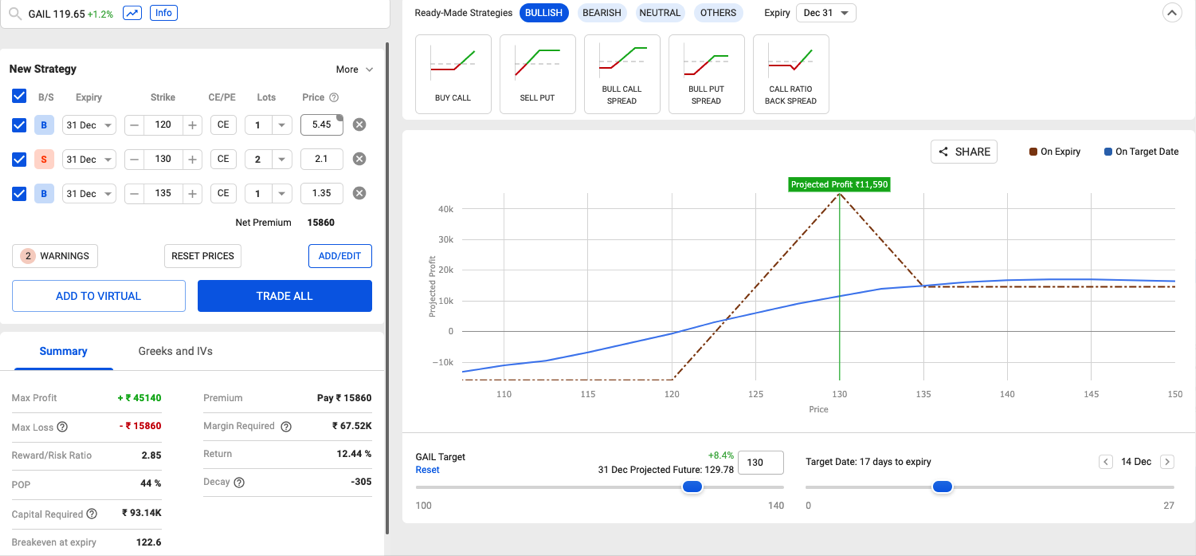
Here’s an example of a call butterfly trade that can lose around 15-16k, but has the potential to make upto around 45k till expiry. The graphical representation is courtesy Sensibull.

GAIL Call Butterfly Dec 31 2020 Expiry

I mean, it’s all still acceptable.

Tweaks?

Let’s say one is losing.

Sells will be in biggish plus.

Square-off the sells. Yeah, break the hedge.

Margin gets returned. Premium pocketed.

Buys are exposed, though.

They are losing big.

With some time to go till expiry, if the underlying goes back up, the buys gain.

What one makes off the trade is proportional to how much the underlying goes up.

It’s riskier. Correspondingly, profit potential is higher.

Money risked here will be up to double of the fully hedged version of the trade, and one could lose this amount if the underlying does not come back up appropriately and in time. Pocketed premium of the squared-off sells softens the hit.

Therefore, it makes more sense to pull this tweak with at least ten days to go before expiry, giving the underlying time to recoup.

Got another tweak.

This one’s intraday, though.

Underlying’s on a roll, and you want to make the most possible off the opportunity.

Square-off the sells at a huge loss.

Let the buys, which are winning big, run for some part of the day.

Chances of them yielding more are very high.

Square-off the buys before close of trade.

If the underlying promises to close on a high, square-off the out-of-the-money buy before close of trade, and take the in-the-money buy overnight.

Risky, though.

You could lessen your risk, and increase your chances of taking most profits off the table by squaring off the in-the-money buy and taking the out-of-the-money buy overnight.

Square-off the overnight buy next morning on a high, or wherever feasible.

With this particular tweak, the trade becomes somewhat more like a lesser exposed futures transaction, at least for some time, after the hedge is broken.

There’s another thing one can do with the call butterfly.

One can adjust it as per the level of perceived bullishness.

If -1 and -1 are set at the same level, one trades for averagely perceived bullishness.

If one -1 is closer to the lower +1, and the other -1 is above this first -1, then one trades for below average perceived bullishness.

If one -1 is closer to the upper +1, and the other -1 is below this first -1, then one trades for above average perceived bullishness.

Anything else worth mentioning?

Volume. Need it.

Bid-ask spread needs to be narrow.

Scaling up needs to correspond to one’s risk-profile, requirement, temperament and acumen.

One can make it an income thing by scaling up, during bull runs, or generally, just in case an up move is tending to pan out.

One can make the call butterfly do a lot of things.

It’s a very versatile trade to play a rising market, with low risk and low capital requirement.

Happy trading!

🙂

Who Breathes Easier – The Investor or the Trader?

Sure…

…asset-light…

…going with the flow…

…can strike both ways…

…care-free almost…

…that’s the image that lures one to the trading world.

Especially when the investor’s world has turned upside down, the investor starts wishing that he or she were a trader instead.

Stop.

Get your investing basics right. Your world will not turn upside down once you invest small quanta into quality coupled with margin of safety, again and again and again.

Let’s dig a little deeper into the trader’s world.

No baggage?

Sure baggage.

Emotional baggage for starters.

Cash baggage.

This one will always be there.

The trader will always have one eye on the cash component.

It needs to be safe.

It is a cause of…

…tension.

Reason is, the safest of havens for this cash component, i.e. sovereign debt, is volatile enough to disturb those who are averse to volatility when it comes to one’s cash component.

So, not asset-light.

Cash component is also an asset. It’s not light.

Sure, go with the flow. Strike both ways.

Can one say that this is a recipe for making higher returns?

NO.

Investors strike in one direction.

Investors are perennial bulls.

At least they know where they are going.

Small entry quanta make market falls work in favour of investors, over many, many entries into an underlying, over the long-term.

Do the math. You’ll see.

When one is focused on one direction, i.e. upwards here, chances of capitalising on runs are higher. The trader’s mind is always bi-polar in this regard, and game-changing runs are missed out on, upon corrections larger than the concerned stop-loss.

Care-free?

Who’s watching the screen all day?

The trader.

The investor watches the screen only upon requirement. There are investors who don’t watch the screen at all.

Images are deceptive.

Don’t go by images.

Whatever one chooses, it should ignite one’s passion.

Nothing else counts.

Let’s say you’re an investor, and you feel that you’re missing something by not trading.

Fine. Fill the gap. Sort out the basic folio, and then dabble in trading with small amounts, that don’t throw you out of whack. Do it for the thrill, if nothing else. As long as one is clear that this is not one’s A-game, and expectations are not as high as they are from one’s A-game, one might even enjoy the ride.

Let’s say you are a trader and need an avenue to park.

Yes, Equity is a serious avenue for parking.

Use it.

With one caveat.

This is not a trade.

Trading rules don’t apply to parking.

In fact, trading rules are inverse to investing rules.

You’ll need to figure this one out before moving your bulk into Equity for parking.

The investor is able to take trading with small amounts casually, and use it as an avenue for amusement.

When the trader explores the avenue of Equity for parking, its serious business, and spells doom for the trader if basics of investing are not understood.

So, who breathes easier?

One would know this by now.

Secret Ingredients in Times like Corona

Hi,

It’s been a while.

Unprecedented times call for every iota of resilience that’s inherent.

Whatever we’ve learnt in the markets is being tested to beyond all levels.

If our learning is solid, we will emerge victorious.

If there are vital chinks in our armour, we will be broken.

Such are the market forces that are prevailing.

Have we learn’t to sit?

Meaning, over all these years, when over-valuation ruled the roost, did we sit?

Did we accumulate funds?

Did we create a sizeable liquid corpus?

If we did, we are kings in this scenario.

One of the main characteristics of a small entry quantum strategy is that it renders us liquidity, almost through and through.

If we are amply liquid in the times of mayhem, there is absent from our armour the debilitating chink of illiquidity.

Illiquidity at the wrong time makes one make drastic mistakes by succumbing to panic.

We’re not succumbing to any panic.

Why?

Because our minds are focused on the bargains available.

The bargains are so mouth-watering, that they are entirely taking away our focus from existing panic.

To twist our psychology into the correct trajectory in a time like Corona, the secret ingredient that’s required is called (ample) liquidity. This secret ingredient is a direct result of the small entry quantum strategy, which we follow. 

Then, let’s address the other potential chink, and just sheer do away with it.

Having access to ample liquidity, are we now greedy?

What does greed mean?

It’s not greedy to buy when there’s blood on the street, no, it’s actually outright courageous. 

Greed Is defined here as per the quantum of buying.

Are we buying disproportionately vis-à-vis our liquidity-size and our risk-profile?

Yes?

Greedy.

No?

Not greedy.

How will we know the answer without any doubt in our mind that we have the correct answer to this question, since it is vital to our learning curve to answer this question correctly?

The answer will make itself felt.

Are we able to sit optimally even if markets crash another double-digit percentage from here?

50% from here?

No? Greedy. We have bought in a manner that doesn’t gel with our risk-profile. Our liquidity is exhausting, and focus shifts from bargains to panic. Ensuing tension amidst further fall will very probably cause us to commit a grave blunder, with this happening very probably at the bottom of the market. We are poised to lose in the markets like this. 

Yes? Not greedy. We have bought and continue to buy as per our risk-profile. We will win…

…in the markets.

The secret ingredient that locks in great prices and continues to do so as the market keeps falling, is called quantum-control as per the tolerance level of our risk-profile towards further fall. This secret ingredient ensures that liquidity outlasts a longish fall, keeping our focus on the bargains and not on the panic. This secret ingredient provides for the basic mechanism of our small entry quantum strategy.

Sometimes, you don’t like it

Sure.

Like now.

Bloodbath in small-caps.

Alleged suicide.

NPAs.

Witch-hunt.

Did you choose Equity as an area of expertise?

Ok, then deal with it.

First up, India’s History is laden with scams.

We are where we are despite these.

Secondly, there’s growth. In other parts of the world, there is not much growth.

India is an emotionally volatile nation.

So are its markets.

Since this is where we act, let’s get used to things.

If you’ve been following the small entry quantum strategy, well, then you’ve got ammunition…

…at a time, when the value of this ammunition is immense…

…because lots of stuff has started to go for a song.

You do feel the pinch though…

… because whatever’s already in, is bleeding.

You don’t like it.

It’s normal.

Going in at a time like this, you will feel pathetic.

However, for your money, you are getting quality at cheap multiples. This will translate into immense long term wealth. Quality at cheap multiples multiplies fast.

Here are a few reasons you should feel ok about going in.

The small entry quantum strategy has rendered you liquid…

…after sorting out your basic family life, income-planning and what have you.

You are going in with money you don’t require for a longish time.

Muster up the courage.

Get over your pinch.

Engage.

Buy quality.

Debt-free-ness.

Shareholder-friendliness.

Generated free cashflow.

Transparency.

Diligent managements.

Product-profile that’s going to be around.

Less dependency on water.

Versatility.

Adaptibility.

Make your own list.

Use the stuff above.

Wishing you lucrative investing with no tears and with lots of smiles.

You Miss, I Hit

We’re in the markets to…

…capture gains. 

How do gains come about?

Buy low sell high?

Sure, you’ve then got some gains. 

Enough?

Probably not, because everyone of us holds enough losers. That’s part of the game. Amongst many losers, we then find a winner.

How does one maximize gain?

One looks for mispricing. 

Let’s say we’ve id’d a stock. 

It passes our entry criteria.

Now, we look for an entry point that will give us a price advantage. 

We would ideally like the public to misprice the stock on the downside. 

That’s when we would like to pick it up. Higher the misplacing, higher our advantage. 

When is maximum gain captured?

This happens when the same stock is mispriced by the same public on the upside. 

Is such a strategy easy to implement?

Sounds easy, but NO!

Why?

(For starters), That’s because it goes against our grain to buy something really low, for fear of it going even lower, since sentiments are so down. 

Can well happen. You buy something really cheap, and before you know it, your something is down by another half. 

What’s your protection?

Rock-solid research. Identification of sound fundamentals. A shareholder-friendly management. Technicals that support you. Mispriced entry point. Product-profile that’s going to be around. Lack of debt. Substantial free cash flow. Etc.

If you’ve got such pillars going for you, it’s only a matter of time till they start to shine forth. 

If mass-depression causes you to wilt, though, it’s on you. 

Mispricing on the upside causes us to blunder too. 

Most sell their big winners which still have sound fundamentals, and can potentially go on to bag much higher multiples. 

Do this, sure, but only if you NEED the money. 

If not, give your potential multibaggers the time to become full-fledged ones. 

Sell early, and you won’t perhaps ever find another entry point. Winners barely ever give an entry-window. 

At market highs, sell your losers, because they’ll perhaps be inflated too, and you might get a good exit. 

When others misprice, make sure you hit some home-runs. 

Nath on Trading – V – Make that a Hundred

81). Paper trading has limited value.

82). That’s because money on the line activates your emotions.

83). Is there a holy grail? No. Stop looking for it.

84). Small edges taken to the nth – that’s what cuts it.

85). Most advisories make more money advising and less money trading.

86). Many advisories ignore sheer basics such as risk : reward.

87). Advisories are after commission and management fees rather than your long-term benefit.

88). If you’re lookig for an advisory, look hard, and don’t be afraid to keep rejecting till you find someone who knows the game and is not greedy.

89). Everything is out there, for you, for the taking, on the internet.

90). Most of this everything is free, if you just make that extra effort to get it.

91). Disclosure laws are so strict, that you can get into the un*erp*nts of a management today, literally at the speed of thought.

92). Thus, to play the market, any market, all you need is funds, due diligence and a device.

93). Due diligence gives you confidence to hold the line.

94). Funds need to be saved first. What goes into trading is that portion of your savings which you are not going to need – at all, at best.

95). Your device needs to become a seamless extension of you. Work on your device till it becomes that.

96). The best ideas are born in silence.

97). The best ideas are also the simplest in nature.

98). Sophistication is a net-net loser’s game.

99). If you’re doing it right, and if you’re not a day-trader by profession, trading takes up only a small portion of your day.

100). Life has myriads of avenues, trading being one small such aspect. Being a trader doesn’t mean losing out on life’s countless drawing boards. Trade. Fine. Live too, and live well. Do all-round justice to your opportunity.

Robotic Stock Selection Anyone?

No…

…thank you…

…is it?

Sure, stockscreens.

We use them all the time. 

A stock screen is a robot.

So why am I still saying no thank you?

I use stockscreens day in and day out.

I use them for trade selection, and I use them for long-term stock selection.

However,…

…(here comes the hammer),…

…the final say is mine. 

I’d like the human touch to answer yes or no.

Also, out of say a hundred selections, I can still say no to all.

And, if something catches my eye, I can dig deeper. 

I’d like to keep all these things in my hand.

I’d like my market approach to be with open eyes and usage of common-sense.

So where are we exactly?

Somewhere between one-fourth and half robotic.

That suits us. 

We save hours of sweat labour.

After sweat labour has done its work, we start applying our minds. 

We take over where the robot has left off.