If it Fits You…

… then nothing else matters.

Who told you that finance is a one-size-fits-all game?

Actually, the truth is very far away.

Truth is truth.

It doesn’t matter how much you twist it, or bury it or whatever.

It eventually emerges, unchanged, unscathed, true.

And the winds here are talking about unique sizing for each market player.

Yeah, only a unique fit is going to fulfill your own market play.

It will look silly to others.

People will laugh.

Doesn’t matter.

It fits you.

You’ve found your fit. That alone is invaluable. People undergo decades of struggle looking for theirs. Many don’t find it.

What is that state of being, when you know that you’ve found your fit?

Satisfaction.

You’re not jumping.

Not edgy.

Not looking further.

Looking for extra time, to develop and enhance what you’ve found.

You’re at peace.

You’re happy sitting.

Small things count big in the markets.

And What’s so Special about Forex?

Imagine in your mind …

… the freedom to trade exactly like you want to.

Is there any market in the world which allows you complete freedom?

Equity? Naehhh. Lots of issues. Liquidity. Closes late-afternoon, leaving you hanging till the next open, unless you’re day-trading. Who wants to watch the terminal all day? Next open is without your stop. Then there’s rigging. Syndicates. Inside info. Tips. Equity comes with lot of baggage. I still like it, and am in it. It doesn’t give me complete freedom, though. I live with what I get, because equity does give me is a kick.

Debt market? A little boring, perhaps. Lock-ins.

Commodities? You wanna take delivery? What if you forget to square-off a contract? Will you be buying the kilo of Gold? Ha, ha, ha…

Arbitrage? Glued to screen all day. No like. Same goes for any other form of day-trading.

Mutual Funds. Issues. Fees. Sometimes, lock-ins. MFs can’t hold on to investments if investors want to cash out. Similarly, MFs can’t exit properly if investors want to hang on. And, you know how the public is. It wants to enter at the peak and cash out at the bottom. 

Private Equity? Do you like black boxes? You drive your car? Do you know how it functions? You still drive it, right? So why can’t you play PE? Some can. Those who are uncomfortable with black boxes can’t. 

CDOs? @#$!*()_&&%##@.

Real Estate? Hassles. Slimy market. Sleaze. Black money. Government officials. Bribery. No like.

Venture Cap? Extreme due diligence required. Visits. Traveling. The need to dig very deep. Deep pockets. Extreme risk. No. 

Forex? 24 hr market. Order feed is good till cancelled. Stops don’t vanish over weekends. Stops can be pin-pointedly defined, and you can even get them to move up or down with the underlying, in tandem or in spurts. You can feed in profit-booking mechanisms too, and that too pin-pointedly. You watch about 10-11 currency pairs; you can watch more if you want to. 10-11 is good, though. You can watch 4, or even 2 or 1, up to you. Platforms are stupendous, versatile, malleable, and absolutely free of charge. You can trade off the chart. Liquidity? So much liquidity, that you’ll redefine the word. No rigging – market’s just too large. The large numbers make natural algorithms like Fibonacci work. Technicals? Man, paradise for technicals. Spreads? So wafer thin, that you barely lose anything on commissions. Oh, btw, spreads are treated as commissions in forex; there’s no other commission. Money management? As defined as you want it to be. Magnitude? As small or as large as you want to play? Comfort? You make your morning tea, sip it, open your platform, feed in orders with trigger-entry, stop and limit, and then forget about the forex market for the rest of the day, or till you want to see what’s happening. Yeah, comfort. Challenge? You’re playing with the biggest institutions in the world. What could be more challenging? I could go on. You’re getting the gist. 

Yeah.

Forex is a very special market. 

Also, the forex market is absolutely accessible to you, online. 

If you decide to enter it one day, play on a practice account till you feel you’re ready for a real account. 

If and when you do start with a real account, for heaven’s sake start with a micro account, where 1 pip is equal to 0.1 USD. 

🙂


Am I Taking Bitcoin Seriously?

Yeah.

Bitcoin is a serious new kid on the block.

Am I getting into it? That’s the more important question, isn’t it?

Well, not yet.

First up, I know very little about it. I’m not going to get into something because of the smoke. Gone are the days.

So, I’m educating myself.

The Web tells me that Bitcoin is not alone. Numerous Crypto-currencies have emerged. Confusing.

Many of these have their main servers or their secondary addresses located in ex-Soviet / ex-iron-curtain nations. Intimidating. I’m afraid.

Then I look at the bid-ask spread for Bitcoin. There’s typically a 1% difference between buying and selling price. That is huge. In fact, it’s outrageous.

After that I look at the Bitcoin price vs time chart.  I can see the panic in the chart. I don’t like panic. I generally stay away from panic markets. If I’m entering a long-term market, I like entering on a solid base foundation. The panic dust hasn’t settled yet. Technical bases build after panic settles, and only if the underlying has long-term mettle. They’re visible on the chart as horizontal stretches. Not happening as yet on the Bitcoin price vs time chart. Means I’m not entering yet.

Then there’s this mining stuff. Like, virtual mining. I don’t understand it. Yet. Looks silly, off-hand. Could this be connected to currency-backing? Or, is this just a hype-creating gimmick that doesn’t make economic sense? I’m not sure, I tell myself.

Last point I’m making against current Bitcoin entry – theft and loss. If I store Bitcoin on my computer, it becomes a potential target. I don’t wish to have the 5 million odd extremely sharp ex-Soviet ex-chess wizard brains targeting my computer. Period.

So, where do we stand?

Meaning, why am I taking Bitcoin seriously?

The USD has nothing backing it. The US seems to be following a fiscal policy with high risk of implosion due to escalating debt. They’ve got no reserves left. Savings are nil. The USD will probably maintain its hierarchy till the world has another alternative.

A few years ago, I thought that Gold could be this alternative. Today, I think Bitcoin is a more serious contender.

First, I need to convince myself that Bitcoin is backed. Meanwhile, the noise will even out, and only the most solid crypto-currencies shall live on. I’d like Bitcoin to still be at the top of all crypto-charts once the noise settles. By then, there’ll be someone reliable in my own country offering Bitcoin investment and trading, someone I know, like an HDFC Bank, or a Kotak Securities. Volumes will escalate. Slippage will be down to a bearable 0.1% or less. Bitcoin’s chart will show a base foundation. I’ll have understood the virtual mining stuff, and hopefully it’ll be connected to currency-backing. Banks will store Bitcoin as an e-holding, which will reflect in one’s Netbanking.

That’s when I’ll enter Bitcoin.

Organic is In

Is your institution “organic”?

What could organic mean?

Let’s try and answer this based on sheer intuition, without surfing the net or getting biased by other opinions. It doesn’t matter if we’re wrong. At least we’re thinking independently, and that is invaluable.

So, what kind of an institution is organic?

A non-synthetic one? Hmm.

One that’s alive? Not bad.

In sync? Better.

One whose left hand knows what its right hand is doing? Good.

One that tugs at the same string at the same time in the same direction. Yeah!

One that’s devoted to a holistic boss. You got it.

Are you part of such an institution?

Yes? God bless you.

No?

Why?

Never looked?

Looked and never found?

Looked, found, and then couldn’t fit in? Keep trying. If you don’t fit in fully into any such institution, firstly, don’t get worried. It’s ok. Found your own organic institution. On the other hand, maybe you are your own institution, but don’t know it yet. When you do discover it, try and be an organic one.

Organic growth is digestible. It sustains.

Short cuts are big in our world.

Why do we try and cut others short?

As investments, look for institutions where employees are not cut short. When talent is rewarded, it starts to perform beyond boundaries.

Apart from good valuations, corporate governance criteria and organic growth are critical factors that one must look for in an investment.

Organic is in, and will remain in.

Where Is The Love?

There’s this song by The Black Eyed Peas, called Where is the Love?

It’s playing on my phone as I write. It’s really good. Features Justin Timberlake. Very catchy tune, amazing lyrics. The Peas are talented. Gotta hear them.

I drag myself through two customer-care calls, one with Dish TV, and the other one with Bharti Airtel.

Exasperating. Pathetic. Nuisance-value. Drains one out. Long.

Where’s the love?

These are some of the words / phrases / questions that come to mind.

Meanwhile, the Dish and Airtel jingles are coming out of all body exits.

Then, I remember my customer-care calls with AmEx.

Smooth.

Officers are clued in.

Zak-Zak-Zak, and your work is done.

Short, and sweet.

And, there’s love, for whatever reason.

What kind of a corporate India are we growing up in?

Indigestible growth over short periods leads to disease.

Are the majority of our corporates diseased?

If they’re not, one should be feeling the love.

Where’s the love?

One does feel it, in some companies. M&M, I think, Thermax, Wipro….Dabur maybe…

Before investing in a company, it might be a good idea to talk to the company’s customer-care, and to see if there is any…love.

It’s got to trickle down from the top. You are only as good as your boss is. If the boss is holistic, the company becomes a beacon of love, understanding and digestible growth. That’s the kind of company one feels like working for…

… and that’s the kind of company one feels like investing in.

Where to, Mr. Nath?

Last month, I scrapped my market-play system.

Happens.

Systems are made to be scrapped later.

One can always come up with a new system.

I love working on a new system.

It’s challenging.

What I want to talk to you about is why I scrapped my last system.

I found four accounting frauds, as I did my market research, all online.

You see, my last system worked well with honest accounting.

It had no answer to accounting frauds.

Also, I got disillusioned.

Are we a nation of frauds?

How does one deal with a nation of frauds?

More importantly, how does one play such a nation?

Does one invest in it? Or, does one sheer trade it?

Questions, questions and more questions. These encircle my mind as I work to put my new system together.

I am in no hurry to come up with an answer. A country like India deserves a befitting answer, and that it will get, even if the sky comes down on me while I put my system together.

Slowly, I started to think. How many systems had I scrapped before?

Hmmm, four or five, give or take one or two.

I have an uncompromising market rule of going fully liquid when I scrap a system.

Full liquidity is a tension-tree state. It allows one to think freely and in an unbiased manner. Being invested during volatility impedes one’s ability to think clearly and put a new system together.

Ok, so what answer would my new system have towards fraud?

All along, it was very clear to me that future market activity would be in India itself. Where else does one get such volatility? I am learning to embrace volatility. It is the trader’s best friend.

Right, so, what’s the answer to fraud?

Trading oriented market play – good. Not much investing, really. First thoughts that come to mind.

Buying above supports. Selling below resistances. Only buying above highs in rare cases, and trailing such buys with strict stops. Similarly , only selling below lows in even rarer cases, and again, trailing such sells with strict stops.

Trading light at all times.

Fully deploying the bulk of one’s corpus into secure market avenues like bonds and arbitrage. You see, bonds in India are not toxic. Well, not yet, and with hawks like the RBI and SEBI watching over us, it might take a while before they turn toxic. If and when they do start turning toxic, we’ll be getting out of them, there’s no doubt about that. Till they’re clean, we want their excellent returns, especially as interest rates head downwards. In India, one can get out of bond mutual funds within 24 hrs, with a penalty of a maximum of 1 % of the amount invested. Bearable. The top bond funds have yielded about 13 – 15% over the last 12 months. So, that 1% penalty is fully digestible, believe me.

With the bulk of one’s returns coming from secure avenues, small amounts can be traded. Trade entries are to be made when the odds are really in one’s favour. When risk is high, entry is to be refrained from. A pure and simple answer to fraud? Yes!

You see, after a certain drop, the price has discounted all fraud and then some. That’s one’s entry price for the long side. On the short side, after a phenomenal rise, there comes a price which no amount of goodness in a company can justify and then some. That’s the price we short the company at.

Of course it’s all easier said than done, but at least one thing’s sorted. My outlook has changed. Earlier, I used to fearlessly buy above highs and short below lows. I am going to be more cautious about that now. With fraud in the equation, I want the odds in my favour at all times.

These are the thoughts going on in my mind just now. Talking about them helps them get organized.

You don’t have to listen to my stuff.

I’m quite happy talking to the wall.

Once these words leave me, there’s more space in my system – a kind of a vacuum.

A vacuum attracts flow from elsewhere.

What kind of a flow will my vacuum attract?

Answers will flow in from the ether.

Answers to my burning questions.

Can Anyone Match Our Financial Sentinels?

It was the aftermath of ’08.

There was blood everywhere.

In my desperation to get a grip on things, I was about to make yet another blunder.

The Zurich International Life pitch had found its way into my office through a leading private bank.

The pitch was fantastic.

I got sucked in.

Access to more than 150 mutual funds world wide…

No switching fee…

Switch as many times as you want…

Joining bonus…

Premium holiday after 18 months…

I quickly signed the documents.

What remained cloudy during the pitch was the 10-year lock-in.

Also, nobody mentioned that the exit penalty was exorbitant. I mean, as I later found out, the level of the exit penalty would make Shylock look like JP Morgan.

In the pitch, I found myself hearing that one could exit after 18 months upon payment of 9% interest p.a. on the joining bonus.

Nobody mentioned the full management fees, which I later calculated to be a staggering approximate of 7.75% per annum for myself, since I had opted for a premium holiday as soon as I could.

I mean, when about 7.75% was being deducted from your corpus each year, what in the world was the corpus going to generate? I found myself asking this question after four years of being trapped in the scheme.

I had soon realized that the pitchers had lied in the pitch. In the fine-print, there was no such clause saying that one could exit after 18 months upon payment of 9% interest p.a. on the joining bonus. If I escalated the matter, at least three people would lose their jobs. Naehhh, that was not my style. I let it go.

When I would look at interim statements, the level of deductions each time made me suspect that there were switching fees after all. I could never really attribute the deductions to actual switches, though, because the statements would straight-away show the number of mutual fund units deducted as overall management fees. If there were switching fees, they were getting hidden under the rug of management fees. Since the level of overall fees was disturbing me totally, I had this big and nagging suspicion that they were deducting something substantial for the switches, and were not showing this deduction openly in their statements.

When I compared all this to how Unit-Linked Insurance Plans (ULIPs) were handled in my own country, I was amazed at the difference.

In India, customer was king.

The customer had full access to the investment platform, and could switch at will from his or her own remote computer. Zurich did not allow me such direct access.

The expense-ratio in India was a paltry 1.5% – 2.0% per annum. Compare this to the huge annual deductions made in the case of my Zurich International Life policy.

Lock-ins in India were much lesser, typically three odd years or so.

Some ULIPs in India allowed redemptions during lock-ins, coupled with penalties, while others didn’t. Penalties were bearable, and typically in the 2 – 5 % (of corpus) range. Those ULIPs that did allow such redemptions only did so towards the latter part  of the lock-in, though. Nevertheless, lock-in periods were not long when compared to ten whole years, during which the whole world can change.

The debt-market funds paid out substantially larger percentages as interest in India when compared to the debt-market funds encompassed by Zurich International Life.

In India, deductions from ULIP premiums in the first few years (which were getting lesser and lesser each year due to legislature-revision by the authorities) were off-set by absence of short-term capital gains tax and entry/exit equity commissions upon excessive switching. This meant, that in India, short-term traders could use the ULIP avenue to trade without paying taxes or commissions. Whoahh, what a loop-hole! [I’m sure the authorities would have covered this loop-hole up by now, because this research was done a few years ago.]

ULIPs in India allowed at least 4 switches per annum that were totally free of cost. After that, switches would be charged at a very nominal flat rate of typically about the value of 2-9 USD per switch, which, frankly, is peanuts. I was suspecting that the Zurich fellows were knocking off upto 1% of the corpus per switch, but as I said, I didn’t see the math on paper. Even if I was wrong, their yearly deductions were too large to be ignored. Also, was I making a mistake in furthermore deducing that Zurich was deducting another 1% from the corpus each time the corpus changed its currency? I mean, there was no doubt in my mind that the Indian ULIP industry was winning hands-down as far as transparency was concerned.

In India, people in ULIP company-offices were accessible. You got a hearing. Yeah. Zurich International Life, on the other hand, was registered in the Isle of Man. Alone the time difference put an extra day (effectively) between your query and action. Anyways, all action enjoyed a T+2 or a T+3 at Zurich’s end, and the extra day made it a T+4 if you were unlucky (Indian ULIPs moved @ T+0, fyi & btw). Apart from the T+x, one could only access officials at Zurich through the concerned private bank, and as luck would have it, ownership at this private bank changed. The new owners were not really interested in pursuing dead third-party investments made by their predecessors, and thus, reaching Zurich could have become a huge problem for me, were it not for my new relationship manager at this private bank, who was humanitarian, friendly and a much needed blessing.

By now, I had decided to take a hit and exit. It would, however, be another story to get officials at Zurich to cooperate and see the redemption through. On her own level, and through her personal efforts, my diligent relationship manager helped me redeem my funds from Zurich International Life.  I am really thankful to her. Due to her help, my request for redemption was not allowed to be ignored / put-off till a day would dawn where really bad exit NAVs would apply. Zurich did have the last laugh, knocking off a whopping 30 odd percent off my corpus as exit penalty (Arghhh / Grrrrr)! Since I had managed to stay afloat at break-even despite all deductions made in the four years I was invested, I came out of the investment 30% in the hole. The moment it returned, the remaining 70% was quickly shifted to safe instruments yielding 10%+ per annum. In a few years, my corpus would recover. In less than 4 years, I would recover everything. In another two, I would make up a bit for inflation. Actually, the main thing I was gaining was 6 remaining years of no further tension because of my Zurich International Life policy. This would allow me to approach the rest of my portfolio tension-free.

The Zurich International Life policy had been the only thorn in my portfolio – it was my only investment that was disturbing me.

I had taken a hit, but I had extracted and destroyed the thorn.

It was a win for the rest of my portolio, i.e. for 90%+ of my total funds. Tension-free and full attention heightens the probability of portfolio prosperity.

Yeah, sometimes a win comes disguised as a loss.

When I look back, I admire the Indian financial authorities, who ensure that the Indian retail customer is treated like a king.

Retail customers in other parts of the world receive very ordinary treatment in comparison.

I know this from first-hand experience.

I don’t plan to invest overseas as long as our financial authorities continue to push such discipline into our financial industry.

I don’t often praise too much in India, but where it is due, praise must emanate from the mouth of a beneficiary. We are where we are because of our fantastic financial sentinels!

Three cheers for the Securities and Exchange Board of India, for the Insurance Regulatory and Development Authority, and, of course, three cheers and a big hurray for the Reserve Bank of India.

Due Diligence Snapshot – IL&FS Investment Managers Ltd. (IIML) – Jan 14 2013

Price – Rs. 23.85 per share ; Market Cap – 499 Cr (small-cap, fell from being a mid-cap); Equity – 41.76 Cr; Face Value – Rs. 2.00; Pledging – Nil; Promoters – IL&FS; Key Persons – Dr. Archana Hingorani (CEO), Mr. Shahzad Dalal (vice-chairman) & Mr. Mark Silgardo (chief managing partner) – all three have vast experience in Finance; Field – Private Equity Fund managers in India (oldest), many joint venture partnerships; Average Volume – around 1 L+ per day on NSE.

Earnings Per Share (on a trailing 12 month basis) – 3.55

Price to Earnings Ratio (thus, also trailing) – 6.7 (no point comparing this to an industry average, since IIML has a unique business model)

Debt : Equity Ratio – 0.35 (five-year average is 0.1); Current Ratio – 1.05

Dividend Yield – 4.7% (!)

Price to Book Value Ratio – 2.1; Price to Cashflow – 5.1; Price to Sales – 2.2

Profit After Tax Margin – 32.85% (!); Return on Networth – 35.24% (!)

Share-holding Pattern of IL&FS Investment Managers – Promoters (50.3%), Public (39.2%), Institutions (4.9%), Non-Institutional Corporate Bodies (5.5%). [The exact shareholding pattern of IL&FS itself is as follows – LIC 25.94%, ORIX Corporation Japan 23.59%, Abu Dhabi Investment Authority 11.35%, HDFC 10.74%, CBI 8.53%, SBI 7.14%, IL&FS Employees Welfare Trust 10.92%, Others 1.79%].

Technicals – IIML peaked in Jan ’08 at about Rs. 59.50 (adjusted for split), bottomed in October of the same year at Rs. 13.60, then peaked twice, at Rs. 56.44 (Sep ’09) and Rs. 54.50 (Aug ’10) respectively, in quick succession, with a relatively small drop in between these two interim high pivots. By December ’11, the scrip had fallen to a low pivot of Rs. 23.30 upon the general opinion that the company wasn’t coming out with new product-offerings anytime soon. A counter rally then drove the scrip to Rs. 32, which is also its 52-week high. During the end of December ’12, the scrip made it’s 52-week low of Rs. 23. People seem to have woken up to the fact that a 52-week low has been made, and the scrip has risen about 4 odd percentage points since then, upon heavier volume.

Comments – Company’s product profile and portfolio is impressive. No new capital is required for business expansion. Income is made from fund management fees and profit-sharing above designated profit cut-offs. Lots of redemptions are due in ’15, and the company needs to get new funds in under management by then. If those redemptions are done under profits, it will increase company profits too. Parag Parikh discusses IIML as a “heads I win (possibly a lot), tails I lose (but not much)” kind of investment opportunity. His investment call came during the mayhem of ’09. The scrip is 42%+ above his recommended price currently. What a fantastic call given by Mr. Parikh. Well done, Sir! Professor Sanjay Bakshi feels that IIML has a unique business model, where business can keep on expanding with hardly any input required. He feels, “that at a price, the stock of this company would be akin to acquiring a free lottery ticket”. I opine that the price referred to is the current market price. Before and after Mr. Parikh’s call, the company has continued to deliver spectacular returns. The company’s management is savvy and experienced. They made profitable exit calls in ’07, and fresh investments were made in ’08 and ’09, during big sell-offs. Thus, the management got the timing right. That’s big. I have no doubt that they’ll get new funds in under management after ’15, alone on the basis of their track record. Yeah, there’s still deep value at current market price. Not as deep as during ’08, or ’09, but deep enough.

Buy? – Fundamentals are too good to be ignored. They speak for themselves, and I’m not going to use any more time commenting on the fundamentals. Technicals show that volumes are up over the last 3 weeks. People seem to be lapping the scrip up at this 52-week low, and the buying pressure has made it rise around 4% over the last 3 weeks. If one has decided to buy, one could buy now, preferably under Rs. 24. The scrip seems to be coming out of the lower part of the base built recently. There is support around Rs. 23 levels, so downside could be limited under normal market conditions.

Disclaimer and Disclosure – Opinions given here are mine only, unless otherwise explicitly stated . You are free to build your own view on the stock. I hold a miniscule stake in IIML. Data / material used has been compiled from motilaloswal.com, moneycontrol.com, equitymaster.com, valuepickr.com, safalniveshak.com and from the company websites of IIML & IL&FS. Technicals have been gauged using Advanced GET 9.1 EoD Dashboard Edition. I bear no responsibility for any resulting loss, should you choose to invest in IIML.

Stock-Picking for Dummies – Welcome to the Triangle of Safety

Growth is not uniform – it is hap-hazard.

We need to accept this anomaly. It is a signature of the times we live in.

Growth happens in spurts, at unexpected times, in unexpected sectors.

What our economic studies do is that they pinpoint a large area where growth is happening. That’s all.

Inside that area – you got it – growth is hap-hazard.

To take advantage of growth, one can do many things. One such activity is to pick stocks.

For some, stock-picking is a science. For others. it is an art. Another part of the stock-picking population believes that it is a combination of both. There are people who write PhD theses on the subject, or even reference manuals. One can delve into the subject, and take it to the nth-level. On the other hand, one can (safely) approach the subject casually, using just one indicator (for example the price to earnings ratio [PE]) to pick stocks. Question is, how do we approach this topic in a safe cum lucrative manner in today’s times, especially when we are newbies, or dummies?

Before we plunge into the stock-picking formula for dummies that I’m just about to delineate, let me clarify that it’s absolutely normal to be a dummy at some stage and some field in life. There is nothing humiliating about it. Albert Einstein wasn’t at his Nobel-winning best in his early schooldays. It is rumoured that he lost a large chunk of his 1921 Nobel Prize money in the crash of ’29. Abraham Lincoln had huge problems getting elected, and lost several elections before finally becoming president of the US. Did Bill Gates complete college? Did Sachin Tendulkar finish school? Weren’t some of Steve Jobs’ other launches total losses? What about Sir Issac Newton? Didn’t I read somewhere that he lost really big in the markets, and subsequently prohibited anyone from mentioning the markets in his presence? On a personal note, I flunked a Physical Chemistry exam in college, and if you read some of my initial posts at Traderji.com, when I’d just entered the markets, you would realize what a dummy I was at investing. At that stage, I even thought that the National Stock Exchange was in Delhi!

Thing is, people – we don’t have to remain dummies. The human brain is the most sophisticated super-computer known to mankind. All of us are easily able to rise above the dummy stage in topics of our choice.

Enough said. If you’ve identified yourself as a dummy stock-picker, read on. Even if you are not a dummy stock-picker, please still read on. Words can be very powerful. You don’t know which word, phrase or sentence might trigger off what kind of catharsis inside of you. So please, read on.

We are going to take three vital pieces of information about a stock, and are going to imagine that these three pieces of information form a triangle. We are going to call this triangle the triangle of safety. At all given times, we want to remain inside this triangle. When we are inside the triangle, we can consider ourselves (relatively) safe. The moment we find ourselves outside the triangle, we are going to try and get back in. If we can’t, then the picked stock needs to go. Once it exits our portfolio, we look for another stock that functions from within the triangle of safety.

The first vital stat that we are going to work with is – you guessed it – the ubiquitous price to earnings ratio, or the PE ratio. If we’re buying into a stock, the PE ratio needs to be well under the sector average. Period. Let’s say that we’ve bought into a stock, and after a while the price increases, or the earnings decrease. Both these events will cause the PE ratio to rise, perhaps to a level where it is then above sector average. We are now positioned outside of our triangle of safety with regards to the stock. We’re happy with a price rise, because that gives us a profit. What we won’t be happy with is an earnings decrease. Earnings now need to increase to lower the PE ratio to well below sector average, and back into the triangle. If this doesn’t happen for a few quarters, we get rid of the stock, because it is delaying its entry back into our safety zone. We are not comfortable outside of our safety zone for too long, and we thus boot the stock out of our portfolio.

The second vital stat that we are going to work with is the debt to equity ratio (DER). We want to pick stocks that are poised to take maximum advantage of growth, whenever it happens. If a company’s debt is manageable, then interest payouts don’t wipe off a chunk of the profits, and the same profits can get directly translated into earnings per share. We want to pick companies that are able to keep their total debt at a manageable level, so that whenever growth occurs, the company is able to benefit from it fully. We would like the DER to be smaller than 1.0. Personally, I like to pick stocks where it is smaller than 0.5. In the bargain, I do lose out on some outperformers, since they have a higher DER than the level I maximally want to see in a stock. You can decide for yourself whether you want to function closer to 0.5 or to 1.0. Sometimes, we pick a stock, and all goes well for a while, and then suddenly the management decides to borrow big. The DER shoots up to outside of our triangle of safety. What is the management saying? By when are they going to repay their debt? Is it a matter of 4 to 6 quarters? Can you wait outside your safety zone for that long? If you can, then you need to see the DER most definitely decreasing after the stipulated period. If it doesn’t, for example because the company’s gone in for a debt-restructuring, then we can no longer bear to exist outside our triangle of safety any more, and we boot the stock out of our portfolio. If, on the other hand, the management stays true to its word, and manages to reduce the DER to below 1.0 (or 0.5) within the stipulated period, simultaneously pushing us back into our safety zone, well, then, we remain invested in the stock, provided that our two other vital stats are inside the triangle too.

The third vital stat that we are going to work with is the dividend yield (DY). We want to pick companies that pay out a dividend yield that is more than 2% per annum. Willingness to share substantial profits with the shareholder – that is a trait we want to see in the management we’re buying into. Let’s say we’ve picked a stock, and that in the first year the management pays out 3% per annum as dividend. In the second year, we are surprised to see no dividends coming our way, and the financial year ends with the stock yielding a paltry 0.5% as dividend. Well, then, we give the stock another year to get its DY back to 2% plus. If it does, putting us back into our triangle of safety, we stay invested, provided the other two vital stats are also positioned inside our safety zone. If the DY is not getting back to above 2%, we need to seriously have a look as to why the management is sharing less profits with the shareholders. If we don’t see excessive value being created for the shareholder in lieu of the missing dividend payout, we need to exit the stock, because we are getting uncomfortable outside our safety zone.

When we go about picking a stock for the long term as newbies, we want to buy into managements that are benevolent and shareholder-friendly, and perhaps a little risk-averse / conservative too. Managements that like to play on their own money practise this conservatism we are looking for. Let’s say that the company we are invested in hits a heavy growth phase. If there’s no debt to service, then it’ll grow much more than if there is debt to service. Do you see what’s happening here? Our vital stat number 2 is automatically making us buy into risk-averse managements heading companies that are poised to take maximum advantage of growth, whenever it occurs. We are also automatically buying into managements with largesse. Our third vital stat is ensuring that. This stat insinuates, that if the management creates extra value, a proportional extra value will be shared with the shareholder. That is exactly the kind of management we want – benevolent and shareholder-friendly. Our first vital stat ensures that we pick up the company at a time when others are ignoring the value at hand. Discovery has not happened yet, and when it does, the share price shall zoom. We are getting in well before discovery happens, because we buy when the PE is well below sector average.

Another point you need to take away from all this is the automation of our stop-loss. When we are outside our safety zone, our eyes are peeled. We are looking for signs that will confirm to us that we are poised to re-enter our triangle of safety. If these signs are not coming for a time-frame that is not bearable, we sell the stock. If we’ve sold at a loss, then this is an automatic stop-loss mechanism. Also, please note, that no matter how much profit we are making in a stock – if the stock still manages to stay within our triangle of safety, we don’t sell it. Thus, our system allows us to even capture multibaggers – safely. One more thing – we don’t need to bother with targets here either. If our heavily in-the-money stock doesn’t come back into our safety zone within our stipulated and bearable time-frame, we book full profits in that stock.

PHEW!

There we have it – the triangle of safety – a connection of the dots between our troika PE…DER…DY.

As you move beyond the dummy stage, you can discard this simplistic formula, and use something that suits your level of evolution in the field.

Till then, your triangle of safety will keep you safe. You might even make good money.

PE details are available in financial newspapers. DER and DY can be found on all leading equity websites, for all stocks that are listed.

Here’s wishing you peaceful and lucrative investing in 2013 and always!

Be safe! Money will follow! 🙂

Can We Please Get This One Basic Thing Right? (Part III)

Yeah, we’re digging deeper.

How does an investor arrive at an investment decision?

It’s pretty obvious to us by now that traders and investors have their own rationales for entry and exit, and that these rationales are pretty much diametrically opposite to each other.

So, what’s the exact story here?

The seasoned investor will look at FUNDAMENTALS, and will exhibit PATIENCE before entering into an investment.

The versatile trader will look at TECHNICALS, and will NOT BE AFRAID of entry or exit, any time, any place. He or she will be in a hurry to cut a loss, and will allow a profit to blossom with patience.

What are fundamentals?

Well, fundamentals are vital pieces of information about a company. When one checks them out, one gets a fair idea about the valuation and the functioning of the company, and whether it would be a good idea to be part of the story or not.

A good portion of a company’s fundamental information is propagated in terms of key ratios, like the Price to Earnings Ratio, or the Debt to Equity Ratio, the Price to Book Value ratio, the Enterprise Value to EBITDA Ratio, the Price to Cash-flow Ratio, the Price to Sales ratio, etc. etc. etc.

What a ratio does for you is that in one shot, it delivers vital info to you about the company’s performance over the past one year. If it’s not a trailing ratio, but a projected one, then the info being given to you is a projection into the future.

What kind of a promotership / management does a company have? Are these people share-holder friendly, or are they crooks? Do they create value for their investors? Do they give decent dividend payouts? Do they like to borrow big, and not pay back on time? Do they juggle their finances, and tweak them around, to make them look good? Do they use company funds for their personal purposes? Researching the management is a paramount fundamental exercise.

Then, the company’s product profile needs to be looked into. The multibagger-seeking investor looks to avoid a cyclical product, like steel, or automobiles. For a long-term investment to pan out into a multibagger, the product of a company needs to have non-cyclical scalability.

After that, one needs to see if one is able to pick up stock of the particular company at a decent discount to its actual value. If not, then the investor earmarks the company as a prospective investment candidate, and waits for circumstances to allow him or her to pick up the stock at a discount.

There are number-crunching investors too, who use cash-flow, cash allocation and other balance-sheet details to gauge whether a coveted company with an expensive earnings multiple can still be picked up. For example, such growth-based investors would not have problems picking up a company like Tata Global Beverages at an earnings multiple of 28, because for them, Tata Global’s balance-sheet projects future earnings that will soon lessen the current multiple to below sector average, for example.

Value-based investors like to buy really cheap. Growth-based investors don’t mind spending an extra buck where they see growth. Value-based investors buy upon the prospect of growth. Growth-based investors buy upon actual growth.

The trader doesn’t bother with fundamentals. He or she wants a management to be flashy, with lots of media hype. That’s how the trader will get volatility. The scrips that the trader tracks will rise and fall big, and that’s sugar and honey for the trader, because he or she will trade them both ways, up and down. Most of the scrips that the trader tracks have lousy fundamentals. They’ve caught the public’s attention, and the masses have sprung upon them, causing them to generate large spikes and crashes. That’s exactly what the trader needs.

So, how does a trader track these scrips? Well, he or she uses charts. Specifically, price versus time charts. The trader doesn’t need to do much here. There’s no manual plotting involved. I mean, this is 2012, almost 2013, and we stand upon the shoulders of giants, if I’m allowed to borrow that quote. Market data is downloaded from the data-provider, via the internet and onto one’s computer, and one’s charting software uses the data to spit out charts. These charts can be modified to the nth degree, and transformed into that particular form which one finds convenient for viewing. Modern charting software is very versatile. What exactly is the trader looking for in these charts?

Technicals – the nitty-gritty that emerges upon close chart scrutiny.

How does price behave with regard to time?

What is the slope of a fall, or the gradient of a rise? What’s the momentum like?

What patterns are emerging?

How many people are latching on? What’s the volume like?

There are hundreds of chart-studies that can be performed on a chart. Some are named after their creators, like Bollinger bands. Others have a mathematical name, like stochastics. Names get sophisticated too, like Williams %R, Parabolic SAR and Andrew’s Pitchfork. There’s no end to chart  studies. One can look for and at Elliott Waves. Or, one can gauge a fall, using Fibonacci Retracement. One can use momentum to set targets. One can see where the public supports a stock, or where it supplies the stock, causing resistance. One can join points on a chart to form a trendline. The chart’s bars / candle-sticks will give an idea about existing volatility. Trading strategy can be formulated after studying these and many more factors.

Where do stops need to be set? Where does one enter? Exit? All these questions and more are answered after going through the technicals that a chart is exhibiting.

One needs to adhere to a couple of logical studies, and then move on. One shouldn’t get too caught up in the world of studies, since the scrip will still manage to behave in a peculiar fashion, despite all the studies in the world. If the markets were predictable, we’d all be millionaires.

How does the trader decide upon which scrips to trade? I mean, today’s exchanges have five to ten thousand scrips that quote.

Simple. Scans.

The trader has a set of scan criteria. He or she feeds these into the charting software, and starts the scan. Within five minutes, the software spits out fifty odd tradable scrips as per the scan criteria. The trader quickly goes through all fifty charts, and selects five to six scrips that he or she finds best to trade on a particular day. Within all of fifteen minutes, the trader has singled out his or her trading scrips.

Do you now see how different both games are?

I’m glad you do!

🙂

Anatomy of a Multibagger

Wouldn’t we all like to rake it in?

A multibagger does just that for you. Over a longish period, its growth defies normalcy.

In the stock markets, a 1000-bagger over 10 years – happens. Don’t be surprised if you currently find more than 20 such stocks in your own native markets.

Furthermore, our goal is to be a part of the story as it unfolds.

Before we can invest in a multibagger, we need to identify it before it breaks loose.

What are we looking for?

Primarily, a dynamic management with integrity. We are looking for signs of honesty while researching a company. Honest people don’t like to impose on others. Look for a manageable debt-equity ratio. Transparency in accounting and disclosure counts big. You don’t want to see any wheelin’-dealin’ or Ponzi behavior. If I’d been in the markets in the early ’80s and I’d heard that Mr. Azim Premji drove a Fiat or an 800, and flew economy class, I’d have picked up a large stake in Wipro. 10k in Wipro in ’79 multiplied to 3 billion by ’04. That can only happen when the management is shareholder-friendly and keeps on creating value for those invested. Wipro coupled physical value-creation with market value-creation. It kept announcing bonus after bonus after bonus. God bless Mr. Premji, he made many common people millionaires, or perhaps even billionaires.

A good management will have a clean balance-sheet. That’s the number two item.

The company you’ re looking at will need to have a scalable business model.

It will need to produce something that has the ability to catch the imagination of the world for a decade or more.

The company you’re looking at will need to come from the micro-cap or the small-cap segment. A market-cap of 1B is not as likely to appreciate to 1000B as a market-cap of 25M is to 25B.

Then, one needs to get in at a price that is low enough to give oneself half a chance of getting such an appreciation multiple.

Needless to say, the low price must invariably be coupled to huge inherent value which the market is not seeing yet, but which you are able to correctly see.

After that, one needs the courage and conviction to act upon what one is seeing and has recognized.

One needs to have learnt how to sit, otherwise one will nip the multibagger in the bud. Two articles on this blog have already been dedicated to “sitting”. Patience is paramount.

The money that goes in needs to be a small amount. It’s magnitude shouldn’t affect your normal functioning.

Once a story has started unfolding, please remember one thing. If a stock has caught the imagination of the public, it can continue to quote at extended valuation multiples for a long time. As long as there is buying pressure, don’t exit. One needs to recognize buying pressure. That’s why, one needs to learn charting basics.

Phew, am I forgetting something here? Please feel welcome to comment and add factors to the above list.

Here’s wishing that you are able to latch on to many multibaggers in your investing career.

🙂

Learning to Sit (Part II)

Can you sit?

I mean, can you really sit?

Maximum money is made by sitting, not by wiggling about.

I didn’t say that, but people far, far greater did.

To name just two who did say so, I’m sure you’ve heard of Jesse Livermore and Warren Buffett.

Fact remains – if you’re a long-term investor, you have to be able to sit.

One can’t sit for very long if one isn’t comfortable.

So, logic dictates – make yourself comfortable first.

Get rid of all extra background noise that disturbs you.

Keep consolidating – till you are comfortable to a point of not wanting to move from where you are.

You’ve gotten rid of investments you don’t understand.

Then, you’ve also dumped those investments that you do understand, but which don’t interest you.

Your rapport with your family is healthy.

You eat and sleep well.

You enjoy your life.

Then, the investments that you’re gonna sit on – are their volumes influencing the normal flow of your life?

If yes, it’ll be hard to stay focused somewhere down the line, because some fragment of your life will invariably be disturbed positively or negatively due to the voluminous investment in question.

Can you digest the volume such that its level does not interfere with your daily life?

What is your capacity for volume digestion?

Some have very large digestive capacities, like RJ. Such people can sleep comfortably on gigantic invested volumes for a very long time.

Others don’t digest volume at all, and can’t sleep over volume, like that day-trader who lives down the road. When the market closes, his invested volume is nil. Otherwise, the rest of his day is ruined.

Identify your volume threshold.

Invest below it. Then, you’ll be able to sit on your investment.

Any investment must have a rationale. Is your investment rationale sound? You’ll only be able to sit long-term on an investment made with sound rationale.

Therefore, take your time. Do solid research. Your research is pivotal for your investment. It doesn’t have to be so technical or so fundamental as to psyche a lay-person. It doesn’t have to deal with nitty-gritty. It doesn’t have to look for wheels within wheels.

In my opinion, market research needs to be broad-minded, and done with common-sense. Researching a company is an art. One doesn’t need to go ballistic with numbers, mathematics, projections, charts etc. One needs to formulate the long-term picture in one’s mind, based on key ratios, charting basics, knowledge of cycles, quality of management etc., and of course (based on) the million dollar question – is one looking at a multibagger? You can fill in the blanks here, for yourself.

Then, don’t enter with too big a bang. That’s my formula. Enter small. You can always top up later, if your conviction about your investment has grown. That’ll allow you to sit if your investment goes wrong in the initial stages. If you’ve entered too big and things go awry, you won’t be able to sleep, and then the first thing you’ll do is exit. So, enter small.

See, you can average down if you’re an expert, but for the longest time and till you get the hang of things, do not average down.

Why am I saying this?

Averaging down can make you even more jumpy if the stock in question goes down further. Your chances of sitting on your investment become even lesser.

Now for the flip-side. Sitting on a profit? Are you booking? Yes? No?

Depends. On you. On your outlook.

I mean, are you going to nip a multibagger in the bud?

I think you got the point.

So, till when do you sit?

Till you’re comfortable. Till you can sleep and eat well. Till you have a happy family life. Again, define you own “tills”.

The rest, as they say, is (your own investing) History.

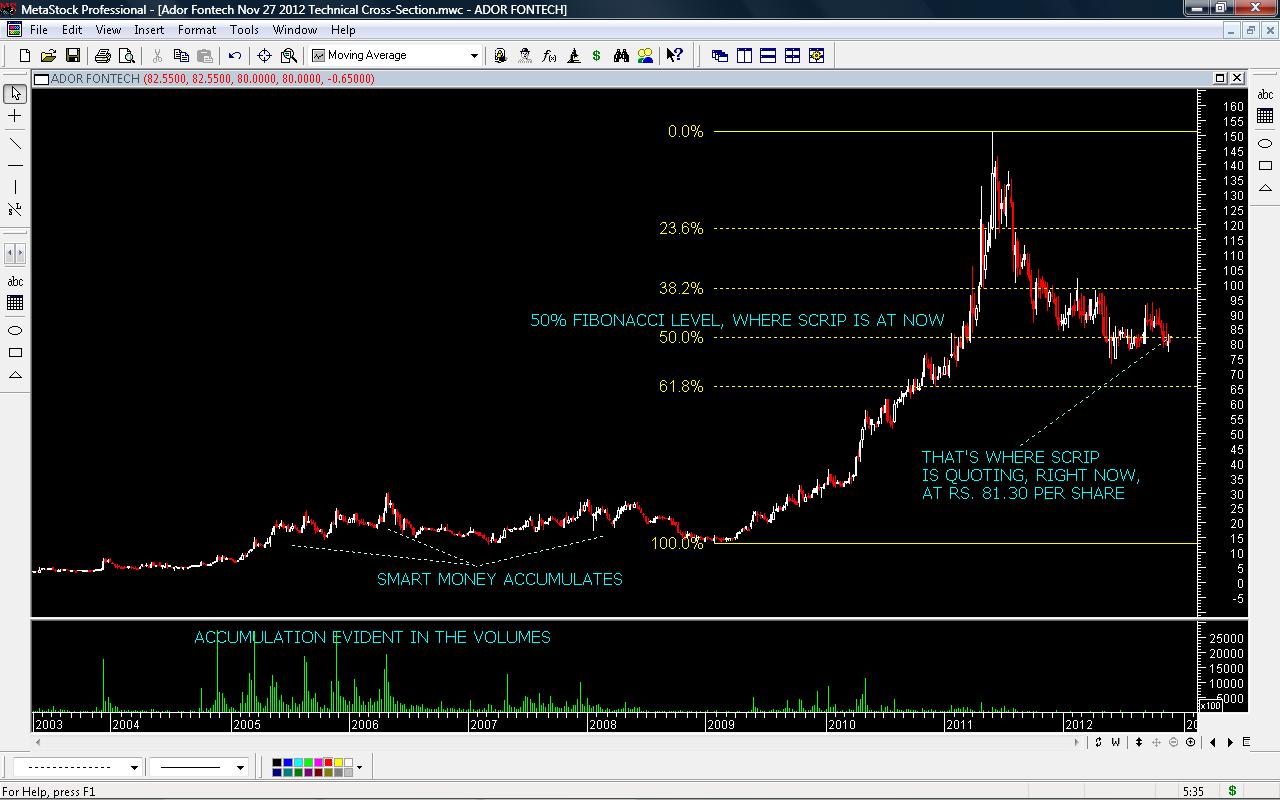
Due Diligence Snapshot + Technical Cross-Section — Ador Fontech Limited — Nov 27 2012

Image

Price – Rs. 81.30 per share

Earnings Per Share projected on the basis of quarter ended Sep 30 2012 – Rs. 12.62

Price to Earnings Ratio (thus, also projected) – 6.44

Price to Book Value Ratio – the stock is selling at approximately 2 x book value currently

Debt : Equity Ratio – Nil

Current Ratio – 2.73

Profit After Tax Margin – 12.51%

Return on Networth – 32.54 %

Pledged Shares %age – Nil

Face Value – Rs. 2.00

Dividend Payout – 50% -150% of face-value.

Average Daily Volumes – around 5 – 6 k / day on BSE.

Product – Reclamation of alloys, fusion surfacing (preventive welding), spraying and environmental solutions.

Promoters – JB Advani & Company Pvt Ltd (of Advani-Oerlikon fame) + a group of other Sindhi business-people.

Share-holding Pattern – Promoters (35.4%), Public (58.9%), Institutions (2.0%), NICBs (3.7%).

Technicals (see chart below) – This is a very low volume scrip, so there could be slippage. The scrip has corrected from its June 2011 peak of Rs. 150.90 to a pivot of Rs. 73.25 within about one year. This low pivot lies bang in between the 50% and the 61.8% Fibonacci levels of correction on the weekly chart. Currently, the scrip is quoting at Rs. 81.30, just below the Fib. 50% level. Volumes are average, with one high volume peak every 7 odd trading days. The scrip is trading in a broad band between Rs. 73.25 and Rs. 93.90. Perhaps it is trying to establish a base.

Comments – Fundamentals are good, and the company’s corporate governance is considered clean. Market for the company’s niche is considered small, and people view that as a long-term growth concern. Technically, correction has taken place, and thus value shines out fundamentally. Debt is nil. Dividend is excellent. Projected PE is low, though P/BV is a bit high. Cushion is there, and profitability and returns are exemplary. Future investment would be required to keep niche-segment status alive.

Buy? – I like the theme – reclamation and preventive welding. Contrary to what others say, I feel the market is going to grow phenomenally, as earth and rare-earth metals become difficult to source, and need to be reclaimed. Valuations are excellent, governance is great, payouts are great too, and a technical buying level has presented itself. Yes, it’s a long-term buy right now. Remember, this is not a trade we are speaking about, so we are not going to talk in terms of a stop-loss. This is a long-term investment, and we’ve been speaking in terms of margin of safety, which I’m sure you’ve noticed. Also, while buying, one needs to show caution regarding slippage, which is invariably going to occur owing to the low-volume nature of the scrip.

Disclaimer and Disclosure – Opinions given here are mine only. You are free to build your own view on the stock. I have bought a miniscule stake in Ador Fontech today. Data given here has been compiled from motilaloswal.com, moneycontrol.com and equitymaster.com. Technicals have been gauged and shown using Metastock Professional version 9.1 by Equis International.

Due Diligence Snapshot – Mindtree Limited – Nov. 24 2012

Price – Rs. 665.25 per share

Earnings Per Share (projected on the basis of quarter ended Sep 30 ’12) – Rs. 70.61

Price to Earnings Ratio (thus, also projected) – 9.42

Price to Book Value – 2.82 (it’s ok for small to mid-sized IT companies to have a high price to book ratio, because book value doesn’t reflect human capital, and small to mid-sized IT companies are more about human capital than about real-estate, hardware etc. Thus, since the real book value is not going to be available, the given price to book ratio could be treated as an artefact, unless it is unreasonably high, which is not the case here).

Debt : Equity Ratio – 0.03

Current Ratio – 2.10

Profit After Tax Margin – 12.11%

Return on Networth – > 25 %

Pledged Shares %age – Nil

Face Value – Rs. 10.00

Dividend Payout – 25% – 30% of face-value.

Average Daily Volumes – around 1 Lakh per day on NSE.

Product – Product Engineering Services, IT Services, worked on Bluetooth technology, also worked on UID (Aadhaar) project.

Promoters – Mr. Bagchi (set up Six-Sigma services at Wipro) and Mr. Soota (has now retired from Mindtree, ex-Wipro, amongst others, responsible for Wipro’s phenomenal growth). Mr. Natarajan is co-founder and current CEO, and is also ex-Wipro.

Share-holding Pattern – Foreign Promoters (3.5%), Indian Promoters (15.9%), Institutions (33.0%), Non-Institutional Corporate Bodies (30.2%), Public (15.7%).

Technicals – IPO days in March 2007 were big, with the scrip peaking at Rs. 1023.30 very early into its launch. By March ’09, though, Mindtree had bottomed out at Rs. 187.05. It then made a high pivot of Rs. 747.00 in Jan ’10, fell to Rs. 321.00 by August 2011, and is currently on the rise, forming a cup and handle pattern on the weekly chart, with the handle having broken out in Sep ’12 to 770.00 on average volume. This was a false breakout, and the scrip came down, to then move in a band between Rs. 633.80 and Rs. 699.90. Currently, Mindtree is quoting at Rs. 665.25, and Friday (Nov. 23rd, 2012) saw it rise by approximately 1 % on volume that was three times its 50-day moving average and many more times its 10-day moving average.

Comments – I like all the fundamentals. Couldn’t find any scams or frauds related to the company, looked only online though. Debt-equity ratio almost nil, great! Ex-Wipro people are the promoters. CEO is ex-Wipro. Friday’s higher volume has gotten me on alert. If all-round conditions in the markets remain stable, the scrip could break-out to beyond Rs. 770 soon. Glassdoor has “OK’d” work culture at Mindtree, with the same rating that Infosys has received. Salaries are considered on the lower side, though, at Mindtree. Also, some employees feel that company is stagnating. Reasons why Mr. Ashok Soota left the company are unclear to me. On the other hand, corporate governance still seems to be decent at Mindtree.

Buy? – Hmmmm, I like almost everything, except the salary and the stagnation bit. Mr. Soota’s presence would have been a bonus. I can take a “stagnating” company that generates good numbers. The ratios are all good, and profitability is decent. There’s almost no debt on the balance-sheet. No shares have been pledged. Dividend is decent. Excellent return on networth. Company does R&D too. Question is, will the scrip correct another 30 to 40 bucks to the lower end of it’s current band, so that one can pick it up 5 odd % cheaper? Anybody’s guess. One could actually go and pick it up now. Earnings are good, and so is the projected PE, well below the industry average, actually.

Disclaimer and Disclosure – Opinions given here are mine only. You are free to build your own view on the stock. Currently, I don’t hold a position in Mindtree Limited, but am considering long-term entry on the basis of what I have found and liked. Data given here has been compiled from motilaloswal.com, moneycontrol.com and equitymaster.com, and technicals have been gauged using Advanced GET 9.1 EoD Dashboard Edition.

Due Diligence Snapshot – Micro Technologies Limited – November 04 2012

Price as on Nov. 04 2012 – Rs. 44.60 per share

Earnings Per Share (trailing 12 month earnings)- Rs. 37.77

Price / Earnings Ratio – 1.18

Price / Book Value – 0.21

Debt : Equity Ratio – 0.55

Current Ratio – 5.63

Quick Ratio – 4.43

Net Profit Margin – 5.98 %

Face Value – Rs. 10.00

Dividend Payout – 10% – 20% of face-value.

Product – IT-based security products.

Promoter – Dr. P. Sekhar, ” a creative entrepreneur”.

Share-holding Pattern – Promoters (36.2%), Non-Institutional Corporate Bodies (42.1%), Individual Investors (19.0%).

Technicals – Since its January ’08 high of Rs. 192.50, the stock has corrected majorly to Rs. 26.80, recovered a little more than half-way (to Rs. 114.00), corrected again to Rs. 50.40, then recovered again to Rs. 91.40, again corrected to a low of Rs. 38.05, and is now in the process of rising, although institutional volume is not accompanying this rise.

Comments – Fundamentals are strong. They absolutely do not match the sell-off to a low of Rs. 38.05 very recently. Why is there a mismatch between fundamentals and technicals?

Possible Reason – There seems to be employee dissatisfaction doing the rounds, owing to questionable corporate governance. Another case of highly debatable corporate governance seems to come to light. In my opinion, this case seems to affect all shareholders negatively. Primarily, this case affected all FCCB (Foreign Currency Convertible Bond) holders, but then the company’s actions concerning the FCCBs possibly disillusioned a part of the shareholders, who went on to sell the scrip. Increase in selling pressure led to a tanking share-price, and this was negative for all share-holders.

Outlook? – You need to decide whether a part of the company’s corporate governance policy is a deal-breaker that overrides the strong fundamentals on paper.

Disclaimer / Disclosure : The opinions given above are mine only. You are free to form your own view on the stock. I don’t hold any position in Micro Technologies Limited. Data given here has been compiled from motilaloswal.com, moneycontrol.com and equitymaster.com, and technicals have been gauged using Advanced GET 9.1 EoD Dashboard Edition.

A Tool By The Name of “Barrier”

Come into some money?

Just don’t say you’re going to spend it all.

Have the decency to at least save something.

And all of a sudden, our focus turns to the portion you’ve managed to save.

If you don’t fetch out your rule-book now, you’ll probably bungle up with whatever’s left too.

Have some discipline in life, pal.

The first thing you want to do is to set a barrier.

Barrier? Huh? What kind of barrier?

And why?

The barrier will cut off immediate and direct access to your saved funds. You’ll get time to think, when hit by the whim and fancy to spend your funds.

For example, a barrier can be constructed by simply putting your funds in a money-market scheme. With that, you’ll have put 18 hours between you and access, because even the best of money market schemes take at least 18 hours to transfer your funds back into your bank account.

Why am I so against spending, you ask?

Well, I’m not.

Here, we are focusing on the portion that you’ve managed to save.

Without savings, there’s nothing. There can be no talk about an investment corpus, if there are no savings. Something cannot grow out of nothing. For your money to grow, a base corpus needs to exist first.

Then, your basic corpus needs a growth strategy.

If you’ve chalked out your strategy already, great, go ahead and implement it.

You might find, that the implemetation opportunities you thought about are not there yet.

Appropriately, your corpus will wait for these opportunities in a safe money market fund. Here, it is totally fine to accept a low return as long as you are liquid when the opportunity comes. There is no point blocking your money in lieu of a slightly higher return, only to be illiquid when your investment opportunity comes along. Thus, you’ve used your barrier to park your funds. Well done!

Primarily, this barrier analogy is for these who don’t have a strategy. These individuals leave themselves open to be swept away into spending all their money. That’s why such individuals need a barrier.

An online 7-day lock-in fixed deposit can be a barrier.

A stingy spouse can be a barrier.

Use your imagination, people, and you’ll come up with a (safe) barrier. All the best! 🙂

Your Personal War in Cyberia

Are you illiterate?

Literacy is not just alphabetical.

The meaning of literacy has expanded itself into your cyber world and also into your financials.

I mean, can you call yourself literate without knowing computer and financial basics?

I don’t think so. Not anymore. Times have changed, and so must you, in case you want to be called literate.

One of the first things one learns during one’s quest for financial literacy is the operation of one’s netbanking.

Once you are logged in, you soon realize, that your assets are under attack, and must be appropriately secured.

Login password, secure login, phishing filter, security questions, transaction password…you are learning fast. Your vocabulary is changing. Your defences are up. Yes, you are at war.

What kind of a war is this?

More of a cold war, till it gets hot for you, which can happen, but is not a must.

Worst-case scenario is that someone cleans you out. As in, a cyber thief steals all your money that was reflecting in your netbanking.

Your common-sense should tell you that your netbanking password is the all-important entity. Tell it to no one. Store it in a password safe. Keep changing it regularly. Don’t forget to update it in your safe. The safe of course opens with its own password, and is in sync between your mobile and your desktop. On both your mobile and your desktop, internet security prevails. Meaning, don’t use an el cheapo antivirus. Use a good one. Pay for it.

If there is a large amount reflecting in your account for a number of days without being used, secure it. Even if someone hacks in, available amounts should be as minimal as possible. Let the hacker first deal with unsecuring a secured amount. This gives you a time-window, during which you read and respond to any sms sent by your bank, that a secured amount has now been unsecured. The shot has been fired, your watchman has alerted you, and you now need to respond.

For the amount to be actually transferred out of your account, one more thing needs to happen. The hacker needs to set up a new payee under third party funds transfer. Some banks take three days for this, during which they coordinate with you whether or not you really want this payee to be set up. Other banks have a one-time password (OTP) system, where a transfer can only be activated by an OTP sent by sms to the registered mobile number linked to the account. Works.

Nevertheless, hackers seem to be getting around these systems, because one hears and reads about such cyber thefts all the time. However, the window created by your systems in place gives you crucial time to respond.

What is your first response, after becoming aware that you are under cyber attack?

Relationship manager (RM) –  call him or her. After you’ve alerted your RM, login if you can, and secure any unsecured amount. Change your login and transaction passwords, along with security images, words, questions and answers. Delete all payees. Logout. Close all windows on your desktop. Clear all history, cache, temporary files, cookies and what have you. Run a virus cum spyware scan. Clean any viruses, then shut your computer.

How does one go about securing unsecured amounts?

Make a 7 day fixed deposit with your unsecured amount. Or, configure your mutual fund operations through your Netbanking itself, and transfer the unsecured amount to a trusted liquid scheme offering 18-20 hour liquidity, all through your netbanking. Pretty straight-forward.

After you’re done, join your RM in finding the loophole. If you’ve incurred a loss, file a police report along with an application for reimbursal, citing all security measures you undertake as a given while also outlining the chronology of your actions after you realized that you were under attack.

That’s about it, I can’t think of anything else that you could do. If you can, please comment.

Right then, all the best!

The Frog That Lived in the Well

Once upon a time, there was a frog.

It lived in a well.

Its cousin, however, lived in the ocean, and this particular cousin came to visit.

Cousin froggy was stunned. How could one thrive in such a small space? Our original froggy, however, did not believe that one’s world could get any better. It loved the well, and only after much coaxing did it agree to see what the ocean was like.

Upon seeing the magnitude of an ocean, our original froggy’s head exploded. This story’s from Paramhans Yogananda. 

I’m sure you’ve heard this story from someone. Something similar probably happened to you too, of course on a much smaller scale of magnitude, with no head explosions and all that.

I used to walk around pretty smugly with my Blackberry, thinking that I was like there, connected. Experienced kind of a head explosion upon moving to an Android smartphone.

What is it about us humans?

Why are we so limiting?

Why do we create barriers around our life-experience, around our possibilities?

Market conditions keep changing. Just as we get tied up into a rut and define a market as range-bound and going nowhere, it breaks out. Are you able to cope?

Be honest.

Can you adapt to such changes in conditions?

Are you quick on your feet? Or are you lethargic, and full of inertia?

What’s that song by The Black Eyed Peas?

“don’t…don’t…don’t … … don’t-stop-the-party!”

I know you’ve been humming this song during your continuing debt market party, but there is more to the scene than just the debt market. The debt market is not where things start and end in the world of investing. There’s more.

The world of investing is like an ocean.

The next buzzing market will make itself known. It’s only a matter of time. Be ready for it. Don’t remain clogged up within the claustrophobic walls of one market only, out of sheer laziness and a false sense of security.

Get out there.

Experience the ocean, without your head needing to explode.

I know a guy who knows another guy who knows this guy…

Well, congratulations.

So you’re well connected.

You probably play golf with the CEO of Big Balls Incorporated.

We’re not even going into how you wangled the slot.

You probably feel, that because of your connectedness, you can get away with anything in life.

Well, almost anything.

That’s the bottom-line.

You can get away with almost anything in life.

Here are two areas where your connectivity counts jack. As in El Zero. Nadda.

One is before the Almighty (presuming that God exists). Buying a slot with God using connections isn’t gonna cut it with the big guy. You can’t buy personal time with deities using money and / or connections, even if you think you can. Also, that “bought” time, when you shoved everyone else out of line, well, that time’s not going to make your life any better, or richer. You’ve just established yourself as someone who shoves others out of line using connections….that’s how your deity is going to view your performance. So, what you’re going to understand from this space is that before deities – the Almighty – God – the Metaphysical – or whatever you might want to call what I’m talking about, connections don’t work. You only end up scoring negative in your deity’s books.

Which brings us to the more relevant matter – where else do connections not work?

In the marketplace of course, my friend.

Don’t believe me? Fine, find it out for yourself, the hard way. Or, read on.

You see, in the marketplace, insiders have an agenda. All insiders. They have an agenda.

That agenda is personal. It includes them. It doesn’t include you … … if you’re not connected to the insider. Once you are, and you use that connection to fish for “lucrative” inside information, that’s where the insider’s agenda starts to include you. The information you get is as per the agenda of the insider. If a promoter wishes to off-load huge quantities of stock, you will be told that the stock’s a good buy, because blah-blah-blah-blah-blah. On the other hand, if the promoter wishes to buy back large quantities of stock, because of attractive valuations, you’ll be told to sell the stock owing to tricky prospects in the future. You are not getting quality information when you fish for tips. You’ll only find yourself getting trapped if you follow insider tips.

There are good insiders too … is that what you are saying? Ok, fine, some insiders are good human beings. They are not vicious, and they wish you well. They might even want to do you a favour, wishing that you make some money from the information they are letting out. All true. Question is, does it really work?

No.

Why?

You see, an insider never functions alone. When a company experiences a turnaround or a great quarter comes along with excellent earnings, white-collared people connected to the functioning of the company obviously know this, and they leak this information out (for a price) to smart researchers and investors. These smarties (along with their entire intimate circle of connectivity) buy into the company’s prospects. The money moved is called smart money. Smart money registers / reflects on the traders’ charts. The scrip might show a bounce-back from a low with huge volume, or a resistance might be broken, or a new high could even be made (all coupled with large volume). Traders latch on. Price movers higher. All this is happening before the CEO has announced quarterly results, mind you. Finally, a few days before the results, the corresponding results-file lands on the CEO’s desk. He or she congratulates his or her staff on the spectacular performance, and over a round of golf, the information is shared with you. The CEO is obviously thinking that the market is going to react positively to the earnings surprise that’s going to be announced.

Well, the earnings are not going to be a surprise. The market already knows, and earnings have thus already been factored into the price, before results are announced. Announcement time is generally selling time for traders, who tend to sell all stock upon the first spike after announcement. With no more buying pressure (since traders are out of the scrip), the inflated scrip tanks despite the good news, leaving you stuck with a peak-price buy. Well done, well done indeed.

See, that’s why. Don’t listen to insiders, even if they mean well.

In the marketplace, you really are on your own. Isn’t that exciting? As in challenging?

All the best, my friend. Learn to rely on your own judgement.

The Thing with the Goldman Attitude

The Goldman attitude is making me puke.

My reaction to it is similar to that of Louis de Funes in this link.

Numbers make the world go round. The human being will do anything to bring home the right numbers.

Investment banks, normal banks, brokers…are lining up for your account. So that their company’s balance sheets look presentable, they have one thing in mind – brokerage generation. Your prospereity is no longer their foremost thought.

So, to be fair, it’s not exactly a “Goldman attitude” only, it’s fairly universal. Lately, it’s gotten publicity after an ex-Goldman employee spilled the beans.

The thing is, where does that leave you? You used to depend upon sound advice from your trusted broker, right?

Well, not happening anymore. You’re in this on your own. Sink, or swim.

The thing with successful business over the long-term is that it needs to be practised with a “win-win”
ideology. If one party loses, one time too many, it then rightly backs off from the business. Brokers and investment bankers worldwide are noticing this backlash.

Why should I be someone who grudges a broker his or her brokerage?

Nope, I’m not such a person. A broker can make all the brokerage he or she wants as long as business remains ethical. The line for me gets drawn when lousy, synthetic, losing investments start to get touted.

And now we come to the public. Frankly and ultimately, it’s the public’s fault. People want to invest their money, but many don’t know the first thing about investing. That’s when they start throwing their hard-earned money at Mrs. Market, and that’s when they make big mistakes.

How long does it take a brain-surgeon to master his or her art? A good 10 – 12 years, right? Similarly, playing the markets successfully over the long term also takes a long time to master. Markets are complicated too. The difference between brain-surgery and Mrs. Market is, that anyone can take a pot-shot at Mrs. Market without the least bit of preparation. This anyone still has a coin-flip (50:50) chance of success. Early, unqualified, lucky success lures this unfortunate person into huge and back-breaking losses later.

Why, people?

When we’ve decided to do something, why can’t we do it well? And, why can’t we take the time to do it ourselves?

Too busy, you say?

Well, there’s no excuse for lack of that minimum threshold involvement in an investment, even if it’s being handled for you by your bankers or brokers.

Let’s say someone really close to you is receiving critical medical treatment. Don’t you get involved? As in, surf the net, find the best doctor, hospital, clinic, keep yourself updated about the progress of the treatment etc. etc. Why do you not behave in the same manner when your own money goes out to earn?

What makes you hand it over to a third party blindly?

Enough said already.

The thing with the “Goldman attitude” is, that it is a wake-up call.

For all of us.

To get our act together.