I know a guy who knows another guy who knows this guy…

Well, congratulations.

So you’re well connected.

You probably play golf with the CEO of Big Balls Incorporated.

We’re not even going into how you wangled the slot.

You probably feel, that because of your connectedness, you can get away with anything in life.

Well, almost anything.

That’s the bottom-line.

You can get away with almost anything in life.

Here are two areas where your connectivity counts jack. As in El Zero. Nadda.

One is before the Almighty (presuming that God exists). Buying a slot with God using connections isn’t gonna cut it with the big guy. You can’t buy personal time with deities using money and / or connections, even if you think you can. Also, that “bought” time, when you shoved everyone else out of line, well, that time’s not going to make your life any better, or richer. You’ve just established yourself as someone who shoves others out of line using connections….that’s how your deity is going to view your performance. So, what you’re going to understand from this space is that before deities – the Almighty – God – the Metaphysical – or whatever you might want to call what I’m talking about, connections don’t work. You only end up scoring negative in your deity’s books.

Which brings us to the more relevant matter – where else do connections not work?

In the marketplace of course, my friend.

Don’t believe me? Fine, find it out for yourself, the hard way. Or, read on.

You see, in the marketplace, insiders have an agenda. All insiders. They have an agenda.

That agenda is personal. It includes them. It doesn’t include you … … if you’re not connected to the insider. Once you are, and you use that connection to fish for “lucrative” inside information, that’s where the insider’s agenda starts to include you. The information you get is as per the agenda of the insider. If a promoter wishes to off-load huge quantities of stock, you will be told that the stock’s a good buy, because blah-blah-blah-blah-blah. On the other hand, if the promoter wishes to buy back large quantities of stock, because of attractive valuations, you’ll be told to sell the stock owing to tricky prospects in the future. You are not getting quality information when you fish for tips. You’ll only find yourself getting trapped if you follow insider tips.

There are good insiders too … is that what you are saying? Ok, fine, some insiders are good human beings. They are not vicious, and they wish you well. They might even want to do you a favour, wishing that you make some money from the information they are letting out. All true. Question is, does it really work?

No.

Why?

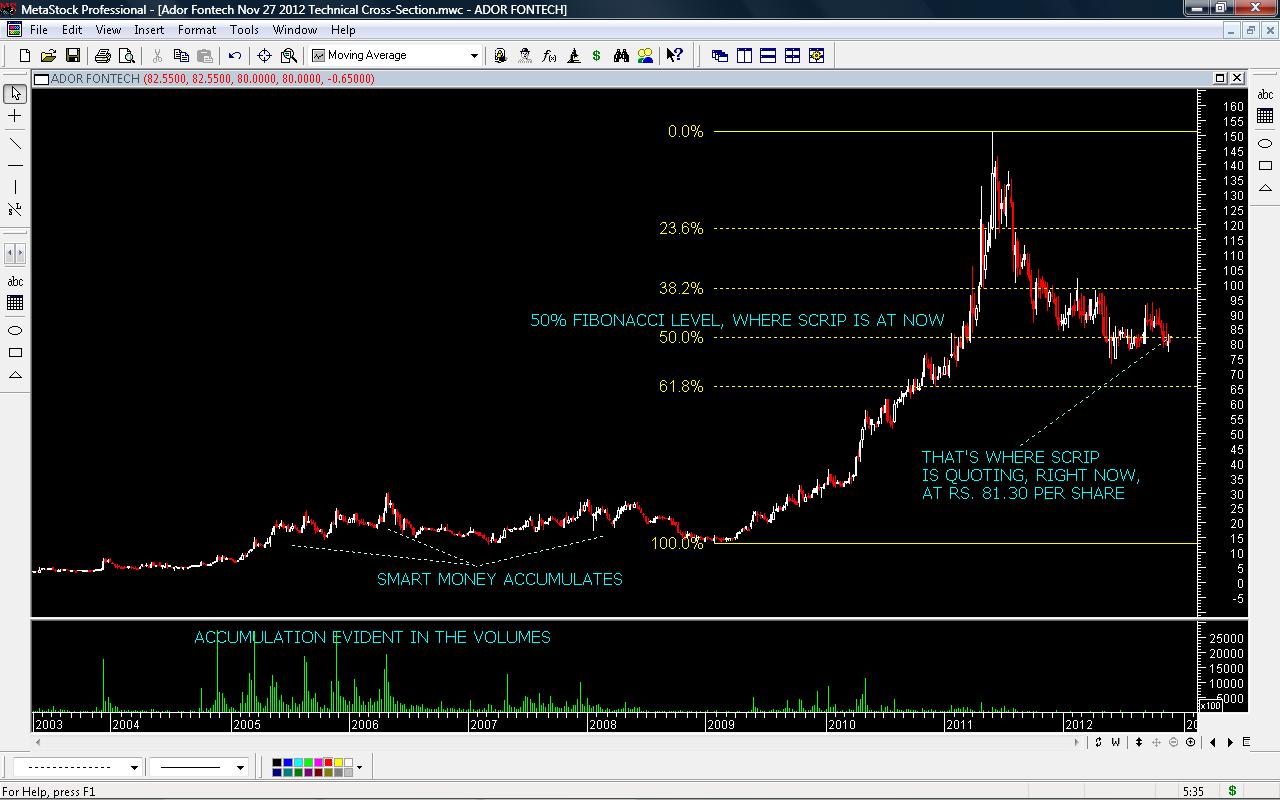
You see, an insider never functions alone. When a company experiences a turnaround or a great quarter comes along with excellent earnings, white-collared people connected to the functioning of the company obviously know this, and they leak this information out (for a price) to smart researchers and investors. These smarties (along with their entire intimate circle of connectivity) buy into the company’s prospects. The money moved is called smart money. Smart money registers / reflects on the traders’ charts. The scrip might show a bounce-back from a low with huge volume, or a resistance might be broken, or a new high could even be made (all coupled with large volume). Traders latch on. Price movers higher. All this is happening before the CEO has announced quarterly results, mind you. Finally, a few days before the results, the corresponding results-file lands on the CEO’s desk. He or she congratulates his or her staff on the spectacular performance, and over a round of golf, the information is shared with you. The CEO is obviously thinking that the market is going to react positively to the earnings surprise that’s going to be announced.

Well, the earnings are not going to be a surprise. The market already knows, and earnings have thus already been factored into the price, before results are announced. Announcement time is generally selling time for traders, who tend to sell all stock upon the first spike after announcement. With no more buying pressure (since traders are out of the scrip), the inflated scrip tanks despite the good news, leaving you stuck with a peak-price buy. Well done, well done indeed.

See, that’s why. Don’t listen to insiders, even if they mean well.

In the marketplace, you really are on your own. Isn’t that exciting? As in challenging?

All the best, my friend. Learn to rely on your own judgement.

What Exactly is a Decent Trade?

A decent trade should yield you money, right?

Not necessarily so.

Am I crazy?

No.

So why am I saying this?

Am I not in the business to be in the green?

Of course I am, so let’s delve a little deeper.

As is slowly becoming clear to you, Mrs. Market is a schizophrenic. Her behaviour is mostly looney, and more often that not, she traverses an unexpected trajectory.

In the business of trading, there lie before you a set of circumstances, and your trading decisions are based upon these.

Thus, you outline your trade.

You plan the entry.

You plan the exit.

You define the reward : risk ratio.

You draw up a trade management plan, as outlined by your system. You preplan your response to all possible movements of Mrs. Market.

Can you do more?

No.

Can you predict Mrs. Market’s future behaviour?

No.

You have an idea about what she might do, based upon past behaviour, but does that make her future path certain?

No.

So that’s it, you enter a trade offering a high reward : risk ratio, based upon information from the past and a probabilistic idea about the future. A high reward : risk means that if there is a payout, it will be high in comparison to the loss you might bear if the trade goes against you. Something like 2 : 1 (possible profit : possible loss), or at least more than 1 : 1.

So what’s going to make your trade decent?

Just stick to your systematic plan, and you’ll have traded well.

Notice, no talk of any money here.

We’ve only spoken of sticking to our system-outlined trading plan.

We are not focusing on money. We are focusing on trading well.

Money is a side-effect to decent trading.

Trade decently, do the right thing, and money will follow as a side-effect, seen over the long run.

If your trade-management plan says you are cutting the trade below point X, and if point X is pierced by Mrs. M as she moves against you, well, the right thing to do would be to cut the trade.

So what if the trade didn’t yield you money?

It was a trade well executed, AS PER YOUR SYSTEM-OUTLINED TRADING PLAN.

What would have made this trade an indecent one would be if you hadn’t cut the trade below point X, irrespective of where Mrs. M went after that.

Why would the trade then be “bad”?

Because you didn’t follow your system’s advice.

You second-guessed yourself.

That means that you don’t have faith in your trade-management abilities, and / or that you succumbed to your emotions. You begun to hope that Mrs. M would start to move your way after piercing point X during her move against your trade direction.

If you did follow your system, you actually didn’t let any hope enter the equation.

Decent.

You had faith in your system, and did not second-guess yourself.

Very decent.

Such faith in one’s system is absolutely essential, and you’ll realize that as you start to scale up in trade-size.

Let’s look at the other part of your trade-management plan.

Let’s say that you decided that if Mrs. M moved in your directon, then you would stay in the trade till you saw the scrip giving at least one sign that it was stagnating. Only then would you book profits, upon such a signal from Mrs. M.

Assume then, that after entry there’s a spike in your direction, and you are in the money.

What do you do now?

Do you get greedy, forget about your trade-management plan, and book the trade? Would such a money-yielding trade be considered decent?

No.

Firstly, you got greedy.

Indecent.

Then, you forgot about your system-outlined trading plan.

Very indecent.

So what if you made money?

Sticking to your system’s advice would have given you the chance to make more, perhaps much more.

It is difficult enough to pinpoint a scrip which is about to explode.

Then, when you land such a scrip, the last thing that you want to be doing to yourself is nipping the explosion in the bud.

You nipped potential profits, even if you took a portion home.

Very, very indecent.

There you have it, people.

Use your common-sense, and, trade decently.

Mentally Speaking

The trader’s biggest enemy is…

…his or her own mind.

The good news is, that one’s mind can be trained … to become one’s friend.

Between these two sentences lies a path.

Some never make it.

For some, this path is arduous.

Other, more disciplined ones make it through.

However, that’s not the end.

Once there, one needs to stay there.

Emotions get in the way.

Fear. Greed. Hubris. Hope. Impatience. Insecurity. Despair …

… you got the drift.

Knock them out, people. Once in the market, stamp all emotion out of your (market) life.

Listen to your system. First make your system.

It doesn’t matter if it’s a technical one, or a fundamental one, or whether it is techno-fundamental, or for that matter funda-technological.

It is your system.

You have spent time putting it together.

You have lost money recognizing its pitfalls, and have tweaked these pitfalls away after they were recognized by you.

Since it has reaped you rewards, you have begun to trust it.

Stay with the trust. Don’t let your mind play tricks on you. It likes to.

Once your trusted system identifies a setup, take it. Period.

Your mind will suddenly switch on. What if this, and what if that?

Ignore.

Only use the mind’s intellect portion to perfect your system. That’s the friendly part for you. Together with it, you construct a system that is capable of identifying setup after setup, from one properly executable trade to another.

You see a setup, and you take it. No ifs, no buts, no what-ifs.

Similary, when your system identifies a stop or a target, and when this is hit, you are out of the trade. Period.

No procrastination. No waiting. No fear. No hoping. No greed.

No mind …

… from entry to trade management to exit.

Switch your mind back on when you have wound up your market activities for the day.

Switch your mind on amidst family. It’ll be fresh.

That’s the path between the two sentences at the top.

Here’s wishing that it’s an easy one for you.

Coin-Flipping in the Marketplace

Are you good at darts?

Actually, I’m not.

I’ve even removed all darts from our home. Hazard. Children might hurt themselves. Yeah, yeah, I know, I’m paranoid. Tell me something new.

Well, just in case you fancy playing darts, here’s a market exercise for your consideration.

Take a newspaper section, and pin it on the wall.

I know, I know, you’d love to take pot shots at your favourite corrupt politician’s picture. Please feel free to do so, let out all your venom. When you’re done, we can resume with the market exercise.

Now substitute whatever picture you’re shooting darts at with the equity portion of your newspaper’s market segment.

Take a dart. Shoot.

You hit some stock or the other. Let’s say you hit XLME Systems.

Now take a coin. Flip it.

Go long XLME Systems if you flip heads. Short it if you flip tails.

You have a 50:50 chance of choosing the correct trade direction here.

This is still a winning system, if you manage your trades with common-sense.

Cut your losers short, quite short, yeah, nip them in the bud. Let your winners ride for as long as you’re comfortable.

These two sentences will turn your little darts cum coin exercise into a winning market system.

Try out a 100 such trades, coupled with proper, common-sensical trade management. You’ll see that you are in the money.

Now, whoever turns towards me and starts to talk about trading systems, well, that person needs to be very crystal clear about one thing.

He or she needn’t bother discussing any trading system with worse results than the above-described trading system.

I mean, come on, people, here’s nature, already presenting something to us which doesn’t require any formal education, just an average ability to aim, fire, flip, trade, and manage with common-sense. This small and natural system is enough to keep us in the money.

So, if we want to spend any time discussing trading systems with an edge, we need to be sure that these systems are functioning at beyond 50:50. At par or below is a waste of time.

Good trading systems with a market-edge function at 60:40.

In the Zone, you maneuver your evolving edge to function at 70:30 and beyond.

Frankly, you don’t need more. You don’t need to function at 80:20 or 90:10. Life at 70:30 is good enough to yield you a fortune.

Getting to 70:30 is not as difficult as it sounds. First, get to a 60:40 trading system. Out of every 100 trades, get the trade direction of 60 right. Comes, takes a bit, but comes eventually.

Now you’ve got your good trading system with a decent edge, it’s working at 60:40, what next? How do you extract that extra edge.

Well, tweak. Adapt. Fine-tune. Till your edge becomes that something extra.

Still want more?

If yes, the game becomes a story about you. How disciplined are you? Are you with the markets regularly, as a matter of routine? Are you with the flow? Can you sense the next move? Are you slipping into the Zone? Can you stay in the Zone for long periods? Once you slip out, can you get back into the Zone soon?

The answers to these questions lead you to 70:30 and beyond.

This is Getting Murky

Have you actually seen China’s account books?

Has anyone, for that matter?

How does the US pay for its imports from China?

With treasury-note IOUs?

Are Chinese GDP numbers doctored?

If yes, for how many years have the Chinese cooked their books?

How many more bailouts is Greece going to require?

Isn’t the amount of financial maneuvering increasing from bailout to bailout?

It feels as if real debt is being made to “go away” synthetically.

Things are getting murky in the financial world.

When that happens, the stage is set for tricky synthetic products to be offered.

It’s time to go on high alert.

You see, for the longest time, banks in the “developed” world have not been clocking actual business growth. However, their balance sheets are growing on the basis of trading profits. In almost all cases, the “float” is not increasing significantly from clients’ savings, or from new business. Instead it is increasing from good trading.

However, trading can go wrong for a bank. All that is required is one rogue trader. Blow-ups keep happening. For banks, good trading is at best a bonus. It is not something solid and everlasting to fall back on for eternity.

Well, that’s what most or all “developed” international banks are doing. They are relying on their international trading operations to see them through these times. (((Compare this to an emerging market like India, where an HDFC Bank generates 30%+ QoQ growth, for the last 8 quarters and counting, on the basis of actual business profits from new accounts, savings and fresh real money that increases the float))).

While the scenario lasts, what kind of synthetic products can one expect from the plastic composers of financial products?

And we are going to get something plasticky soon, since “developed” international banks have gotten into the groove of trading, and since trading is their ultimate bread and butter now.

So what’s it gonna be?

The conceivers of plastic in the ’80s still had a conscience. For example, Michael Milken’s “Junk Bonds” still had actual underlying companies to the investment. That the companies were ailing, and could probably go bust, was a different issue. In lieu of that, junk bonds were giving returns that beat the cr#p out of inflation twice over, and then some. Though investors knew that these underlying companies were ailing, greed closed their eyes, as crowds lapped up the product. We know how the story ended.

In the ’90s, anything with the flavour of IT ran like an Usain Bolt. The conceivers of plastic products here were tech enterpreneurs, coupled with bankers that pushed through their IPOs. One had a lot of shady dotcoms with zero or minus balance-sheets clocking huge IPOs, apart from being driven up to dizzy heights by greedy public, from where their fall began.

By the ’00s, whatever 2 pennies of conscience that remained were now out the window. Products like CDOs did the rounds. These had no actual underlying entity, like a bond or a debenture. They were totally synthetic, mathematical products, assembled by bundling together toxic debt. The investment bankers that conceived these products knew that the debt was toxic, and were cleverly holding the other end of the line, i.e. they sold these products to their clients as AAA, and then shorted these very products, knowing that they were bound to go down in value because of their toxic contents.

We are well into the ’10s.

What’s it gonna be?

I think it’s probably going to be a “Structure”.

There is going to be an underlying. The world is wary about “no underlyings”.

The catch is going to come from the quality of the underlying, as in when it’s ailing badly and the world thinks otherwise (in the ’80s, the junk value of the underlying was no secret. Here, it probably will be).

Where is the product going to be unleashed?

Emerging markets. That’s where money has moved to. Also, investors there are not as savvy, since they’ve not been properly hit.

Why is the time ripe?

Interest rates are kinda peaking. Investors have gotten used to sitting back and raking in 10%+ returns, doing nothing. When interest rates start to move down, that would be the stage for the unleashing of the product in question.

Lazy, spoilt investors would probably lap up such products offering something like 13%+ returns, with “certified” AAA underlying entities to the investment.

So watch out. Don’t be lazy or greedy. As and when interest rates start to move down, move your money into appropriate products that are not shady and that have safe underlyings. From knowledge, not from hearsay.

Be very selective about who you let in to give investment advice. Even someone you trust could be pushed by his or her employer institution to aggressively sell you something synthetic with a shady underlying.

Be very, very careful. Do your due diligence.

Don’t get into the wrong product, specifically one with a lock-in.

Dealing With a Bully

I know a way of dealing with a bully – sock the bully a real tight one in the solar plexus. Inside, there’s only air, and that one tight punch is going to burst the balloon and reduce the bully to his real self, i.e. a meek failure.

What if this bully is the government itself?

Let’s just caste a very quick glance at the track-records of the governments of independent India till date.

Education has been a total failure. Whatever meaningful education is being imparted in India is being done so mostly by private institutions, at least till high school level, if not even after that.

Healthcare – another very big failure. The government’s hospitals, just like its schools, are a disgrace.

Left to the government, infrastructure would have been a massive failure too, which it was, till the private sector stepped in.

Let’s not even start speaking about the governmental airline carrier, Air India. Words fail me here.

You want to avoid the police lest they stick you one at a time when you have other problems.

You want to settle any disputes out of court, because the semi-dysfunctional judicial system will, in all probability, stretch the issue over decades, with much ensuing harassment.

I mean, I could go on and on. Point of the matter is, governance in independent India has been an overall and disastrous failure.

We are not a democracy – we are a joke.

Over the last few years, these and more blunders are coming to light. They are being flashed over the papers and on television, nationally and internationally. People are getting to see and know the quality of people that has been governing the country. Citizens are disgusted.

Instead of charting a course of rectification, what does the bully do?

It tries to hide its own failures by passing on the responsibility to private institutions. Governments and governments have robbed common citizens of their basic rights to education, healthcare etc. over decades. Now, when the deprivation has become too glaring, they want private institutions to accomodate the deprived, and that too quasi-free of cost. I’m talking about the current developments in the education sector. Rest assured, other sectors will be affected too, if one goes by the governmental mind-set.

The government is bullying private schools into reserving 25% (number could vary for different states) of their capacities for kids from backward classes. The government says it’s going to pay for this partly, but knowing the value of its words, this money is never going to come. Basically, it wants want private schools to lift this burden and pay for it too. Unbelievable.

The government’s massive failure in the field of education has caused downtrodden classes to finally start asking, “What have you done for us?” and “Where is our education?” and “Why is the quality of the schools built for us by you so pathetic?” and “Where does the education cess go, which you charge along with every monetary transaction in the country?” and again, “Where is our education?”

Now the government gets really cute, and says, “You see those private educational institutions over there, look at them, they are doing so well, they will make your kids rise, we will steam-roll them into admitting your kids, there is your education!”

Laws in India are basically stacked up against private institutions and in favour of the government. One false move here or there, and you could be breaking a law as a private player. Hence, as a private player, you are always in the government’s grip. To function smoothly and not show a loss, you could end up slightly bending a rule or two. The government agrees to look the other way, and lets you function, but then you have to mutually agree to get bullied by it every now and then. Sometimes, the bullying takes on ridiculous levels, like it has for the education sector. My remedy to deal with a bully (given at the top) like the government is not going to work, because I just wouldn’t know how to implement it. I wouldn’t even know what to implement.

And that’s the story, people. India Inc. is heavily burdened by its failure watchdogs. You need to incorporate this fact into any investment strategy that concerns India Inc. Right within its purchase price, any investment in India needs to discount for the governmental failure that will inevitably be patched onto the private institution that you are planning on buying into.

What does that mean for governmental institutions as investments? Frankly, looking at the mess, one can’t even think of buying into these, unless one wants to own companies with Ph.D.s in inefficiency and mismanagement.

Betting Your Monsters and Checking Ace-High

Blah, blah, blah, I know, poker terminology yet again…

Can’t help it, people, it’s just so valid…

When you’re holding a monster hand, you bet out on the next street to build up the pot. Similarly, when a trade starts to run, you’re looking to load up some more on the scrip at the appropriate point.

When you’re holding air, or a mere bluff-catching hand like ace-high, you check it down through the river. Likewise, if the scrip you’ve just bought into stagnates, or moves a bit down, you do not double up on your trade. Instead, you just wait for your stop to be hit, or if before that your time-stop has run out, you square-off the trade.

An aggressive-passive style?

Who cares?

Recipe for winning in the long run?

Yes.

Right, then we’re taking it.

Two out of ten trades may start to run big. It’s taken you time, money and effort to identify those two. You are in the trade. You can feel the adrenaline pumping. Now’s not the time to sit passively. Spade-work’s all done. Right, put some more money on the winning scrip. Point is, when?

Additional points of entry are tricky.

I prefer a little margin of safety here. I like to double up at a point where there’s been some correction, and possibly when a Fibonacci level has been hit. After that, I want to see the scrip going up back through the level, and I’d like to see volume go up simultaneously. That’s my point of second entry.

You can be more aggressive, no one’s stopping you.

You can even choose to enter the second time above some kind of a previous high or above the breaking of a resistance with volume.

Risky?

Yes.

You do, however, stand a good chance of catching a big move in a very short time.

You see, at this particular point, where you’re choosing to enter, the scrip is pretty hot. People are plunging in. There is no resistance from above. Upward movement is smooth.

Downside is, that those who’ve been sitting on notional profits might start to book these anytime. When that happens, the scrip might plunge well below your high entry and hit your stop. That’s a risk you have to take, since you have decided to enter above a high.

No risk, no gain.

At my more conservative second entry point, the scrip is not as hot. It is meeting with overhead resistance from recent entrants who entered high to then find the scrip correcting, and who are now happy to exit at their entry points as the scrip retraces its upward move. So, I will have to wait longer for a possible second run of the scrip to develop, and this might or might not develop. That’s a chance I have to take. That’s the price of being conservative during second entry. I’m comfortable.

Staying in your comfort-zone at all times adds a lot of value to the rest of your life, even after you shut down your computer. One does carry over one’s emotions, and it’s best if these are under control when you reach home. By trading in your comfort-zone at all times, you make sure that you come home in an emotionally balanced state.

If you can take the second entry above a high or above a resistance while still remaining in your comfort-zone, by all means, please do so. It’s an exciting play, capable of yielding large and quick rewards. I’ve tried it at times, but cannot get a grip on the excitement levels. Thus, I normally choose the more conservative play mentioned above. It’s just a personal choice.

Similarly, I’m very comfortable checking my ace-high trades down through the river. If I’m in a trade and it’s not running, I don’t jump about trying to pull stuff out of a hat in an effort to make the trade run.

If it’s not running, it’s not running. Feed in a trigger stop and shut the computer.

Once you are alerted that the stop’s been hit, look for a new trade.

Keep it simple. That’s another recipe for winning.

Moments Before the Plunge

A very common sight right through school and college was last minute cramming. It was an epidemic. I was more the odd one out, walking around without any books a day before any exam. Reason was, I was convinced that if I was unsure of myself a day before an exam, delving into course-material at that stage would make me feel even more insecure.

“Do you have any coffee?”, whispered someone. This fellow woke me up in the middle of the night, leaving with my entire bottle of instant coffee-powder. He was doing an all-nighter before some board exam. At the cost of not being super-prepared, I preffered to sleep the night.

Interestingly enough, I’ve had the chance to speak to some brides and grooms hours before the knot was tied. Jitters, man. Everyone was jittery, well almost. The most common feeling was “… what if this is the wrong step?” This was followed by “…what if we don’t get along?”

Seriously, people, why moments before the plunge? Why does the human being expose him- or herself to destabilizing thoughts just before pulling the trigger? There’s ample time much, much before, to sort all the destabilizing stuff out while deciding whether one goes ahead with a particular action. Similarly, there’s ample time to study for an exam if one starts from day one. Just an hour a day, throughout the term, and there’s no need for any all-nighters.

If you’re all sorted out and well rested to boot, you then have the best chance of seeing peak-performance emanating from your system.

And that’s what we are looking to be, just before opening a market position.

We’ve sorted out our worries and fears. We know how much risk we can handle, and have systems in place to manage this risk, i.e. we know what we have to do if our trade goes bad. Also, we know how to behave when a trade does well. We are aware about the size of the position we need to put on as an appropriate ratio to our stack-size. We’ve tuned in to the idea of position-sizing, and are practising it as we win more or lose more. Basically, we have our basics in order.

After that, we have to see whether we actually feel like trading. Even when our trading system identifies a set-up, the innate go-ahead to trade might just not come from within. There can be some reason for this. For example, there could be some tension prevailing at home. Sort out the external disturbance to the level of closure if you can, or it might constantly disturb trading.

So, internal sorting out, external sorting out, then comes a trade set-up, and one takes the trade. No jitters, here, there, anywhere. All jitter-causing avenues have been chewed up and digested. That’s when triggers can be pulled when they appear.

When Mrs. Market asks you to ride alongside her, your bag should be packed already. You can then jump on to her motor-bike without worries, for you’ve packed well for the trip.

Moving on to a Higher Table

You’ve started to rake in regular profits on your poker table, or, if you will, on your regular trade-size.

Common-sense now tells you, that you need to scale it up a bit. After all, you’d still be risking the same percentage of your stack-size per trade. Simultaneously, if your win-ratio remains constant, you’d be allowing your stack to grow at a faster pace.

You move on to a higher table.

Welcome to the concept of position-sizing.

Those who position-size can evolve into huge winners in minimum time. Even though the idea of position-sizing is so central to trading, it is still one of the most under-discussed of topics. We need to thank Dr. Van Tharp for teaching this concept properly.

Think about it. When you win, your principal increases. On the next trade, you then put the same principal percentage at risk like you’ve always done. Because your new principal was more, it allowed you to buy more. Thus, you put yourself on the line to win more.

What’s essential here is also to down-size your position when you are losing. Taken a few bad beats in a row? Move down to a lower table for a bit, man. Allow your stack to recuperate at this lower level and then some before moving back higher. With that, when you’re losing, you start to risk less. Crucial point.

Of the different methods available to you to position-size, here, we speak about increasing trade-size when a new trade starts.

The advantage you enjoy when you’re doing pure equity is that on each new trade, your position-size can pinpointedly be adjusted according to your stack-size. Scale-up, scale down, trade upon trade, as the situation demands. Beautiful.

Why does this work out so beautifully for you?

You see, your system gives you an edge. You are opening your positions on high-percentage winners only. Period. Simultaneously, you are cutting your losses at your pre-defined maximum. You are also allowing your winners to win more. And, you are taking your stops. Even if your system then gives you a 55:45 edge over Mrs. Market, you’re doing great. Over a large sample-size (many, many trades, or for that matter many, many poker hands), your stack will increase with a high level of probability. As it goes on increasing, you keep turning on the heat by increasing your position-size further and further.

What happens then? What do you see?

Something beautiful happens.

Your trading principal (what we’ve been calling stack-size all the time) starts to increase exponentially. Have you seen the progress of an exponential function as one travels from zero to the right on the x-axis (the x-axis here would stand for sample-size or the number of trades taken)? If not, check it out on the net.

A good system should give you a 60:40 market-edge. In the Zone, you’d probably trade at 70:30 or beyond. That’s 70 winning trades out of every 100 taken, and 30 losing ones. Imagine what that does to your trading principal over 1000 trades, if you adhere to position-sizing, let your winners ride and take your stop-losses.

The numbers will boggle your mind.

Go for it.

Going All-in Against Mrs. Market

Yeah, yeah, I’ve been there.

And it backfired.

Luckily, my stack-size in those days was small. That’s the good part. The shocking bit was, that back then, I had defined my stack-size as my networth. Biggest mistake I’ve made till date in my market-career, and I was very lucky to escape relatively unhurt.

Wait a minute, why is all this poker terminology being used here, to describe action in the world of applied finance?

Well, poker and market action have so much in common. Specifically, No-Limit Hold-’em is deeply related to Mrs. Market. We’re talking about the cash-game, not tournament poker. It’s as if Hold-’em is telling Mrs. Market (with due respect to Madonna):

i’ve got the moves baby
u got the motion
if we got together
we’d be causing a commotion

A no-limit hold-’em hand is like one trade. Playing 20-50 hands a day is excellent market practice. You’ve got thousands of games available to you online, round the clock, and most of these are with play money. Even though the “line” is missing here because of no money on the line, this is a no-cost avenue for trade practice, and it’s entertaining to boot.

Back to stack-size? What is stack-size, exactly?

Well, your stack size is the sum of all your chips on the table. You play the game with your stack, and on the basis of your stack-size. The first thing you need to do before there’s any market action is to define your stack-size.

A healthy stack-size is one that allows you to play your game in a tension-free manner. My definition, you ask? Well, I’d start the game with a stack-size that’s no more than 5% of my networth. Segregate this amount in an account which is separate from the rest of your networth, and trade from this segregated account. That’s the wiser version of me speaking. Don’t be like the stupid version of yours truly by defining your entire networth as your stack-size.

In this 5% scenario, you have 20 opportunities to reload. It’s not going to come to that, because even if a couple of your all-in bets go bust, you will eventually catch some big market moves if your technical research is sound and if you move all-in when chances of winning are high.

Wait patiently for a good hand. Then move. One doesn’t just move all-in upon seeing one’s hole-cards. If these are strong, like pocket aces, or picture pocket pairs, one bets out a decent amount to build up the pot. Similarly, if a promising trade appears, and the underlying scrip breaks past a crucial resistance, pick up a decent portion of the scrip. Next, wait for the flop (further market action) to give you more information. Have you made a set on the flop? Right, then bet more, another decent amount, but not enough to commit you fully to the pot. Then comes the turn. The scrip continues to move in your direction. You’ve made quads, and you’re holding the nuts. Now you can commit yourself fully to the pot and move all-in. Or, you can do so on the river, checking on the turn to disguise your hand and to allow others to catch up with your nuts somewhat, so that they are able to fire some more bets into the pot on the river. Your quads win you a big pot. You fired all-in when the scrip had shown its true colours, when winning percentages were high. You exhibited patience before pot-commitment. You allowed others to fire up the pot (scrip) further, and you deservedly caught a big market move. Just get the exit right, i.e. somewhere around the peak, and you’re looking at an ideal trade strategy already, from entry to trade management to exit.

Fold your weak hands. If something’s not working out, give it up cheaply. Ten small losses against a mega-win is enough to cover you and then some.

Often, a promising trade just doesn’t take off after you enter. The underlying might even start to move below your entry price after having been up substantially. You had great hole cards, but didn’t catch a piece of the flop, and now there are two over-cards staring at you from the flop. Give up your trade. Muck your hand.

At other times, you move all-in and the underlying scrip tanks big against you in a matter of hours. Before you can let your trade go, you’re already down big. You’ve suffered a bad beat, where the percentages to win were in your favour, but the turn-out of events still caused the trade to go against you. Happens. That’s poker.

Welcome to the world of trading. Pick yourself up. Dig out another stack from your networth. Don’t allow the bad beat to affect your future trades. If you are thinking about your bad beat, leave the table till you are fresh and can focus on the current trade at hand.

And then, give the current trade at hand the best you’ve got.

The Line

In the world of applied finance, you will meet the “line”.

Though the line is an abstract phenomenon, it is very real.

Whenever you connect to Mrs. Market, you do so through the line, which comes into existence (you guessed it) when you put your money “on the line”.

Please be aware of the capabilities of the line. If you allow it to, it grabs hold of the emotional switches of your brain. When the price of the scrip you’re trading plunges, the line can turn on your depression switch. As the loss multiplies, the line makes you go into freeze mode. On the other hand, it can also make you go on a spending spree with your notional profits, if your scrip is doing well. If you allow it to, the line then controls how you interact with your family and for that matter with everyone else.

Why give it so much power? Let’s keep the line in its boots. When you’re flying a kite with strong winds prevailing, and the kite plunges downwards and out of control towards some electricity wires, what do you do? Obvious answer, let the string go. Well, not so obvious when you’re holding the string (substitute string for “line” if you wish). You could try and save your kite, or for that matter, your trade, at the cost of being electrocuted, or, in trading jargon, burnt.

When you’re holding the line, common-sense often goes out the window. You start thinking emotionally. Our society doesn’t teach us to embrace failure. We are taught to win. Thus, we want to turn every trade into a winning trade. Big mistake. We are not able to let the line go while any loss is still bearable.

Wins come. The fact remains, that in applied finance, many transactions will be failures. You’ve won if you can then let your line go at a digestible failure level.

When a win does come along, again one is completely misled by the teachings of modern society. “Book your success now, put it on your resume”. An even bigger mistake in applied finance.

A winning trade needs to be allowed room to win some more. After struggling with failures, you’ve finally identified a winning horse. Aren’t you going to let it win more (races)? Aren’t you going to continue holding the line to let a multibagger emerge, instead of letting the line go while you’re showing a small profit which doesn’t even cover your failed trades?

The line is an enigma concerning the discernment of befitting moments for attachment and detachment.

We need to let it go when it threatens to burn us. Also, we need to hold on to it, contrary to any public opinion, that “XYZ can’t possibly go any higher”.

There’s no way we’re playing the line according to public opinion or society rules.

Also, there are times when it doesn’t make sense to get a line going, because the kite just doesn’t take off. At other times, you need to put out one line after another into the sky, because your kites start to soar, one after another.

In the world of applied finance, you need to put your money on the line. There’s no other way to connect to Mrs. Market.

The “when” is up to you, when to get it going, when to let it go, when to hold on, when to scale it up.

And at that level, trading becomes an art.

Elephant in a China Shop

Mr. Cool just plugged his trading exam.

Big time, and for the umpteenth time.

It all started out like this. He partied late night. Had one too many, of course. Slept till late morning. Woke up with a headache.

Then he made his first mistake of the new day. He decided to trade.

Why was this a mistake, you ask? After all, trading is his profession.

Two mistakes here, I’d say. Firstly, there was no market preparation. Secondly, health was not up to the mark. Deciding to trade after this backdrop – hmmm – bad call.

The next set of mistakes came right after that. Coolers asked his broker Mr. Ever So Clever the wrong question, this being “What’s moving, mate?”

True to his form was Mr. Cool-i-o. Two mistakes here again. Firstly, you don’t ask your broker technical questions. You tell your broker what to do. You instruct him or her. Asking your broker to instruct you is like asking the second hand car dealer to start ripping you off.

Next, if you are asking Mr. Ever So Clever anything at all, it can be about your funds in transit, or your equity in transit or basically something mechanical. You are not in this business to give Mr. Clever even an inch more of space by asking market questions like what’s moving or what’s going to move.

If you still do, as Mr. Coolovsky obviously proved, then of course Mr. Ever So Clever is going to tout to you what his other clients are squaring off. Specifically illiquid scrips. These need buyers, and if you’ve just announced yourself as a buyer and are asking what to buy, illiquid scrips that others are selling will definitely be touted to you for buying.

Also, a scrip doesn’t have to be illiquid to be touted. One can even be dealing with a very large order which a big player is looking to off-load at a relative peak. A whole set of brokers then does the rounds to get buyers interested.

The bottom-line is this – you are not giving your broker any kind of leeway with regards to what you are buying or selling. You need to do your own technicals, or fundamentals or whatever it is that you do, to gauge what is moving. You don’t ask what is moving.

On many occasions, rallies wind up soon after big players square off. This time was no different. Coolster had loaded himself with a scrip which had already peaked. With no buying pressure to push it up any further, its price started to sink.

Next set of mistakes.

He’d marked a vague stop-loss in his head because everyone had been ticking him off for not applying stops. Specifically our friend Mr. System Addict, remember him? He had been very vocal about it. Because the stop was vague, Mr. Cool wasn’t motivated enough to feed it into his trade as the price neared his stop.

Not feeding in a mental stop – mistake.

As the scrip’s price undershot his mental stop, Coolins did nothing except to hope it would climb back to his buy level, which is when he would exit.

Hoping in a trade – big mistake.

Not taking your loss once stop is undershot – even bigger mistake.

What happened after that can’t be called a mistake anymore (on humanitarian grounds), because Coolinsky had gone into freeze mode. The reason was the sinking scrip. Huge losses were piling up. Coolitzer answered two back to back margin calls in this frozen state of body and mind. He was frozen. Didn’t know what he was doing. Scrip didn’t turn back up before Mr. Cool was cleaned out.

This chronology of events is a kind of worst-case scenario. A grade F minus in an exam.

Every trade is an exam. One needs to tread carefully from step to step, from pre-trade preparation to actual trade to after-trade emotional wind-down.

Remember that, so you fare much, much … much, much better than our F minus candidate. And don’t worry about him, Mr. Cool-Dude will be back. He’s always able to get back, you’ve gotta give credit to Mr. Cool for that.

Is This Blood?

When there’s blood on the streets, that’s when you should go out and invest.

That’s an ancient proverb.

The 64 million dollar question is, IS THIS BLOOD?

I’m going to focus on India, because that’s my playground.

So ICICI Bank breached the 700 mark, did it? The 2009 low was around 250 bucks. At 700, it’s not blood. True, the banking sector is down. However, we are nowhere near blood levels. State Bank of India might have fallen around 50 % this year, but it’s still double the price of its 5 year low.

The Sensex shows an average price to earnings ratio of around 14. Remember 2008 and 2009? Average PE of about 9? Well, in my opinion, those are blood levels. These aren’t.

True, the mid-cap segment has taken a hammering. Let’s take Sintex Industries. At 75 levels, this stock has fallen big. Nevertheless, it’s still double the price of it’s 2009 low. At 98 rupees, Jain Irrigation has really fallen too. The PE ratio has come down from 35+ to around 14, and this looks attractive. Even Sintex’s sub-5 PE ratio looks very attractive, also because the company is aggressively pursuing water-purification and “green-innovation”. Agreed, attraction to invest is present, especially in the mid-cap arena, where you’re likely to find quality in management too, as opposed to the small-cap area, where this is less likely. However, to say that there’s overall mayhem here would be going too far.

The BSE small-cap index has halved since late 2010, but is again at double the 2009 low. Many small-cap stocks are bleeding badly, though. Most small-caps haven’t proven their pedigree yet. Thus, people are letting them bleed.

Then there are stocks like Karuturi Global and KS Oils, that have been hammered down to penny-stock levels. One has problems getting into such stocks, because the underlying story can be shady. With penny stocks, there’s always the danger of oblivion, i.e. they might cease to exist down the line. Such stocks need to be traded at best, with small amounts and for the short-term. In their present conditions, they are not investment-grade stocks.

The picture that emerges is that there are selective attractive bets being offered by Mrs. Market. There are good investments to be made for long-term investors, if you possess patience and holding-power. I’m short on patience, so I like to trade India. That should not deter you. If you are a long-termer, and have what it takes, well, then you are a long-termer. And this market is offering you some good bets, so be very selective and go for it, but don’t bet the farm, since we’re not seeing all-out blood on the street yet.

Learning to Be

Mrs. Market becomes an enigma, at times.

At such times, she’s very difficult to understand. She’s erratic and jumps around in an exaggerated fashion. She defies all logic, and flushes all analyses down the toilet.

I like such times.

Mrs. Market is not the only one who knows how to dump others. Over the years, she’s taught me the art of dumping. So, during incomprehensible stretches, I dump Mrs. Market.

The key to dumping her is learning to be. You need to be comfortable in just being. You roll out a few novels, or surf around, or even catch a few movies on your laptop. Or, you can close your eyes, envision something beautiful, focus on your breath, and listen to some music. At these times, there’s no need for any market- activity, and you’re not going to give her any.

Mostly, during these stretches, the rate of return in the debt segment is great. So, you identify safe debt instruments, park your funds, and go into hibernation mode. She’ll come around soon enough. Remember, you’re calling the shots and are not going to let her get into control mode. Otherwise, you’re fried.

Hibernation mode is a beautiful time. Your system recuperates. You even, perhaps, go on a holiday. Your off-spring enjoy the extra attention from you. And just because you’re not pushing Mrs. Market’s buttons for a bit does not mean you can bug your spouse that much more!

So, market people, learn to be. Nobody made a rule saying that one has to be market-active all the time. Do away with the norms, as long as you don’t injure anyone’s fundamental rights. Norms were made for average citizens. Are you satisfied being average?

The enemy of just being is boredom. You’re not going to get market-active just out of boredom. You’d rather wait for a conducive time to enter the market again.

In today’s world, there’s so much happening, that there’s no room for boredom. Thousands of hobbies are waiting to be tapped. Do something good for society. Help other people. Live life in a manner that you feel good about yourself. There are many ways to “just be”.

Or, just get acquainted with your inner-self and you’ll be amazed at the kind of avenues that open up.

Get with it people, dump your 24x7x365 market-activity compulsion, and just learn to be.

Watch Out for Bottomless Pits

A shareholder-friendly management?

Forget about it.

Very difficult to find, nowadays.

Gone are the days where you’d see an Azim Premji driving his 800, or a Narayana Murthy travelling economy class.

These legends believed in increasing the shareholder’s pie. And this they did, big time. Ask any Wipro or Infosys shareholder. These legends were very clear about one thing: there was no question of pumping in useless expenditure into their public limited company at the cost of the shareholder.

The norm, btw, is totally opposite. Public limited company managements live it up at the cost of the shareholder. Very few promoters are actually bothered about their shareholders. It is the norm to put medical bills, day to day living / wining / dining / entertainment costs, personal property purchases etc. into the company. Why should the promoter bear such costs when there is the public limited company to put these and such costs into? Logical?

Don’t expect too much from your average promoter. He’s not in the game for you.

Where does all this leave you, by the way?

Firstly, you need to look out for, and avoid bottomless pits. These are companies that bear huge amounts of expenditure emanating from the whims and fancies of the promoter. For example, the total sports sponsorship bill for Kingfisher Airlines is staggering. Then there’s this huge red flag in their balance sheet – the company is in under a mountain of debt. On top of that, this company just reported almost a 100 million USD Q2 loss. Math doesn’t add up for you to be investing in such bottomless pits, does it?

In your search for idealistic and shareholder-friendly managements, you might come up with a handful of names. Next you’ll find that it’s no secret. If there’s an idealistic and shareholder-friendly promoter around, people can see this in his or her deeds and of course in the balance sheet of his or her company. Savvy early investors make a beeline for such companies, with the result that by the time you get there, the concerned share-price is already quite inflated. You’ve identified a good investment, but you are not going to enter at an expensive price. If you do, you’ll not be able to sit on your investment for the long-term. Even slight volatility will shake you out of it.

Instead, you choose to wait for the right price to arrive, and then you enter. Well played.

The deal is, that more than 90% – 95% of managements don’t play it like an Azim Premji, or a Narayana Murthy, or an Anu Aga for that matter. However, shareholder-unfriendly promoters sometimes own companies that are lucrative investments. This can be due to niche, cycles, technology, crowd mentality, whatever. When do you buy into such companies?

As a long-term investor, you wanna be buying such companies at a deep discount to real value. My thumb-rule is a single-digit price to earnings ratio. You can have your own thumb-rule. You might have to wait a long time to get this kind of a price, but that’s what long-term investing is about.

As a trader, you buy into such a company with the momentum. You can buy after a resistance is broken. Or after a high is taken out. Or upon a substantial dip after the first burst of momentum. As a trader, what is far more important for you is to know when to let such a company go. Know the level by heart below which or at which you will exit such a company. In trading, exits are far more important than entries.

The mistake you don’t want to be making is to invest in a bottomless-pit, no matter how cheap the share price is.

What U Gonna Do When They Come For U?

“Bad Boys Bad Boys, what u gonna do…

what u gonna do…

… when they come for you?”

Lots of bad boys floating around.

They make a beeline for an underlying, for example Gold. Hike up its price. Entice you to enter at a peak. They cash out. You, the slow poke, are left high and dry.

Then the bad boys gang up and short the underlying simultaneously. Price tanks. From one day to the next, you are sitting on a large loss. You get out, disgusted.

Don’t make yourself vulnerable to such bad boys. Get your strategy right.

Buy at strategic points. If you are buying at dips, do so at pinpointed levels, like Fibonacci ones. You can also buy when a resistance is broken. Or, you can buy when a high is taken out with volume. Don’t buy above that. Meaning to say, that’s the vulnerability cut off. After that, you expose yourself to the bad boys, because you don’t have any margin of safety after that point. Through your actions, you activate bad boy zone.

On the short side, go short at strategic points in a rally. That’s where margin of safety is maximum. You can also short when a support is broken. Or, you may go short when a low is taken out with volume. Below that is bad boy zone.

At times, the human being likes the thrill of being in bad boy zone. Got me there, I like it too. Only sometimes. In bad boy territory, you need to be light. Don’t carry too much cash in your pockets when they come for you. In bad boy territory, do options. Options are your best friends here.

The advantage of operating in bad boy territory is that every now and then, there’s a jackpot for the taking. There’s no telling how far bad boys take an underlying in a particular direction. Where there’s risk, there’s reward. Out of ten option trades you put on, at least two or three should hit the pot if your research is good. That’s all you need.

In bad boy territory, the only position you want to be in is about showing the jackpot in the one hand and the finger from the other. By default, your losses must be small here, and they are, because you are doing options. Period. With that, you’ve shown the necessary aggression that is required in this territory, and you’ve also shown proper backfoot (defence) strategy. That is winning behaviour in bad boy territory. That’s the language understood by bad boys, telling them to lay off. Now, even if they try to come for you, they’ll not get you. Ever.

When Cash is King

I don’t like crowds.

The last thing I ever want to do is to conform to crowd behaviour.

That’s one goal defined.

What does this mean?

Very clearly, for starters, it means singing one’s own tune, i.e. defining one’s own path.

It also means not listening to anyone. That requires mental strength, and the power to resist. Very tough.

In life, generally, one likes to be in tandem with the Joneses. And then, smart cookies that we are, we like to go one up on the Joneses, which would be the cue for the Joneses to catch up and then overtake us. Hypothetically, this is how the Joneses and the Naths could blow up all their cash.

It doesn’t stop there. To keep up, the average citizen doesn’t think twice before leaping into debt.

Bottomline is, when cash is king, hardly anybody has cash. In fact, most people owe money at that time.

This is the age of black swans. Crisis after crisis, then a bit of recovery, then another crisis, then some recovery, followed by a mega-crisis.

When a master-blaster crisis ensues, cash becomes king. Quality stuff on the Street starts to sell so cheap, that one needs to pinch oneself to believe the selling prices. Margins of safety are unprecedented. Now’s the time one can salt away a part of one’s cash in Equity, for the long-term.

That’s if one has cash to spare. This is report card time. How have you done in your REAL investment exam? Have you learnt to sit on cash? Have you learnt to buy with margin of safety? The Street doesn’t care for your college degree, in fact, it vomits on your college degree. Your college degree has no value on the Street, it’s just a piece of paper.

Learning on the Street happens everyday, with every move, every investment, every trade, every observation. Unless and until your own money is on the line, this learning is ineffective.

Get real, wake up, so that when cash is king, you feel like an emperor!

An Elliott-Wave Cross-Section through a Crowd Build-Up

At first, there’s smart money.

Behind this white-collared term are pioneering investors who believe in thorough research, and who are willing to take risks.

Smart money goes into an underlying, and the price of this underlying moves up. Wave 1.

At the sidelines, there are those who have been stuck in this underlying. As the price moves above their entry level, they begin to off-load. There’s a small correction. Wave 2.

By now, news of the smart money has perforated through the markets. Where is it moving? What did it pick up? Who is behind it? Thus, more investors following news or fundamentals (or both) enter. The price moves past the very recent short-term high of Wave 1, accompanied by a surge in volume.

This is picked up on the charts by those following technicals, who enter too. By now, there are analysts speaking in the media about the turn-around in company so and so, and a large chunk of people following the media do the honours by entering. Wave 3 is under way.

Technical trend-followers latch on, and soon, we are at the meat of Wave 3, i.e. the middle off the trend.

Analysts on the media then speak about buying on dips. All dips are cut short by a surge of entrants seeking to be part of the crowd.

The first feelings of missing the bus register. The pangs of these cause more people to enter.

Meanwhile, the short community has been getting active. Large short positions have been in place for a while, and they are bleeding. Eventually, the short community throws in the towel, and there’s massive short-covering, causing a further surge in price.

Short-covering is sensed by gauging buying pressure despite very high price levels. It is the ideal time for smart money to exit. That’s exactly what it does, without any dip in the price of the underlying whatsoever.

Short-covering is over. Smart money starts boasting about its returns of X% in Y days, openly, at parties, in the media, everywhere. This causes pangs of jealousy and intense feelings of missing the bus in those still left out. Some enter, throwing caution to the wind.

The price has reached a level at which no one has the guts to enter. Demand dries up. With no buying pressure, the price dips automatically. Bargain hunters emerge, and so do shorters. The shorters sell to the bargain hunters right through a sizable dip. This dip happens so fast, that most of the crowd still remains trapped. Wave 3 has ended, and we are now looking at the correcting Wave 4 in progress.

At this stage, technical analysts start advising reentry upon Fibonacci correction levels. Position traders buying upon dips with margin of safety enter, and so does the second-last chunk of those feeling they’d missed the bus. The price edges up to the peak of Wave 3 and past it. That’s the trigger for technical traders to enter.

We now see a mini-repeat of Wave 3. This is called Wave 5. Once Wave 5 crosses its meat, the last chunk of those still feeling they’d missed the bus makes a grand entry with a sharp spike in the price. These are your Uncle Georges, Aunt Marthas and Mr. Cools who know nothing about the underlying. They cannot discern a price to earnings ratio from an orangutan. They desperately want to be a part of the action, since everyone is, at whatever the price. And these are the very people that traders sell to as they exit. With that, the crowd is at its peak, and so is the price. There are no more buyers.

What’s now required is a pin-prick to burst the bubble. It can be bad news in the media, the emergence of a scandal, a negative earnings report, anything.

The rest, they say, is History.

Dealing with Distraction

I’m a huge Sherlock Holmes fan.

The stand-out quality I admire about Holmes, apart from his mastery in observation and deduction, is his ability to switch off.

In the midst of the most engrossing case, Holmes will switch off for half a day or more, and will visit the museum, or will play the violin. While having switched off, there will not be a single thought on his mind concerning the ongoing investigation. He will be fully and totally involved in the recreational activity. Of course he switches off at a juncture where he knows that nothing of consequence is happening for the next so many hours, but that’s not the point.

The ability to switch off is a huge asset to the trader. It allows the trader’s mind and body to recuperate. Also, it does away with overtrading. If a position is showing good profit, the trader who installs a trailing stop, and then switches off, opens the window for still larger profits.

At many times, one is distracted. It is potentially dangerous to trade while distracted, just as it is dangerous to drive while communicating on the cellphone. While distracted, the trader needs to switch off. As long as it takes. Till the source of distraction is nullified, at least in the trader’s mind.

Just a minute, forget about the trader. Investors need to be experts at switching off too, after having entered into an investment. If they don’t have this ability, they’ll be thinking about their investment day in, night out, for years at a stretch. The investment will eat into their life. If we’re looking at the average investor with 10 to 20 investments and without the ability to switch off, we’re also looking at a mental and emotional wreck.

Traders and investors both need to learn how to switch off from Sherlock Holmes.

Taking Compulsion Out of One’s Trading Equation

Mr. Cool’s next trading cameo starts a few months after his last blow-up. He keeps coming back, you’ve gotta give him that.

This time around, his girl-friend wants a fur coat. Cool is determined to buy a fur coat for her from his trading profits.

Thus, Mr. Cool has put himself in a position where he is compelled to trade. Compulsion adds pressure. A trader under pressure commits basic blunders. There’s no question of getting into the Zone while pressure mounts.

Sure enough, Cool overtrades. Apart from that, he fails to cut his position-size after the first run of losses. These are two basic mistakes. They are being caused by compulsion. Mrs. Market is ruthless with players who commit basic blunders. As usual, Cool blows up, yet again. The fur coat is not happening. In fact, there’s no girl-friend anymore.

Meanwhile, Mr. System Addict has been evolving. He’s achieved a large-sized fixed income by ploughing previous profits into safe fixed-income products. He’s under no compulsion to trade. His fixed income allows him to live well, even without trading. He has a lot of time to think. Often, he gets into the Zone, where he’s moving in tandem with the market, and is able to swing with the market’s turn. What makes him get into the Zone so often?

It’s the lack of pressure. He’s comfortable. A free mind performs uniquely. There’s no question of making basic mistakes, because full focus is there. Addict is a human being who is aware. He knows when he is in the Zone. That’s when he doubles up his position-size and logs his trade. His win : loss ratio is 70:30 by now. His trading income surpasses his fixed income for the year.