Anatomy of a Multibagger

Wouldn’t we all like to rake it in?

A multibagger does just that for you. Over a longish period, its growth defies normalcy.

In the stock markets, a 1000-bagger over 10 years – happens. Don’t be surprised if you currently find more than 20 such stocks in your own native markets.

Furthermore, our goal is to be a part of the story as it unfolds.

Before we can invest in a multibagger, we need to identify it before it breaks loose.

What are we looking for?

Primarily, a dynamic management with integrity. We are looking for signs of honesty while researching a company. Honest people don’t like to impose on others. Look for a manageable debt-equity ratio. Transparency in accounting and disclosure counts big. You don’t want to see any wheelin’-dealin’ or Ponzi behavior. If I’d been in the markets in the early ’80s and I’d heard that Mr. Azim Premji drove a Fiat or an 800, and flew economy class, I’d have picked up a large stake in Wipro. 10k in Wipro in ’79 multiplied to 3 billion by ’04. That can only happen when the management is shareholder-friendly and keeps on creating value for those invested. Wipro coupled physical value-creation with market value-creation. It kept announcing bonus after bonus after bonus. God bless Mr. Premji, he made many common people millionaires, or perhaps even billionaires.

A good management will have a clean balance-sheet. That’s the number two item.

The company you’ re looking at will need to have a scalable business model.

It will need to produce something that has the ability to catch the imagination of the world for a decade or more.

The company you’re looking at will need to come from the micro-cap or the small-cap segment. A market-cap of 1B is not as likely to appreciate to 1000B as a market-cap of 25M is to 25B.

Then, one needs to get in at a price that is low enough to give oneself half a chance of getting such an appreciation multiple.

Needless to say, the low price must invariably be coupled to huge inherent value which the market is not seeing yet, but which you are able to correctly see.

After that, one needs the courage and conviction to act upon what one is seeing and has recognized.

One needs to have learnt how to sit, otherwise one will nip the multibagger in the bud. Two articles on this blog have already been dedicated to “sitting”. Patience is paramount.

The money that goes in needs to be a small amount. It’s magnitude shouldn’t affect your normal functioning.

Once a story has started unfolding, please remember one thing. If a stock has caught the imagination of the public, it can continue to quote at extended valuation multiples for a long time. As long as there is buying pressure, don’t exit. One needs to recognize buying pressure. That’s why, one needs to learn charting basics.

Phew, am I forgetting something here? Please feel welcome to comment and add factors to the above list.

Here’s wishing that you are able to latch on to many multibaggers in your investing career.

πŸ™‚

How To Nip A Ponzi In The Bud

Mirror Mirror on the wall…

Who’s most prone of them all?

As in, most prone to Ponzis…

Frankly, I think it is us gullible Indians.

Everyday, there’s some report of a Ponzi scheme being busted, with thousands already duped.

Charles Ponzi’s is a case of the tip of the iceberg – maximum recognition came posthumously. If Charlie would have received a cut every time his scheme was used by mankind, he would probably have become the richest man in the world. Unfortunately for him, he popped it before reaping the full rewards of his crookedness.

What Charlie did leave behind was a legacy. Yeah, Charlie did an Elvis, meaning that many have tried to emulate Charles Ponzi since he departed. Maybe I’ve gotten the chronology wrong, but you know what I mean…

Chances are, a Ponzi will eventually cross your path sooner or later. More sooner than later.

How do you recognize a Ponzi? Yeah, that’s the first step here – identification.

A Ponzi will talk big – he or she will flash. There will be a small track record to back up what is being said, and this will almost be blown into your face, after you’ve been dazzled by the Ponzi’s fancy car, expensive clothes and gold pen. The Ponzi will be a good orator, and his words will have a hypnotic effect on you (ward this off with full strength). The Ponzi will show off, making you feel awkward. You will feel like being “as successful” as what is being projected before you, right there, right then. When all these symptoms match, and such feelings well up inside of you, you are, with very high probability, talking to a Ponzi, who is trying to suck you in with a promise of stupendously high returns.

After you have identified the Ponzi, the next step is to not get sucked in. This is going to take all your self-control. Remember, the grass is not greener elsewhere. Take charge of your emotions. You’ve identified a Ponzi, man, that’s big. Now you need to follow through and see to it that a minimum number of people come to harm.

Hear the Ponzi out. Don’t react. In fact, don’t say a word. Don’t commit a penny. Keep reminding yourself, that you have it in you to succeed. You don’t need the Ponzi’s help to get good returns on your money. You certainly don’t want to lose all your money. With that thought in mind, block the Ponzi and his promises out. Leave politely and inconspicuously.

After you’ve left securely, without having committed a penny and without having left your details with the Ponzi, you now need to sound the alarm. Tell all your friends of the lurking danger. Forewarn them, so that no one you know gets sucked in. Ask everyone to spread the word. The whole town needs to know within no time.

Identify – Control – Alarm – this is a three step programme to nip the Ponzi In the bud – try it out, it works!

Cheers! πŸ™‚

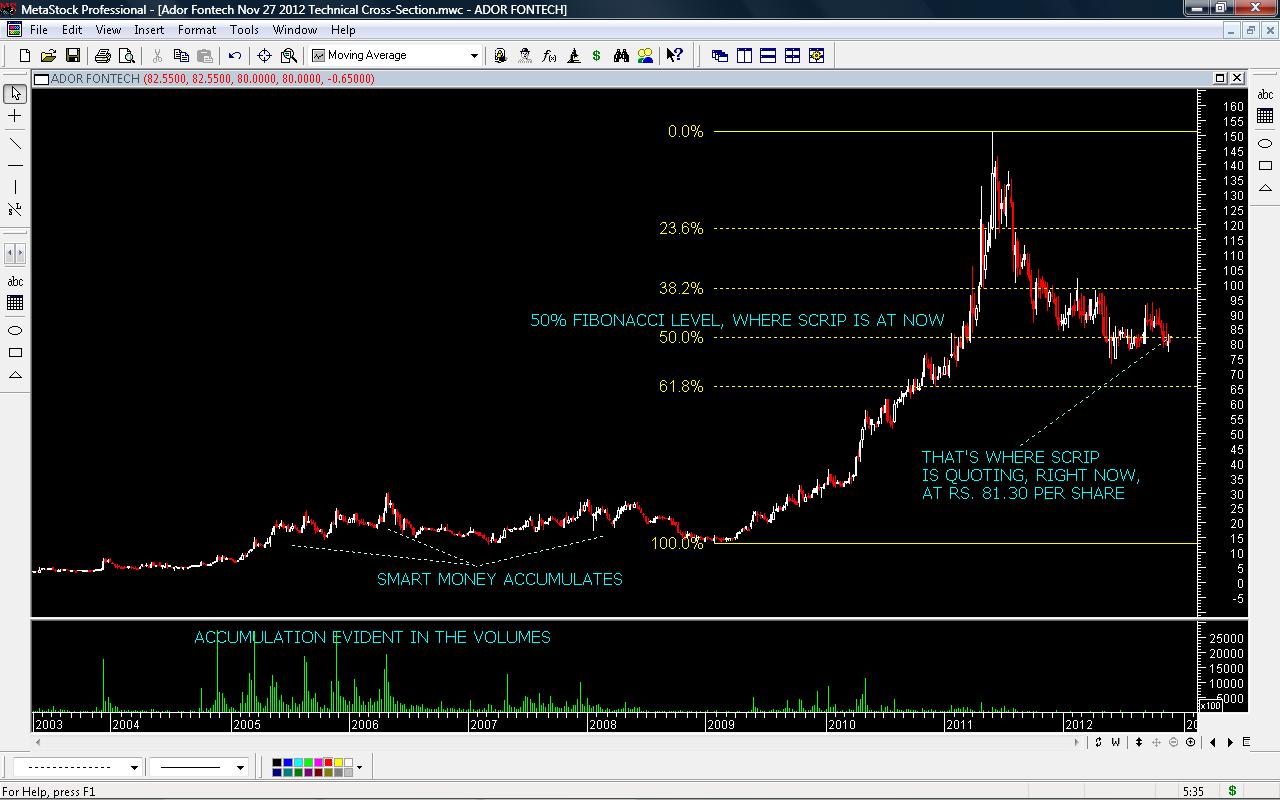
Due Diligence Snapshot + Technical Cross-Section — Ador Fontech Limited — Nov 27 2012

Image

Price – Rs. 81.30 per share

Earnings Per Share projected on the basis of quarter ended Sep 30 2012 – Rs. 12.62

Price to Earnings Ratio (thus, also projected) – 6.44

Price to Book Value Ratio – the stock is selling at approximately 2 x book value currently

Debt : Equity Ratio – Nil

Current Ratio – 2.73

Profit After Tax Margin – 12.51%

Return on Networth – 32.54 %

Pledged Shares %age – Nil

Face Value – Rs. 2.00

Dividend Payout – 50% -150% of face-value.

Average Daily Volumes – around 5 – 6 k / day on BSE.

Product – Reclamation of alloys, fusion surfacing (preventive welding), spraying and environmental solutions.

Promoters – JB Advani & Company Pvt Ltd (of Advani-Oerlikon fame) + a group of other Sindhi business-people.

Share-holding Pattern – Promoters (35.4%), Public (58.9%), Institutions (2.0%), NICBs (3.7%).

Technicals (see chart below) – This is a very low volume scrip, so there could be slippage. The scrip has corrected from its June 2011 peak of Rs. 150.90 to a pivot of Rs. 73.25 within about one year. This low pivot lies bang in between the 50% and the 61.8% Fibonacci levels of correction on the weekly chart. Currently, the scrip is quoting at Rs. 81.30, just below the Fib. 50% level. Volumes are average, with one high volume peak every 7 odd trading days. The scrip is trading in a broad band between Rs. 73.25 and Rs. 93.90. Perhaps it is trying to establish a base.

Comments – Fundamentals are good, and the company’s corporate governance is considered clean. Market for the company’s niche is considered small, and people view that as a long-term growth concern. Technically, correction has taken place, and thus value shines out fundamentally. Debt is nil. Dividend is excellent. Projected PE is low, though P/BV is a bit high. Cushion is there, and profitability and returns are exemplary. Future investment would be required to keep niche-segment status alive.

Buy? – I like the theme – reclamation and preventive welding. Contrary to what others say, I feel the market is going to grow phenomenally, as earth and rare-earth metals become difficult to source, and need to be reclaimed. Valuations are excellent, governance is great, payouts are great too, and a technical buying level has presented itself. Yes, it’s a long-term buy right now. Remember, this is not a trade we are speaking about, so we are not going to talk in terms of a stop-loss. This is a long-term investment, and we’ve been speaking in terms of margin of safety, which I’m sure you’ve noticed. Also, while buying, one needs to show caution regarding slippage, which is invariably going to occur owing to the low-volume nature of the scrip.

Disclaimer and Disclosure – Opinions given here are mine only. You are free to build your own view on the stock. I have bought a miniscule stake in Ador Fontech today. Data given here has been compiled from motilaloswal.com, moneycontrol.com and equitymaster.com. Technicals have been gauged and shown using Metastock Professional version 9.1 by Equis International.

Danza Kuduro x Gangnam Style = Indian Political Circus

Can you ignore the circus around you?

Sooner or later, you’ll need to learn how to.

Why?

Because growth is where we are.

And, growth is dying in many parts of the world.

So, why do you need to ignore the circus?

To focus. The circus won’t let you focus properly.

And why do you need to focus?

To take advantage of the growth around you.

Growth is a coveted commodity, remember that.

One could say that you are lucky to be born in an area showing growth. You are in demand. People from other parts of the world want to participate in any available growth story. These are competent people, selling highly developed technology and expertise. They deserve to participate in growth stories, why not? The question here is about you.

Are you able to make the most of your times, and that too – ethically?

Then forget about the circus.

The circus won’t let you function ethically.

You need to learn to function despite the circus.

Welcome to the world of minimal exposure. At times, you will need the circus, since it controls the machinery of your system. That’s about it, that’s your minimal exposure. No more exposure than what is absolutely required – these are golden words summing up your policy of minimal exposure.

And you are totally going to succeed despite minimal exposure – many have done so already, so why should you be an exception?

The quality of success that emerges, after having followed a policy of minimal exposure, is sweet. It’s a no-strings-attached kind of success. It is lasting, and brings peace and exhilaration. Definitely worth striving for. So, circus shmirkus, don’t even bother, just go for it, and make the most of the growth happening around you. Because of your ethical angle, I wish even more, that you succeed.

All the best! πŸ™‚

Going Legit in the Times of Robber Vodka

A good, clean, healthy and tension-free life – don’t you want that for your children and families?

Right, people, go legit.

It is possible, despite the Robber Vodkas, the Call Muddies and the Rama Lundgren Rajus of our times.

The first step is going white.

Go white, people. Declare your assets, pay your taxes, just sheer refuse to deal in black money as much as you can, and for heaven’s sake, start cutting out unwanted people dealing in black from your lives.

Second step – avoid people wearing whites. 98%+ of male folk dressed in whites in this country are either inactively or actively politically connected. In the process, you might pass up on the 2% genuinely good ones in whites, but you’ll have avoided all the ones you want to avoid. Political connect in India will not allow you to go legit. People hook up with politicians for favours, and / or because they feel that in their hour of need, their political clout will save them. Did you know, that for the one favour, your political connection will make you do ten illegit things in reciprocation, stuff you’d never dream of doing normally. Ask yourself. Is the trade-off really worth it? No, right?

Then, avoid dealing with people who use body-guards. I mean, use your common-sense. There’s no reason to shun a benevolent, well-known corporate honcho with or without body-guards, like Anand Mahindra for example. You’ll learn to recognize shady honchos. There’s that feel about them, that mafioso vicious vibe. If you can sense that vibe in a honcho, don’t deal with that person. Forget about the profit you’re losing out on, and look at the level of tension and complication you’re avoiding.

Don’t deal with people promising stupendous returns. Nip the Ponzis in the bud. Dealing with a Ponzi will eventually land you in court, to get your money out . Believe me, you don’t want our super-efficient judicial system messing up your life, if you can help it.

Be firm while dealing with any government officer. The government officer will only start to misbehave if there is any weakness from your side. Remember, a government officer is supposed to serve the nation. His or her salary is paid from the taxes you dish out. If your dealing is clean, the official could harass you for refusing to bribe, but that’s about it. Take the harassment, but keep coming back till your work is done. We need to stop bribing. Then, and only then will government officers eventually stop expecting us to bribe.

Right, we’ve pretty much cut ourselves off from a lot of people and things, so where does this leave us?

Don’t worry, we are not alone.

There are like-minded people around, and we need to make these like-minded people a part of our lives. Yeah, and we can lead good, healthy lives with such people surrounding us.

Also, don’t for a moment think we can’t do anything for our country, just because we’ve nixed the political linkage. Private opportunities come along everyday, to help people and society. If you want to still make a difference, grab these opportunities. Poor people come to you for medical aid. Help them. You can contribute privately to social-welfare. Many private citizens are running clean NGOs. As the name suggests, these NGOs have no government involvement, and are less likely to be corrupt. Funds donated to clean NGOs will very likely reach disaster areas on time and in full.

You can make a difference, all by yourself. You don’t need a corrupt government to make a 20-odd% difference for you per unit of currency you trust them with, as tax or whatever. Yeah, only about that %age gets converted into welfare; the rest is nibbled up along the way.

Make a difference – all by yourself.

What are you waiting for?

Clean up your act, go legit.

It’s not going to cut you off from any good, clean and healthy action.

Trust me on this.

Happy Second Birthday, Magic Bull !!

Seasons change. So do people, moods, feelings, relationships and market scenarios.

A stream of words is a very powerful tool to understand and tackle such change.

Birthdays will go by, and, hopefully, words will keep flowing. When something flows naturally, stopping it leads to disease. Trapped words turn septic inside the container holding them.

Well, we covered lots of ground, didn’t we? This year saw us transform from being a money-management blog to becoming a commentary on applied finance. The gloom and doom of Eurozone didn’t beat us down. Helicopter Ben and the Fed were left alone to their idiosyncrasies. The focus turned to gold. Was it just a hedge, and nothing but a hedge? Could it replace the dollar as a universal currency? Recently, its glitter started to actually disturb us, and we spoke about exit strategies. We also became wary of the long party in the debt market, and how it was making us lazy enough to miss the next equity move. Equity, with its human capital behind it, still remained the number one long-term wealth preserver cum generator for us. After all, this asset class fought inflation on auto-pilot, through its human capital.

Concepts were big with us. There was the concept of SprachgefΓΌhl, with which one could learn a new subject based on sheer feeling and instinct. The two central concepts that stood out this year were leverage and compounding. We saw the former’s ugly side. The latter was practically demonstrated using the curious case of Switzerland. There was the Ayurvedic concept of Satmya, which helps a trader get accustomed to loss. And yeah, we meet the line, our electrolytic connection to Mrs. Market. We bet our monsters, checked Ace-high, gauged when to go all-in against Mrs. Market, and when to move on to a higher table. Yeah, for us, poker concepts were sooo valid in the world of trading.

We didn’t like the Goldman attitude, and weren’t afraid to speak out. Nor did we mince any words about the paralytic political scenario in India, and about the things that made us go Uffff! We spoke to India Inc., making them aware, that the first step was theirs. We also recognized and reacted to A-grade tomfoolery in the cases of Air India and Kingfisher Airlines. Elsewhere, we tried to make the 99% see reason. Listening to the wisdom of the lull was fun, and also vital. What would it take for a nation to decouple? For a while, things became as Ponzi as it gets, causing us to build a very strong case against investing a single penny in the government sector, owing to its apathy, corruption and inefficiency. We were quite outspoken this year.

The Atkinsons were an uplifting family that we met. He was the ultimate market player. She was the ultimate home-maker. Her philanthropy stamped his legacy in caps. Our ubiquitous megalomaniac, Mr. Cool, kept sinking lower this year, whereas his broker, Mr. Ever-so-Clever, raked it in . Earlier, Mr. Cool’s friend and alter-ego, Mr. System Addict, had retired on his 7-figure winnings from the market. Talking of brokers, remember Miss Sax, the wheeling-dealing market criminal, who did Mr. Cool in? She’s still in prison for fraud. Our friend the frog that lived in a well taught us about the need for adaptability and perspective, but not before its head exploded upon seeing the magnitude of an ocean.

Our endeavors to understand Mrs. Market’s psychology and Mr. Risk’s point of view were constant and unfailing, during which we didn’t forget our common-sense at home. Also, we were very big on strategy. We learnt to be away from our desk, when Mrs. M was going nowhere. We then learnt to draw at Mrs. M, when she actually decided to go somewhere. Compulsion was taken out of our trading, and we dealt with distraction. Furthermore, we started to look out for game-changers. Scenarios were envisioned, regarding how we would avoid blowing up big, to live another day, for when cash would be king. Descriptions of our personal war in Cyberia outlined the safety standards we needed to meet. Because we believed in ourselves and understood that we were going to enhance our value to the planet, we continued our struggle on the road to greatness, despite any pain.

Yeah, writing was fun. Thanks for reading, and for interacting. Here’s wishing you lots of market success. May your investing and trading efforts be totally enjoyable and very, very lucrative! Looking forward to an exciting year ahead!

Cheers πŸ™‚

Isn’t This Other Party Getting Too Loud?

We in India have decided to go for gold after the Olympics.

I mean, there’s a whole parallel party going on in gold.

What’s with gold?

Can it tackle inflation?

No.

Is there any human capital behind it?

No.

Meaning, gold has no brains of its own, right?

Correct.

Is there a storage risk associated with gold?

Yes.

Storage volume?

Yes.

Transport inconvenience?

Yes.

Price at an all time high?

Yes, at least for us in India. We’d be fools to consult the USD vs time chart for gold. For us, the INR vs time chart is the more valid one for gold, because we pay for gold in INR.

Getting unaffordable?

Yes.

No parameter to judge its price by, like a price to earning ratio for example?

No.

Then how am I comfortable with gold, you ask?

Right, I’m not.

Can I elaborate, is that what you are requesting?

Sure, it’s exorbitance knocks out its value as a hedge. A hedge is supposed to balance and stabilize a portfolio. Gold’s current level is in a trading zone. It is not functioning as an investor’s hedge anymore.

Why?

Because from a huge height, things can fall big. Law of gravity. And gold’s fallen big before. It doesn’t need to begin it’s fall immediately, just because it is too high. That alone is not a valid reason for a big fall, but the moment you couple the height with factors like improvement in world economics, turnaround in equities (if these factors occur) etc., then the height becomes a reason for a big fall. Something that can fall very big knocks out stability and peace of mind from an investor’s portfolio. The investor needs to bring these conditions back into the portfolio by redefining and redesigning the portfolio’s dynamics.

How?

By selling the gold, for example, amongst other things.

What’s a good time to sell?

Well, Diwali’s a trigger.

Right.

Then, there are round numbers, like 35k.

What about 40k?

Are you not getting greedy?

Yeah – but what about 40k?

Nothing about 40k. Let 35k come first. I like it. It’s round. It’s got a mid-section, as in the 5. It’s a trigger, the more valid one, as of now.

Fine, anything else?

Keep looking at interest rates and equities. Any fall in the former coupled with a turnaround in the latter spells the start of a down-cycle in gold.

Is that it?

That’s a lot, don’t you think?

I was wondering if you were missing anything?

No, I just want to forget about gold max by Diwali, and focus on equities.

Why’s that?

There are much bigger gains to be had in equities. History has shown us that time and again. Plus, there is human capital behind equities. Human capital helps fight inflation. What more do you want? Meanwhile, gold is going to go back to its mean, as soon as a sense of security returns, whenever it does.

And what is gold’s mean?

A 1 % return per annum, adjusted for inflation, as seen over the last 100 years.

That’s it?

Yeah.

And what about equities?

If you take all equities, incuding companies that don’t exist anymore, this category has returned 6% per annum over the last 100 years, adjusted for inflation.

And what if one leaves out loser companies, including those that don’t exist anymore.

Then, equity has returned anything between 12 -15% per annum over the last 100 years, adjusted for inflation.

Wow!

Yeah, isn’t it?

The Frog That Lived in the Well

Once upon a time, there was a frog.

It lived in a well.

Its cousin, however, lived in the ocean, and this particular cousin came to visit.

Cousin froggy was stunned. How could one thrive in such a small space? Our original froggy, however, did not believe that one’s world could get any better. It loved the well, and only after much coaxing did it agree to see what the ocean was like.

Upon seeing the magnitude of an ocean, our original froggy’s head exploded. This story’s from Paramhans Yogananda.Β 

I’m sure you’ve heard this story from someone. Something similar probably happened to you too, of course on a much smaller scale of magnitude, with no head explosions and all that.

I used to walk around pretty smugly with my Blackberry, thinking that I was like there, connected. Experienced kind of a head explosion upon moving to an Android smartphone.

What is it about us humans?

Why are we so limiting?

Why do we create barriers around our life-experience, around our possibilities?

Market conditions keep changing. Just as we get tied up into a rut and define a market as range-bound and going nowhere, it breaks out. Are you able to cope?

Be honest.

Can you adapt to such changes in conditions?

Are you quick on your feet? Or are you lethargic, and full of inertia?

What’s that song by The Black Eyed Peas?

“don’t…don’t…don’t … … don’t-stop-the-party!”

I know you’ve been humming this song during your continuing debt market party, but there is more to the scene than just the debt market. The debt market is not where things start and end in the world of investing. There’s more.

The world of investing is like an ocean.

The next buzzing market will make itself known. It’s only a matter of time. Be ready for it. Don’t remain clogged up within the claustrophobic walls of one market only, out of sheer laziness and a false sense of security.

Get out there.

Experience the ocean, without your head needing to explode.

Getting Too Comfy For Our Boots, Are We?

What a party we are having in the debt-market, aren’t we?

Exceptional payouts, day after day, week after week, month after month, it’s almost going to be year after year.

Are you getting too comfortable? Lazy, perhaps?

Meaning to say, that when you can get a 10 % return after tax without having to move your behind for it, it is a very welcome scenario, right?

People, scenarios change.

It isn’t always going to be like it is at the moment.

Are you flexible enough to change with the scenario?

Or will you be lost in the current moment, so lost, that you will not recognize the signs of change?

What would be these signs? (Man, this is like spoon-feeding….grrrrrr&#*!).

Inflation begins to fall.

The country’s central bank announces back to back interest rate cuts.

Too lazy to read the paper? Or watch the news? Ok, if nothing else, your online liquid mutual fund statement should tip you off.

How?

The payout, dammit, it will have decreased.

Also, something else starts performing.

What?

Equity.

Smart investors don’t like the debt payout anymore. They start moving their smart money into value equity picks.

Slowly, media stops reporting about a gloomy economy. The buzz gets around. Reforms are on the way.

Foreign direct investment picks up. The media latches on to it. It starts speaking about inflows as if the world begins and ends with inflows.

Now, the cauldron is hot and is getting hotter.

Debt payouts are getting lesser and lesser. Equity is already trending upwards, and has entered the meat of the move.

If the trend contnues, a medium to long-term bull market can result.

There you have it, the chronology played out till just before the start of a bull market of sorts.

Be alert. Recognize the signs early. Be mentally in a position to move out of the debt market, if the prevailing scenario changes.

Otherwise…

… you miss a first run in equity. Boo-hoo. When stocks cool at a peak, and start falling, you make multiple wrong entries into them.

You get hammered by equity, having caught it on the down-swing.

You missed the correct entry time-point in equity because the debt-market made you too comfortable. You were late to act. When you acted, finally, you caught a correction, and took a hammering.

One or two more hammerings like that, and you’ll be off equity for the rest of your life.

And that, my dear friend, would be a pity.

Why?

Because, in mankind’s history, it is stocks that have given the best long-term returns. Not gold, not debt, not bonds, but stocks.

You need to approach them properly, and timing is key.

Power of Compounding II – The Curious Case of Switzerland

What comes to mind when one thinks of Switzerland?

– Blood Money – world’s haven for,

– “Neutralness” – has never fought a war in modern times,

– Beauty – it is God’s own country, with its mountains, meadows, valleys, lakes, trails…,

– Discipline – blessed with the works, punctuality, law and order, you name it,

– Technological supremacy – for example their watch-technology, or their advances in heavy mechanical engineering,

– Culinary supremacy – as in their chocolates, or for that matter their herbal know-how, superior quality of their milk, and of course, their cheese,

– Love for their country – the Swiss really look after their country, are loyal to it, and would probably die for it willingly.

Only the first factor has a negative sound.

Well, they do provide a safe-haven. I mean, look at all the other factors. People feel that their money’s safe in a swiss bank. You can’t blame a country for being a safe country.

Most of the world is not safe today. So, most of the world’s money flows to locations that are considered safe. A good percentage of the world’s money is blood money, but that’s how it is. When foreign funds flow into a country, a country doesn’t ask questions. Do we in India ask questions? No. For all we know, it is Mafia money flowing into our country, inflating our markets. Nobody cares as long as it is coming in.

When foreign funds flow into a country excessively, as is the case with Switzerland, such a country can dictate the interest-rate it pays out for such funds. For many, many decades, Swiss banks have been in demand because of the safe-haven quality of their country, and the interest-rate doled out is a pittance, something like 0.5 % or perhaps 1% per annum, something in that range. I could be making a mistake of an odd 1 % here or there, but, you see, people don’t store their money in Switzerland so that it accumulates to an even bigger amount. They store it there so that the principal stays safe. Switzerland doesn’t participate in wars. Thus, wealth is not destroyed. In fact, during wars elsewhere, fund-flow towards safe-havens heightens.

And that’s the game. Almost unlimited inflow, pittance of a payout, loan the money further on 6%, 7%, 8%, huge differential, year upon year, decade upon decade, humungous compounding, enough to spark-off, inculcate and fully support massive all-round development – couple this with all the other factors given above about Switzerland, and you have a hugely positive n-th loop. A hugely positive n-th loop is the exact opposite of a hugely negative vicious cycle. Switzerland sets the framework for the all-round blossoming of life, and the inflow provides lubrication and fuels development. After a while, they don’t depend upon the inflow anymore. In fact, the Swiss were probably self-sufficent even before the inflow began. That’s how they were able to provide a stable system. The inflow is just a bonus. Due to the power of its compounding, all the other diamond qualities of CH sparkle even more brightly.

Living in India, with its legacy of corrupt leaders who have siphoned off most of our wealth towards safe-havens, how should one react?

It is not the fault of the safe-haven. We need to evolve and make our own citizens feel comfortable with keeping their funds here. Our system needs to provide that safety.

Only then will the funds stay here. If our funds are not staying in our own country, it is our own fault.

“Don’t Turn Around – Der Kommissar’s in Town”

There’s activity within our slow-poke government.

Yup, we just got a new finance minister. PC’s back. Or, as the newspaper said, PC reboots.

He’s probably reinforcing backdated taxation.

He’s hinted at interest-rate cuts.

He’s after more service-tax candidates.

He’s transferred lots of portfolios.

He’s trying to dish out motivational quotes, so that the economy revives.

“Alles klar, Herr Kommissar?”

The last time PC was in town, there was volatlity in the markets. First they went up and up and up, and then they went down and down and down. Mr. Chidambaram is a by-word for volatility.

How does he do it?

Frankly, I don’t care.

If I’m getting volatility, I’m taking it.

Not that India as a market lacks any volatility without PC.

We Indians are emotionally volatile people. When we are happy, we are sooooooo happy. When we are down and out, man, we are totally gone. No surprise that our markets reflect our topsy-turvy and dramatic emotional nature. Yes, the trader in India is blessed with a volatile trading scenario by default.

So, PC or no PC, volatile trades make themselves available to us in the Indian markets regularly. What PC does is, he gives the system’s volatility a turbo-boost. Our market’s “beta” goes up wth PC, and it goes up fast, quite fast.

Man, how does he do it?

You know, I still don’t care, but if I did, I think this would be the correct answer.

Der Kommissar seems to do it in two steps. First he creates carrots, lots of carrots. These are dangled before India Inc. Things start hotting up. Foreign investment wakes up – demand – buying pressure – our markets go up. Then, when the balloon is inflated, der Kommissar will appear on television and will let out comments (implementation of stick, like the backdated taxation thing) which the market takes exception to. Or, he might give some interview in the media which India Inc. interprets negatively. Well, down we come crashing. Frankly, I still couldn’t care less. Upwards or down, there’s a trade to be found.

Just a few days in his seat, and pivot points are leading to bounce-backs, supports are holding, resistances cracking (it’s the carrots), and technicals are very, very initially changing from “range-bound” to “trending”.

Fine, let’s just trade the Kommissar while he’s in town.

I’ve quoted Falco above and I’m quoting him again : “Alles klar, Herr Kommissar!”

What Does it Take to Decouple?

Is Decoupling a myth?

Why hasn’t any country been able to decouple from collective world economics for longish periods?

What does it take to decouple?

For starters, good governance. Over long periods.

Resources. One needs to have independent resources, as in energy resources. For example, India does not have ample independent oil resources. Going nuclear could make it a stronger candidate for decoupling, but does the country have responsible governance to handle nuclear energy safely? As of now, no.

A conducive business environment is the order of the day. Business needs to thrive. It can only do so, if laws are approved, that are favourable for business. The private sector needs to be allowed to grow wherever possible. Red-tapism and babudom are enemies of decoupling.

To thrive, business needs proper infrastructure. Bottlenecks arise when those responsible for getting this infrastructure in place simutaneously siphon away funds, thereby decreasing the quality of the infrastructure proportionately. Bottlenecks are enemies of decoupling.

Internal demand drives a decoupled economy. The demographic social structure of such an economy allows demand for manufactured goods to blossom.

What kind of a population dynamics caters to this sort of demand creation? One with a healthy demographic pyramid, with the broad pyramid base boasting a large, young consumer base.

This young consumer base is also supposed to be the decoupled economy’s demographic dividend.

Demographic dividends don’t just start existing just like that. They need to be reaped after sowing the proper seeds. An economy needs to first provide proper education and healthcare infrastructure, so that its citizens enjoy a beneficial environment to grow up in, which is when they can go on to become productive citizens.

Savings of productive citizens provide cushion to the decoupled economy. No savings, no cushion. The first Tsunami then destroys the decoupling.

Domestic payment cycles need to be healthy, and not chokingly long.

Imports are a necessary element of trade. Importers should thrive too, but not to the extent of recoupling a decoupled economy.

Then there are moral values. These keep a decoupled economy on track, after everything else is in the correct trajectory. Productive citizens need to do the right thing. Long-term, holistic thinking. No corner-cutting.

Sounds utopic, right?

Well, at least one is allowed to dream!

What Are We, Really? (Part 3)

Heinous crimes … happen in India.

For example the recent Gurgaon r#pe case.

What are we, really?

We were supposed to be reaping a demographic dividend. What happened?

A society that mistreats its women-folk is a sick society.

At its core, the ideology of India is spiritual. And, the driving force of our spiritualism is “Shakti”. The “Shiva” portion is more like a rock of stability. The activity bit is left to Shakti, to rise, purify, and reach Shiva. Shakti is about action. She is the driving spiritual force of India.

So, when from deep inside, our driving force is feminine in nature, and when on the outside, we find ourselves in a male-dominated society, this is a huge paradox that we are forced to deal with.

China has dealt with a similar paradox – with force. Chinese governments, over the ages, have suppressed China’s mandarin-spiritual nature so heavily, that today, it is buried deep, deep down, and is not able to surface. Thus, their paradox is not able to feed off itself, since one pole is out of action. It’s not a solution, but that’s what they’ve done.

In India, spiritualism and basic life go hand in hand. Shakti is beyond suppression. Simultaneously, male domination makes itself felt, in pockets. At every moment, we are faced with our paradox. We need to deal with it, properly, peacefully.

Though the average Indian is dramatic in nature, let’s just get realistic for a while. Which portion of a society is responsible for its continued existence? As in, who bears children?

Bob Marley got his lyrics wrong in one song. “No woman…no KIDS” is what the scene is. No kids … no continued existence … end of your civilization.

A society can only be deemed healthy and fit for continued existence, if it provides a safe and harmonious environment to its women and children. Period.

How are women in India dealing with the paradox?

There is rebellion. Some are able to express themselves. They rebel openly, in their speech, their way of life, dressing-sense, etc. etc. Many others are not able to rebel openly, because of suppression. They rebel in their minds. At the first opportunity, their rebellion will break out.

How is the average dominating male reacting?

There is resentment. Jealousy. Anger. Frustration. Etc. etc. Evolved males are not showing these symptoms. They are dealing with the rebellion peacefully. Unevolved, unemployed, raw / young males are showing the above negative symptoms. They are not able to deal with this new expression of freedom. Their domination is threatened, and their hormones play havoc, which is when they commit heinous crimes, for example r#pe. Unforgivable. Yet, committed.

That’s where we are, people. A two-tier society in every respect. Spiritually (evolved-unevolved divide), structurally (male-female divide), and economically (rich-poor divide). We are still finding ourselves. Please don’t treat us as a mature society.

Specifically, please don’t invest your money here with the idea of steady growth. There will be growth, but it will be hap-hazard, as and when we keep finding ourselves. Many set-backs. Then proper trajectory again. Then road-bumps. And so on, and so forth, till we find ourselves once and for all.

Your money here is set for a volatile ride, till India’s out-of-whack pockets begin to heal.

This is Getting Murky

Have you actually seen China’s account books?

Has anyone, for that matter?

How does the US pay for its imports from China?

With treasury-note IOUs?

Are Chinese GDP numbers doctored?

If yes, for how many years have the Chinese cooked their books?

How many more bailouts is Greece going to require?

Isn’t the amount of financial maneuvering increasing from bailout to bailout?

It feels as if real debt is being made to “go away” synthetically.

Things are getting murky in the financial world.

When that happens, the stage is set for tricky synthetic products to be offered.

It’s time to go on high alert.

You see, for the longest time, banks in the “developed” world have not been clocking actual business growth. However, their balance sheets are growing on the basis of trading profits. In almost all cases, the “float” is not increasing significantly from clients’ savings, or from new business. Instead it is increasing from good trading.

However, trading can go wrong for a bank. All that is required is one rogue trader. Blow-ups keep happening. For banks, good trading is at best a bonus. It is not something solid and everlasting to fall back on for eternity.

Well, that’s what most or all “developed” international banks are doing. They are relying on their international trading operations to see them through these times. (((Compare this to an emerging market like India, where an HDFC Bank generates 30%+ QoQ growth, for the last 8 quarters and counting, on the basis of actual business profits from new accounts, savings and fresh real money that increases the float))).

While the scenario lasts, what kind of synthetic products can one expect from the plastic composers of financial products?

And we are going to get something plasticky soon, since “developed” international banks have gotten into the groove of trading, and since trading is their ultimate bread and butter now.

So what’s it gonna be?

The conceivers of plastic in the ’80s still had a conscience. For example, Michael Milken’s “Junk Bonds” still had actual underlying companies to the investment. That the companies were ailing, and could probably go bust, was a different issue. In lieu of that, junk bonds were giving returns that beat the cr#p out of inflation twice over, and then some. Though investors knew that these underlying companies were ailing, greed closed their eyes, as crowds lapped up the product. We know how the story ended.

In the ’90s, anything with the flavour of IT ran like an Usain Bolt. The conceivers of plastic products here were tech enterpreneurs, coupled with bankers that pushed through their IPOs. One had a lot of shady dotcoms with zero or minus balance-sheets clocking huge IPOs, apart from being driven up to dizzy heights by greedy public, from where their fall began.

By the ’00s, whatever 2 pennies of conscience that remained were now out the window. Products like CDOs did the rounds. These had no actual underlying entity, like a bond or a debenture. They were totally synthetic, mathematical products, assembled by bundling together toxic debt. The investment bankers that conceived these products knew that the debt was toxic, and were cleverly holding the other end of the line, i.e. they sold these products to their clients as AAA, and then shorted these very products, knowing that they were bound to go down in value because of their toxic contents.

We are well into the ’10s.

What’s it gonna be?

I think it’s probably going to be a “Structure”.

There is going to be an underlying. The world is wary about “no underlyings”.

The catch is going to come from the quality of the underlying, as in when it’s ailing badly and the world thinks otherwise (in the ’80s, the junk value of the underlying was no secret. Here, it probably will be).

Where is the product going to be unleashed?

Emerging markets. That’s where money has moved to. Also, investors there are not as savvy, since they’ve not been properly hit.

Why is the time ripe?

Interest rates are kinda peaking. Investors have gotten used to sitting back and raking in 10%+ returns, doing nothing. When interest rates start to move down, that would be the stage for the unleashing of the product in question.

Lazy, spoilt investors would probably lap up such products offering something like 13%+ returns, with “certified” AAA underlying entities to the investment.

So watch out. Don’t be lazy or greedy. As and when interest rates start to move down, move your money into appropriate products that are not shady and that have safe underlyings. From knowledge, not from hearsay.

Be very selective about who you let in to give investment advice. Even someone you trust could be pushed by his or her employer institution to aggressively sell you something synthetic with a shady underlying.

Be very, very careful. Do your due diligence.

Don’t get into the wrong product, specifically one with a lock-in.