Gaugers

Hey.

We gauge…

…situations, …

…sentiment, …

…reactions, …

…anomalies, …

…hubris, greed, fear, depression, …

…and, amongst other things, also the tendency of the human being…

…to give advice.

Sometimes, we find ourselves giving advice too, randomly, unwarranted. We gauge that too.

Our effort focuses on identifying market pivots.

Why?

We act on pivots.

These are the most lucrative points in a market’s trajectory.

These are also very difficult to predict in advance.

However, because of our mental tuning resulting from constant gauging, we are somewhat in a position to recognize pivots when they have started to develop, or when they are just about to finish developing.

That’s the cut-off.

Meaning, that if action goes in any later than that, rewards lessen.

Once the whole world knows that a pivot is in play, price zooms or tanks from there rapidly. We want in or out before the zooming or tanking, respectively.

So, apart from technicals and fundamentals, comprehensive gauging allows for better thought synthesis and thus better market action.

Whilst gauging, we learn a lot about human beings and the psychology that drives our financial life.

Markets teach us so much, that they become a fulfilling profession.

Wishing you safe and happy wealth multiplication!

🙂

Obviousness

Knowledge streams…

…at unprecedented speed.

You want it?

You got it.

Lag is negligible.

Everyone has access.

Conclusion? Fazit? Nichor? Bilan?

What seems obvious is likely a trap.

Fundamentals can be fudged, to an extent. A closer look at gaps between fundamentals vs actuals unveils those who fudge. Actuals on the ground will need to match fundamentals, somewhere. For example, if there’s no debt on the balance-sheet, there will well be a surplus which the company in question accumulates, and there will be a path on which this surplus flows. This path should be visible in the annual report. If there’s no surplus, company will show visible signs of stagnation. If something officially declared by a company doesn’t match (visible) actuals, the fudging window opens. We steer clear of companies with even a fudging crack open.

Technicals can be used to set entry and exit traps.

By professionals

For the masses.

Masses act at levels.

Generally, price hovers around an obvious level till the majority has acted. Then, generally, price goes against. When crowds cut entries, institutions enter on their exits. This strategy paves the way for relatively easy and heavy entries.

Moral of the story for us?

We wait for an obvious level.

We don’t act. Yet. However, we are on alert.

We envision an aftermath play in our minds.

Entry pivots are coming quick, nowadays. There’s hardly any time to act, especially if one has an otherwise busy schedule.

Therefore…

…we only deal in GTTs. Period.

Thus we feed in our GTTs, as per mentally outlined situation, and back up these with funding, if entry-trigger is less than 5.2% away. All this we do in a cool moment, after market hours, away from the noise, when we can think clearly.

And, most importantly, …

…we do it away from the obviousness.

Chronology

Pipelines…

…come at a cost.

And, first up, there’s no need to fret about this cost.

I know, it pinches.

Having funds at a 20 second disposal will definitely cost.

Why go this extra, extra mile?

That’s a very befitting question.

We are not mad to create pipelines on call within 20 seconds.

Well, just to give you a heads up about how things can go down, here’s something.

June 4th, India, markets tank in the first hour.

Alerts, GTDs, GTTs, what-have-yous trigger.

I’m busy. Business meeting. Can’t get away.

6 of 7 GTTs in place get hit, and I’m in on these 6 scrips, at my price. 7th gets hit. No entry. No more funds in purchase account reported.

As meeting leader delivers on taxation laws in the country, there’s regret in my mind. Why did I not have enough funds in place?

Idea.

Let’s slimily look busy, and, meanwhile, activate a pipeline, put funds in place, and forcefully enter this particular scrip at CMP.

“Could you please pay attention, Mr. Nath, and put your phone away!”

Yikes.

Meeting ends (phew).

Action stations. Funds in place. Yes.

But what have we here?

Scrip’s showing a huge pin, and live daily candle has become a hammer. Bottomed out and then some, has the scrip. CMP is now 11% above the bottom.

Chickening out.

11% shaved off my margin of safety, in 45 minutes.

Yes people, that’s the window nowadays, for getting dream entries.

45 minutes.

Had it not been for the meeting, I would have been in within a minute or two, after reading the alert that GTT got triggered but no funds were available.

Lost time in this case would have been the interval between reading messages, plus a minute or two to have funds in place and go through with the buy. I’m not very regular about messages, though, perhaps on purpose, and 30 minute plus periods can well elapse. So, window cuts very fine. Idea is, whenever awareness kicks in, one needs to be in within a minute or two, if the GTT option has failed to deliver due to whatever reason.

The case described above was the one time that did not work, despite having everything of the highest quality in place.

What puts salt on the wounds is that the scrip quasi doubled from there within three months, so those lost 11% on margin of safety were peanuts. Yeah, the final fail was my fearful mind.

Painfulllllll….

That’s how it crumbles. One learns from the pain.

No pain, no learning.

My learning from this is that when GTT limit is 5.2% below CMP, we just sheer put funds in place for that GTT…

…now.

Chancing

How does one discover the missing ingredient?

By chancing it. 

One keeps trying different mixes…

…till something hits. 

The hit is then fine-tuned…

…such that it is reproduced again and again.

Once the hit can be reproduced at will, one has got the strategy all together. 

A successful strategy is then let loose. 

At first it is on manual.

Ultimately, it comes on auto, or semi-auto, whatever best is possible. 

There has come and passed a stage, when this same strategy has not been winning. 

Aha. 

What is the difference between the mix of that stage and the current – winning – mix?

It’s some kind of a twist you’ve discovered. 

Something you are adding, or doing differently. 

This something is making the strategy win. 

Congratulations!

You’ve kept trying. 

You’ve been in the field. 

You weren’t away from the field, ruminating. 

You were getting action. 

Losing action, but action. 

Losing action has huge educational value. 

It tells you how not to do it. 

You keep twisting, fitting, tuning, upon loss. 

You chance new stuff.

Eventually, something clicks. 

You develop that something further and take it to the nth. 

Where does that leave you?

You have to keep chancing it. 

There is no way around this. 

Make funds available for the R&D. 

Have the courage. 

Don’t be afraid of a hundred losses. 

Winning is around the corner. 

Dance the Bawwdy Music!

..dance the body music

makes you feel so happy

dance the body music

music makes you happy

hear the music play

feel your body sway

hear the dj say

oh what a big smash big smash

dance the body music…


Osibisa, was it, late ‘70s?

Yup. 

What an cool swingy number, sung by an unforgettable band!

Disco beat. Rhythm. Easy peasy lyrics. Synth. Floor’s going crazy. Song’s all over the people. People are all over the song. 

Euphoria. 

Why are we talking about it?

Music or euphoria?

Euphoria. 

I used the music element to paint a picture of euphoria in your mind.

What is it about euphoria?

Why does it push me on alert?

Is it that I don’t wish to enjoy my life?

What could I have against euphoria?

I’ll tell you. 

Before I tell you, I’d like to mention that I love the feeling. 

It fantastic being in the feeling. I’ve got one eye on my alerts though. 

WHY?

We make our biggest mistakes when hit by Euphoria. 

Yes. 

Surprised?

Don’t be. 

Under the influence of Euphoria, our biochemistry is so, so different. 

We’re far from peak. 

Our defences are down. 

We are highly capable of plunging into…an abyss…oblivion…call it what you feel is befitting. 

We let go of safety. 

We bet big. 

We bet dangerous. 

We bet the farm.

That’s what euphoria can do to us. 

I do feel euphoric, at times. 

A trade’s gone well. 

A deal’s come through. 

Stability at home. 

Euphoria. 

However…

…as I told you…

…one eye is on my alerts. 

If even a single thought emerges of betting big, bigger than my normal size, well, my predefined red-alert also goes up with such a thought. 

I see my alert’s red flare, and the unwanted thought subsides. 

I am able to sick to within the confines of my position-size rule.

If even one thought emerges of trying a new untested line, just because all current lines are doing ok, well, my predefined strategy saturation alert also goes up with such a thought. 

I remind myself that I’ve decided upon financial strategy saturation, and don’t plan to add a new line, at least not in a hurry or upon an impulse. 

I’m able to stick to my strategy saturation decision. 

Are you understanding what I’m trying to tell you?

If yes, I’m so happy for you. 

You’re not leaving it for later. You’re understanding it without being hit by the aftermath of a decision taken under the influence of euphoria. 

Cheers mate!

🙂

Auto is our Motto

What are you doing…

…that’s not on auto?

Next question is, why is it not on auto?

On purpose?

Sure, there’s some stuff that you’d like to reserve for manual. That’s absolutely fine. 

Not on purpose?

Meaning you want it to be on auto, but haven’t done so?

Right. 

Why not?

Meaning, why are you not using that one big benefit of the twenty-first century – to your benefit?

Lazy?

Couldn’t care less?

Too complicated?

In a rut?

Whatever. 

Bottomline is, you’re losing out. 

How?

You’re losing out on…

…time…

…growth…

…evolution…

…prosperity…

…sense of fulfilment…

…sense of purpose…

…and what have you.

You can also start figuring out for yourself how you are losing out on these things amongst other stuff. No spoon-feeding here. 

Automation is the minimal requirement of our times. 

Automation requires transcending an activation barrier. 

This is a one-time input, before the concerned process goes on auto. 

This is also the step which makes many lose interest in going auto. 

Well, from nothing comes nothing. 

You will have to put in that time and energy for the one-time input that pushes the process into auto-mode. 

There is no way around it. 

However, each time you’ve gone auto, you’ll get a huge sense of accomplishment. 

You’ll want to recreate that feeling again and again and again. 

You’ll want to put more and more stuff on auto. 

With so much of auto stuff adding to you from the background, your life will become fuller. More enjoyable. More time to pursue whatever you wish to pursue. More time to be…

…you.

Cheers. 

Wealth-Generators know how to Sit

Most humans don’t know how to sit. 

Most humans are not wealthy. 

If you are a wealth-generator, you’ve probably already made the connection, knowingly or unknowingly. 

You sit. 

You are focused.

You know what you are doing. 

You are confident about what you are doing. 

You don’t keep looking over your shoulder. 

You are not jumpy. 

You don’t require a daily quote. 

In fact, you’re quite happy with a monthly quote. 

You know the value of your underlying. The world cannot tell you otherwise. 

You seal one wealth-generating opportunity, and move on to the other. 

That helps you to sit on the former, while you focus on the latter…

…till you seal the latter, which is when you move on to the next one, and so on and so forth. 

Soon, you are at the pivot of many, many wealth generating ideas. 

You are surrounded by multiples. 

Some have fully matured. 

You bring them to their logical conclusion. If this is a cash-out, well it’s a cash-out. 

You move the funds resulting appropriately…

…perhaps to a new avenue…

…or perhaps to finance something big…

…be it a lifetime-requirement…

…or what have you. 

You recognise the fact that one of the main purposes of wealth is also to fulfil lifetime-requirements. 

Mere income is not able to fulfil these. 

Generated wealth is. 

You recognise that. 

You are a wealth-generator. 

You know how to sit. 

MP vs MoS : the lowdown on Trade-Entry

Margin of Safety (MoS)… 

… hmmm… 

… wasn’t that in investing? 

Well – surprise – it’s in trading too. 

You can enter a trade with MoS. 

How? 

Ok.

ID the trend. 

Wait for a minor reversal.

Let the reversal continue towards a pivot, or a support or a what have you. 

During this reversal, whenever you feel that you have considerable MoS, well – enter. 

Why shouldn’t you wait for the pivot to get touched? 

Things happen real fast at a pivot. Upon a pivot-touch, you can lose your comfort-zone even within minutes. 

Two vital things can happen at a pivot. 

Either there’s a quick bounce-back, or the pivot gets broken. 

Bounce-back means your trade is now in the money, and that you can go about managing your trade as per your trade-management rules. Wonderful. 

Pivot-break is not a worry for you. 

Why? 

Because you’ve placed your stop slightly below pivot, after the noise. 

Upon pivot-break, you get stopped out. You take the small hit and move on to your next trade. 

Eventually, things heat up. 

There is movement. 

Tops get taken out. 

Fast money can be made. 

How do you enter here? (Needless to say, for shorts, everything is to be understood reversed). 

Momentum play (MP)… 

… is the weapon of choice. 

You set up a trigger entry after a top or a resistance or a what have you, and wait for price to pierce, and for your entry to get triggered. Then you place your stop, below top or resistance or what have you. 

MP vs MoS is a matter of style. 

If you’re not comfortable changing your trading style to adapt to times, that’s fine too. Stick to one style.

If you’re conservative, stick to MoS. 

In a frenzy, however, MoS might almost never happen. 

In a frenzy, entry will be triggered exclusively through MP.

Take your pick. Adapt. Do both. Or don’t. Do one.

You call the shots. 

This is about you.

Market-maker

Manipulation. 

Recognition. 

Alignment. 

Trade. 

Spike. 

Out. 

How does one recognize manipulation? 

On the charts. 

After eyeballing many many charts, one gets a feel for it. 

Manipulated strike-points become pivot points. 

It’s a push from a fund-heavy conglomerate. Push becomes a cascade as traders join in. 

After the spike, the market-maker pulls out funds so cleverly that rates don’t fall. 

Funds are now ready for the next push. The same funds. 

Repeat. Same loop. 

Till strategy fails. 

Then, maker starts manipulating in opposite direction. 

Life’s busy for the maker. 

There’s trouble with the authorities. Ends on a compromise. Maker will step in when authorities need to prop the market. 

No maker – no market. 

Why do you think there’s always a quote to your underlying? 

Because of the maker. 

After a market has crossed critical mass, makers sit on their spikes. They roll-over on expiries, and enjoy the ride. 

Ride is not always smooth. 

Makers often get greedy and break their own rules. Functioning with no safeties, many makers get wiped out. To add to their woes, a large percentage functions on borrowed money. 

Makers have an electronic life, which loops from cellphone to terminal and back. It’s a life that’s punctuated by headaches, physical and mental. 

Don’t envy a maker. 

He or she is just doing his or her job. That’s all. 

Trade the maker. 

Approaching a Contrarian Buy as a Pivot Point Trade

Quote

Approaching a Contrarian Buy as a Pivot Point Trade


Long live Jesse Livermore!

In his colourful life, Jesse pioneered the science of pivot points. He went bust many times while trying to understand pivot points, but ever since the fundamentals have been delineated by him, pivot points have stood the test of time.

After falling to a pivot point, where there is heavy volume, a stock then doesn’t look back for a while. Entry into a stock is considered ideal at or around a pivot point. Due to the surge-potential at pivot points, one’s trade gets into the money very fast here.

I don’t think pivot points can be predicted off-hand. Potential pivot points make themselves visible at newer lows. Their trademark is the accompanying very high volume.

So, what does one do here?

One punches in a trigger-buy above the pivot-bar or pivot-candle.

If the point pans out as a pivot, and the characteristic surge follows, one’s entry is triggered as the price pierces the pivot-bar high. Good entry.

Now manage the trade, and exit properly.

How does one exit properly?

I’ve spoken about this many times, and will do so again, not today, but very soon.

Cheers!

Happy Third Birthday, Magic Bull!

Hey,

We turn three.

You know it, and I know it…

… that this year’s been a slow going.

Sometimes, life is slow.

Such junctures are great times to recuperate and consolidate.

Inaction is big in the markets.

Very few know how to be inactive – and stay sane.

Those who do – well – they make big bucks when it’s time for action.

That’s only if they haven’t gotten rusty and lazy by then.

Yeah, inaction is an art.

In the markets, it is at least equal in importance to – action.

So, for the most part of the year that’s gone by, my market activity’s been practically zilch.

It’s not that I’ve been sitting and twiddling my thumbs. No! For heaven’s sake! Of course I’ve been doing other stuff.

Inaction in the markets must be coupled with action elsewhere, if one plans to stay sane, that is.

Also, inaction in the markets leads to preservation of capital. That, what you made during active times, remains safe, pickled and intact.

Then, when there’s opportunity, you’ve got your whole arsenal to cash in with.

While changing gears, don’t jump out of your seat with your saliva drooling, though.

Have some rules in place for opportunistic action.

I have some basic rules for myself at such junctures. I don’t put more than 10% of my networth on the line, while pursuing an idea. This rule applies for me while changing gears too, more than ever. Also, I don’t pursue more than two ideas at any given point of time. Most of the time, I’m not pursuing any idea, till an idea appears, refuses to break down, and just sticks.

Safe.

Simple.

Comfortable.

Ideal circumstances…

… to hit the sweet-spot…

… when it’s time for action.

Wishing you happiness, safety and profits in whatever market activity you pursue,

Yours sincerely, and just there for you, period,

Magic Bull.

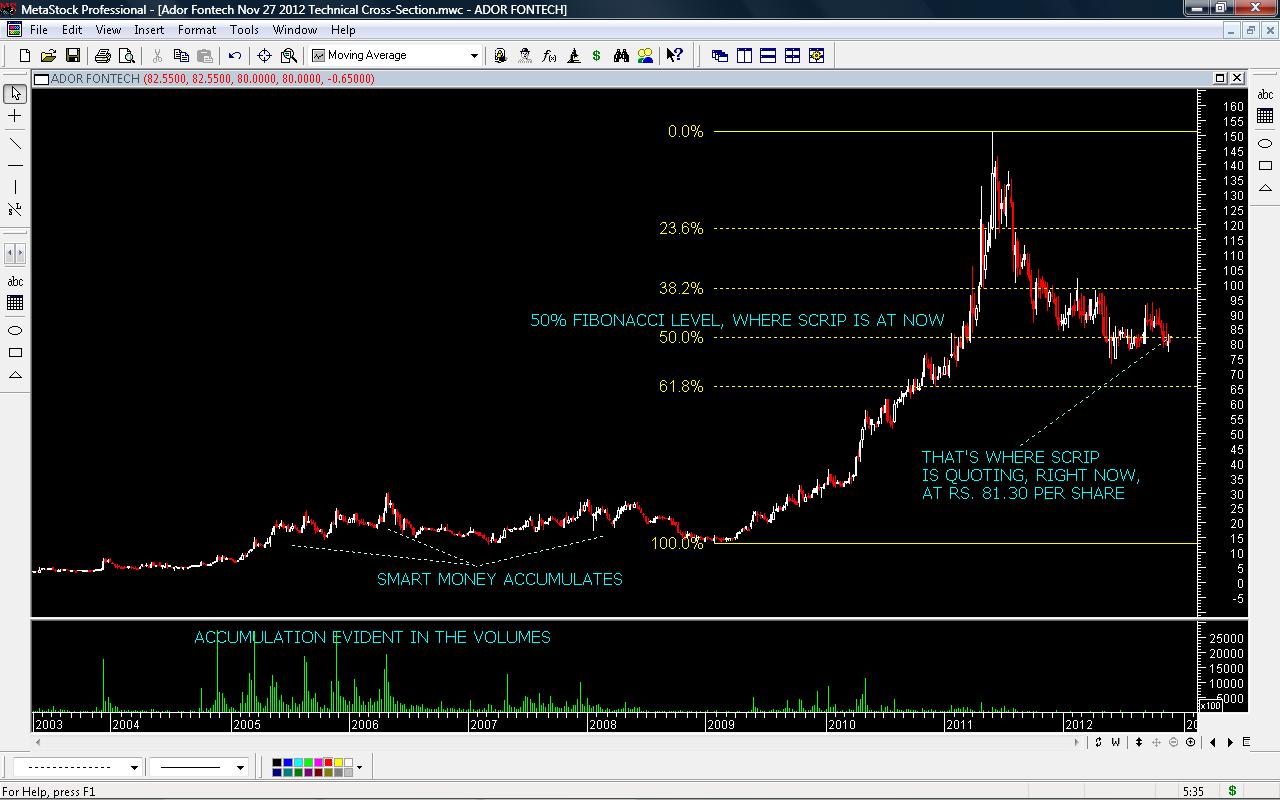
Due Diligence Snapshot + Technical Cross-Section — Ador Fontech Limited — Nov 27 2012

Image

Price – Rs. 81.30 per share

Earnings Per Share projected on the basis of quarter ended Sep 30 2012 – Rs. 12.62

Price to Earnings Ratio (thus, also projected) – 6.44

Price to Book Value Ratio – the stock is selling at approximately 2 x book value currently

Debt : Equity Ratio – Nil

Current Ratio – 2.73

Profit After Tax Margin – 12.51%

Return on Networth – 32.54 %

Pledged Shares %age – Nil

Face Value – Rs. 2.00

Dividend Payout – 50% -150% of face-value.

Average Daily Volumes – around 5 – 6 k / day on BSE.

Product – Reclamation of alloys, fusion surfacing (preventive welding), spraying and environmental solutions.

Promoters – JB Advani & Company Pvt Ltd (of Advani-Oerlikon fame) + a group of other Sindhi business-people.

Share-holding Pattern – Promoters (35.4%), Public (58.9%), Institutions (2.0%), NICBs (3.7%).

Technicals (see chart below) – This is a very low volume scrip, so there could be slippage. The scrip has corrected from its June 2011 peak of Rs. 150.90 to a pivot of Rs. 73.25 within about one year. This low pivot lies bang in between the 50% and the 61.8% Fibonacci levels of correction on the weekly chart. Currently, the scrip is quoting at Rs. 81.30, just below the Fib. 50% level. Volumes are average, with one high volume peak every 7 odd trading days. The scrip is trading in a broad band between Rs. 73.25 and Rs. 93.90. Perhaps it is trying to establish a base.

Comments – Fundamentals are good, and the company’s corporate governance is considered clean. Market for the company’s niche is considered small, and people view that as a long-term growth concern. Technically, correction has taken place, and thus value shines out fundamentally. Debt is nil. Dividend is excellent. Projected PE is low, though P/BV is a bit high. Cushion is there, and profitability and returns are exemplary. Future investment would be required to keep niche-segment status alive.

Buy? – I like the theme – reclamation and preventive welding. Contrary to what others say, I feel the market is going to grow phenomenally, as earth and rare-earth metals become difficult to source, and need to be reclaimed. Valuations are excellent, governance is great, payouts are great too, and a technical buying level has presented itself. Yes, it’s a long-term buy right now. Remember, this is not a trade we are speaking about, so we are not going to talk in terms of a stop-loss. This is a long-term investment, and we’ve been speaking in terms of margin of safety, which I’m sure you’ve noticed. Also, while buying, one needs to show caution regarding slippage, which is invariably going to occur owing to the low-volume nature of the scrip.

Disclaimer and Disclosure – Opinions given here are mine only. You are free to build your own view on the stock. I have bought a miniscule stake in Ador Fontech today. Data given here has been compiled from motilaloswal.com, moneycontrol.com and equitymaster.com. Technicals have been gauged and shown using Metastock Professional version 9.1 by Equis International.

Due Diligence Snapshot – Mindtree Limited – Nov. 24 2012

Price – Rs. 665.25 per share

Earnings Per Share (projected on the basis of quarter ended Sep 30 ’12) – Rs. 70.61

Price to Earnings Ratio (thus, also projected) – 9.42

Price to Book Value – 2.82 (it’s ok for small to mid-sized IT companies to have a high price to book ratio, because book value doesn’t reflect human capital, and small to mid-sized IT companies are more about human capital than about real-estate, hardware etc. Thus, since the real book value is not going to be available, the given price to book ratio could be treated as an artefact, unless it is unreasonably high, which is not the case here).

Debt : Equity Ratio – 0.03

Current Ratio – 2.10

Profit After Tax Margin – 12.11%

Return on Networth – > 25 %

Pledged Shares %age – Nil

Face Value – Rs. 10.00

Dividend Payout – 25% – 30% of face-value.

Average Daily Volumes – around 1 Lakh per day on NSE.

Product – Product Engineering Services, IT Services, worked on Bluetooth technology, also worked on UID (Aadhaar) project.

Promoters – Mr. Bagchi (set up Six-Sigma services at Wipro) and Mr. Soota (has now retired from Mindtree, ex-Wipro, amongst others, responsible for Wipro’s phenomenal growth). Mr. Natarajan is co-founder and current CEO, and is also ex-Wipro.

Share-holding Pattern – Foreign Promoters (3.5%), Indian Promoters (15.9%), Institutions (33.0%), Non-Institutional Corporate Bodies (30.2%), Public (15.7%).

Technicals – IPO days in March 2007 were big, with the scrip peaking at Rs. 1023.30 very early into its launch. By March ’09, though, Mindtree had bottomed out at Rs. 187.05. It then made a high pivot of Rs. 747.00 in Jan ’10, fell to Rs. 321.00 by August 2011, and is currently on the rise, forming a cup and handle pattern on the weekly chart, with the handle having broken out in Sep ’12 to 770.00 on average volume. This was a false breakout, and the scrip came down, to then move in a band between Rs. 633.80 and Rs. 699.90. Currently, Mindtree is quoting at Rs. 665.25, and Friday (Nov. 23rd, 2012) saw it rise by approximately 1 % on volume that was three times its 50-day moving average and many more times its 10-day moving average.

Comments – I like all the fundamentals. Couldn’t find any scams or frauds related to the company, looked only online though. Debt-equity ratio almost nil, great! Ex-Wipro people are the promoters. CEO is ex-Wipro. Friday’s higher volume has gotten me on alert. If all-round conditions in the markets remain stable, the scrip could break-out to beyond Rs. 770 soon. Glassdoor has “OK’d” work culture at Mindtree, with the same rating that Infosys has received. Salaries are considered on the lower side, though, at Mindtree. Also, some employees feel that company is stagnating. Reasons why Mr. Ashok Soota left the company are unclear to me. On the other hand, corporate governance still seems to be decent at Mindtree.

Buy? – Hmmmm, I like almost everything, except the salary and the stagnation bit. Mr. Soota’s presence would have been a bonus. I can take a “stagnating” company that generates good numbers. The ratios are all good, and profitability is decent. There’s almost no debt on the balance-sheet. No shares have been pledged. Dividend is decent. Excellent return on networth. Company does R&D too. Question is, will the scrip correct another 30 to 40 bucks to the lower end of it’s current band, so that one can pick it up 5 odd % cheaper? Anybody’s guess. One could actually go and pick it up now. Earnings are good, and so is the projected PE, well below the industry average, actually.

Disclaimer and Disclosure – Opinions given here are mine only. You are free to build your own view on the stock. Currently, I don’t hold a position in Mindtree Limited, but am considering long-term entry on the basis of what I have found and liked. Data given here has been compiled from motilaloswal.com, moneycontrol.com and equitymaster.com, and technicals have been gauged using Advanced GET 9.1 EoD Dashboard Edition.

“Don’t Turn Around – Der Kommissar’s in Town”

There’s activity within our slow-poke government.

Yup, we just got a new finance minister. PC’s back. Or, as the newspaper said, PC reboots.

He’s probably reinforcing backdated taxation.

He’s hinted at interest-rate cuts.

He’s after more service-tax candidates.

He’s transferred lots of portfolios.

He’s trying to dish out motivational quotes, so that the economy revives.

“Alles klar, Herr Kommissar?”

The last time PC was in town, there was volatlity in the markets. First they went up and up and up, and then they went down and down and down. Mr. Chidambaram is a by-word for volatility.

How does he do it?

Frankly, I don’t care.

If I’m getting volatility, I’m taking it.

Not that India as a market lacks any volatility without PC.

We Indians are emotionally volatile people. When we are happy, we are sooooooo happy. When we are down and out, man, we are totally gone. No surprise that our markets reflect our topsy-turvy and dramatic emotional nature. Yes, the trader in India is blessed with a volatile trading scenario by default.

So, PC or no PC, volatile trades make themselves available to us in the Indian markets regularly. What PC does is, he gives the system’s volatility a turbo-boost. Our market’s “beta” goes up wth PC, and it goes up fast, quite fast.

Man, how does he do it?

You know, I still don’t care, but if I did, I think this would be the correct answer.

Der Kommissar seems to do it in two steps. First he creates carrots, lots of carrots. These are dangled before India Inc. Things start hotting up. Foreign investment wakes up – demand – buying pressure – our markets go up. Then, when the balloon is inflated, der Kommissar will appear on television and will let out comments (implementation of stick, like the backdated taxation thing) which the market takes exception to. Or, he might give some interview in the media which India Inc. interprets negatively. Well, down we come crashing. Frankly, I still couldn’t care less. Upwards or down, there’s a trade to be found.

Just a few days in his seat, and pivot points are leading to bounce-backs, supports are holding, resistances cracking (it’s the carrots), and technicals are very, very initially changing from “range-bound” to “trending”.

Fine, let’s just trade the Kommissar while he’s in town.

I’ve quoted Falco above and I’m quoting him again : “Alles klar, Herr Kommissar!”