The Path

You’re just two steps away…

… from success in finance.

Don’t follow anyone.

Use your common-sense.

That’s all it takes.

Use your nose to sniff out trouble.

Use your eyes to identify Ponzi billboards, with promises of 12%+ returns. Use your hands to push away the Ponzis, or your feet to kick them out of your office.

Shut your ears to the external world. No tips, no rumours. Use your ears to hear the sound of your own intuition. Yes, use them to hear your inner voice. Correct, this is about you. You and only you bear full responsibility for your finances and well-being.

As and when you identify the taste of success, you might realize the following.

Success doesn’t taste sweet without appropriate struggle. To really know, feel and retain something, the human being must know and feel the opposite pole first.

What matters in the end?

Meaning, after you’ve gotten your success, and are sitting on top of things?

Yeah, what matters then?

Any ideas?

The path you took. That’s what matters.

Your path has shaped your soul.

Success is a mere statistic.

The real game was played on the path.

Did you enjoy the path?

Did you enjoy it despite the struggle?

Did it challenge you?

Did you learn something?

Did you grow?

Did you stop to smell the flowers while on the path?

Did you help others who were struggling with their paths, even as you were coming to terms with your own path?

Did your path fulfill you?

Did it give you the feeling of “Yes, I’ve done something”?

Did it make you happy?

These are the factors that really matter.

They make your grade in the path called life.

Enjoy your path. It’s nature’s gift to you, whereas…

… success is a mere statistic.

Where to, Mr. Nath?

Last month, I scrapped my market-play system.

Happens.

Systems are made to be scrapped later.

One can always come up with a new system.

I love working on a new system.

It’s challenging.

What I want to talk to you about is why I scrapped my last system.

I found four accounting frauds, as I did my market research, all online.

You see, my last system worked well with honest accounting.

It had no answer to accounting frauds.

Also, I got disillusioned.

Are we a nation of frauds?

How does one deal with a nation of frauds?

More importantly, how does one play such a nation?

Does one invest in it? Or, does one sheer trade it?

Questions, questions and more questions. These encircle my mind as I work to put my new system together.

I am in no hurry to come up with an answer. A country like India deserves a befitting answer, and that it will get, even if the sky comes down on me while I put my system together.

Slowly, I started to think. How many systems had I scrapped before?

Hmmm, four or five, give or take one or two.

I have an uncompromising market rule of going fully liquid when I scrap a system.

Full liquidity is a tension-tree state. It allows one to think freely and in an unbiased manner. Being invested during volatility impedes one’s ability to think clearly and put a new system together.

Ok, so what answer would my new system have towards fraud?

All along, it was very clear to me that future market activity would be in India itself. Where else does one get such volatility? I am learning to embrace volatility. It is the trader’s best friend.

Right, so, what’s the answer to fraud?

Trading oriented market play – good. Not much investing, really. First thoughts that come to mind.

Buying above supports. Selling below resistances. Only buying above highs in rare cases, and trailing such buys with strict stops. Similarly , only selling below lows in even rarer cases, and again, trailing such sells with strict stops.

Trading light at all times.

Fully deploying the bulk of one’s corpus into secure market avenues like bonds and arbitrage. You see, bonds in India are not toxic. Well, not yet, and with hawks like the RBI and SEBI watching over us, it might take a while before they turn toxic. If and when they do start turning toxic, we’ll be getting out of them, there’s no doubt about that. Till they’re clean, we want their excellent returns, especially as interest rates head downwards. In India, one can get out of bond mutual funds within 24 hrs, with a penalty of a maximum of 1 % of the amount invested. Bearable. The top bond funds have yielded about 13 – 15% over the last 12 months. So, that 1% penalty is fully digestible, believe me.

With the bulk of one’s returns coming from secure avenues, small amounts can be traded. Trade entries are to be made when the odds are really in one’s favour. When risk is high, entry is to be refrained from. A pure and simple answer to fraud? Yes!

You see, after a certain drop, the price has discounted all fraud and then some. That’s one’s entry price for the long side. On the short side, after a phenomenal rise, there comes a price which no amount of goodness in a company can justify and then some. That’s the price we short the company at.

Of course it’s all easier said than done, but at least one thing’s sorted. My outlook has changed. Earlier, I used to fearlessly buy above highs and short below lows. I am going to be more cautious about that now. With fraud in the equation, I want the odds in my favour at all times.

These are the thoughts going on in my mind just now. Talking about them helps them get organized.

You don’t have to listen to my stuff.

I’m quite happy talking to the wall.

Once these words leave me, there’s more space in my system – a kind of a vacuum.

A vacuum attracts flow from elsewhere.

What kind of a flow will my vacuum attract?

Answers will flow in from the ether.

Answers to my burning questions.

Can Anyone Match Our Financial Sentinels?

It was the aftermath of ’08.

There was blood everywhere.

In my desperation to get a grip on things, I was about to make yet another blunder.

The Zurich International Life pitch had found its way into my office through a leading private bank.

The pitch was fantastic.

I got sucked in.

Access to more than 150 mutual funds world wide…

No switching fee…

Switch as many times as you want…

Joining bonus…

Premium holiday after 18 months…

I quickly signed the documents.

What remained cloudy during the pitch was the 10-year lock-in.

Also, nobody mentioned that the exit penalty was exorbitant. I mean, as I later found out, the level of the exit penalty would make Shylock look like JP Morgan.

In the pitch, I found myself hearing that one could exit after 18 months upon payment of 9% interest p.a. on the joining bonus.

Nobody mentioned the full management fees, which I later calculated to be a staggering approximate of 7.75% per annum for myself, since I had opted for a premium holiday as soon as I could.

I mean, when about 7.75% was being deducted from your corpus each year, what in the world was the corpus going to generate? I found myself asking this question after four years of being trapped in the scheme.

I had soon realized that the pitchers had lied in the pitch. In the fine-print, there was no such clause saying that one could exit after 18 months upon payment of 9% interest p.a. on the joining bonus. If I escalated the matter, at least three people would lose their jobs. Naehhh, that was not my style. I let it go.

When I would look at interim statements, the level of deductions each time made me suspect that there were switching fees after all. I could never really attribute the deductions to actual switches, though, because the statements would straight-away show the number of mutual fund units deducted as overall management fees. If there were switching fees, they were getting hidden under the rug of management fees. Since the level of overall fees was disturbing me totally, I had this big and nagging suspicion that they were deducting something substantial for the switches, and were not showing this deduction openly in their statements.

When I compared all this to how Unit-Linked Insurance Plans (ULIPs) were handled in my own country, I was amazed at the difference.

In India, customer was king.

The customer had full access to the investment platform, and could switch at will from his or her own remote computer. Zurich did not allow me such direct access.

The expense-ratio in India was a paltry 1.5% – 2.0% per annum. Compare this to the huge annual deductions made in the case of my Zurich International Life policy.

Lock-ins in India were much lesser, typically three odd years or so.

Some ULIPs in India allowed redemptions during lock-ins, coupled with penalties, while others didn’t. Penalties were bearable, and typically in the 2 – 5 % (of corpus) range. Those ULIPs that did allow such redemptions only did so towards the latter part  of the lock-in, though. Nevertheless, lock-in periods were not long when compared to ten whole years, during which the whole world can change.

The debt-market funds paid out substantially larger percentages as interest in India when compared to the debt-market funds encompassed by Zurich International Life.

In India, deductions from ULIP premiums in the first few years (which were getting lesser and lesser each year due to legislature-revision by the authorities) were off-set by absence of short-term capital gains tax and entry/exit equity commissions upon excessive switching. This meant, that in India, short-term traders could use the ULIP avenue to trade without paying taxes or commissions. Whoahh, what a loop-hole! [I’m sure the authorities would have covered this loop-hole up by now, because this research was done a few years ago.]

ULIPs in India allowed at least 4 switches per annum that were totally free of cost. After that, switches would be charged at a very nominal flat rate of typically about the value of 2-9 USD per switch, which, frankly, is peanuts. I was suspecting that the Zurich fellows were knocking off upto 1% of the corpus per switch, but as I said, I didn’t see the math on paper. Even if I was wrong, their yearly deductions were too large to be ignored. Also, was I making a mistake in furthermore deducing that Zurich was deducting another 1% from the corpus each time the corpus changed its currency? I mean, there was no doubt in my mind that the Indian ULIP industry was winning hands-down as far as transparency was concerned.

In India, people in ULIP company-offices were accessible. You got a hearing. Yeah. Zurich International Life, on the other hand, was registered in the Isle of Man. Alone the time difference put an extra day (effectively) between your query and action. Anyways, all action enjoyed a T+2 or a T+3 at Zurich’s end, and the extra day made it a T+4 if you were unlucky (Indian ULIPs moved @ T+0, fyi & btw). Apart from the T+x, one could only access officials at Zurich through the concerned private bank, and as luck would have it, ownership at this private bank changed. The new owners were not really interested in pursuing dead third-party investments made by their predecessors, and thus, reaching Zurich could have become a huge problem for me, were it not for my new relationship manager at this private bank, who was humanitarian, friendly and a much needed blessing.

By now, I had decided to take a hit and exit. It would, however, be another story to get officials at Zurich to cooperate and see the redemption through. On her own level, and through her personal efforts, my diligent relationship manager helped me redeem my funds from Zurich International Life.  I am really thankful to her. Due to her help, my request for redemption was not allowed to be ignored / put-off till a day would dawn where really bad exit NAVs would apply. Zurich did have the last laugh, knocking off a whopping 30 odd percent off my corpus as exit penalty (Arghhh / Grrrrr)! Since I had managed to stay afloat at break-even despite all deductions made in the four years I was invested, I came out of the investment 30% in the hole. The moment it returned, the remaining 70% was quickly shifted to safe instruments yielding 10%+ per annum. In a few years, my corpus would recover. In less than 4 years, I would recover everything. In another two, I would make up a bit for inflation. Actually, the main thing I was gaining was 6 remaining years of no further tension because of my Zurich International Life policy. This would allow me to approach the rest of my portfolio tension-free.

The Zurich International Life policy had been the only thorn in my portfolio – it was my only investment that was disturbing me.

I had taken a hit, but I had extracted and destroyed the thorn.

It was a win for the rest of my portolio, i.e. for 90%+ of my total funds. Tension-free and full attention heightens the probability of portfolio prosperity.

Yeah, sometimes a win comes disguised as a loss.

When I look back, I admire the Indian financial authorities, who ensure that the Indian retail customer is treated like a king.

Retail customers in other parts of the world receive very ordinary treatment in comparison.

I know this from first-hand experience.

I don’t plan to invest overseas as long as our financial authorities continue to push such discipline into our financial industry.

I don’t often praise too much in India, but where it is due, praise must emanate from the mouth of a beneficiary. We are where we are because of our fantastic financial sentinels!

Three cheers for the Securities and Exchange Board of India, for the Insurance Regulatory and Development Authority, and, of course, three cheers and a big hurray for the Reserve Bank of India.

A Chronology of Exuberance

The biggest learning that the marketplace imparts is about human emotions.

Yeah, Mrs. Market brings you face to face with fear, greed, exuberance, courage, strength, arrogance … you name it.

You can actually see an emotion developing, real-time.

Today, I’d like to talk about the chronology of exuberance.

In the marketplace, I’ve come face to face with exuberance, and I’ve seen it developing from scratch.

When markets go up, eventually, fear turns into exuberance, which, in turn, drives the markets even higher.

What is the root of this emotion?

The ball game of exuberance starts to roll when analysts come out with a straight face and recommend stocks where the valuations have already crossed conservative long-term entry levels. As far as the analysts are concerned, they are just doing their job. They are paid to recommend stocks, round the year. When overall valuations are high, they still have to churn out stock recommendations. Thus, analysts start recommending stocks that are over-valued.

Now comes the warp.

At some stage, the non-discerning public starts to treat these recommendations as unfailing cash-generating  opportunities. Greed makes the public forget about safety. People want a piece of the pie. With such thoughts, the public jumps into the market, driving it higher.

For a while, things go good. People make money. Anil, who hadn’t even heard of stocks before, is suddenly raking in a quick 50Gs on a stock recommendation made by his tobacco-seller. Veena raked in a cool 1L by buying the hottest stock being discussed in her kitty party. Things are rolling. Nothing can go wrong, just yet.

Thousands of Anils and Veenas make another 5 to 6 rocking buys and sells each. With every subsequent buy, their capacity increases more and more. Finally, they make a big and exuberant leap of faith.

There is almost always a catalyst in the markets at such a time, when thousands make a big and exuberant leap of faith into the markets, like a really hot IPO or something (remember the Reliance Power IPO?).

Yeah, people go in big. The general consensus at such a time is that equity is an evergreen cash-cow. A long bull run can do this to one’s thinking. One’s thinking can become warped, and one ceases to see one’s limits. One starts to feel that the party will always go on.

Now comes the balloon-deflating pin-prick in the form of some bad news. It can be a scandal, or a series of bad results, or some political swing, or what have you. A deflating market can collapse very fast, so fast, that 99%+ players don’t have time to react. These players then rely on (hopeful) exuberance, which reassures them that nothing can go wrong, and that things will soon be back to normal, and that their earnings spree has just taken a breather. Everything deserves a breather, they argue, and stay invested, instead of cutting their currently small losses, which are soon going to become big losses, very, very big losses.

The markets don’t come back, for a long, long time.

Slowly, exuberance starts dying, and is replaced by fear.

Fear is at its height at the bottom of the markets, where maximum number of participants cash out, taking very large hits.

Exuberance is now officially dead, for a very long time, till, one day, there’s a brand new set of market participants who’ve never seen the whole cycle before, supported by existing participants who’ve not learnt their lessons from a past market-cycle. With this calibre of participation, markets become ripe for the re-entry of exuberance.

Wiser participants, however, are alert, and are able to recognize old wine packaged in a new bottle. They start reacting as per their designated strategies for exactly this kind of scenario. The best strategy is to trade the markets up, as far as they go. Then, you can always trade them down. Who’s stopping you? Shorting them without any signals of weakness is wrong, though. Just an opinion; you decide what’s wrong or right for you. The thing with exuberance is, that it can exercise itself for a while, a very long while – longer than you can stay solvent, if you have decided to short the markets in a big way without seeing signs of weakness.

At market peaks, i.e at over-exuberant levels, long-term portfolios can be reviewed, and junk can be discarded. What is junk? That, which at prevailing market price is totally, totally overvalued – that is junk.

Formulate your own strategy to deal with exuberance.

First learn to recognize it.

Then learn to deal with it.

For success as a trader, and also as an investor, you will not be able to circumvent dealing with exuberance.

Best of luck!

Three Ways to Double Down

To win big as a trader, one needs to understand and implement a strategy of doubling down when things are looking good.

The difference between mediocre success and mega-success as a trader is linked to a trader’s ability to double down at the proper time.

We’ve discussed position-sizing. That’s one way to double down.

A day-trader, or a very short-term trader has the luxury of seeing one trade culminate and the next trade start off after the first one culminates at its logical conclusion. For most longer-term traders, many trades can be occurring simultaneously, because started trades have not yet come to their logical end, and new opportunities have cropped up before trades commenced have come to their logical end.

What do such traders do? I mean, they do not know the final outcome of the preceeding trades.

Yeah, how could such traders position-size properly?

Well, a trade might not have come to its logical conclusion, but you do know how much profit or loss you are sitting on at any given point of time. The calculation of the traded value for the next trade is simply a function of this profit or loss you are sitting on. Simple, right?

Well, what if you don’t like to position-size in that manner?

What if you say, that here I am, and I’ve finally identified a scrip that is moving, and that I’m invested in it, and am sitting on a profit. Now that I know that this scrip is moving, I’d like to invest more in this very scrip.

Good thinking. Nothing wrong at all with the thinking process.

You now pinpoint a technical level for second entry into the scrip. Once your level is there, you go in. No heavy or deep thinking required. As a trader, you are now accustomed to plunging after trade identification and upon setup arrival.

Question is, how much do you go in with?

Is your second entry a position-sized new trade? Or, do you see how much profit you are sitting on, and enter with the exact amount of profit you are sitting on? The latter approach is called pyramiding, by the way. Pyramiding is a close cousin of position-sizing. Normally, one speaks about pyramiding into one very scrip, when the trader buys more of that very scrip after showing a profit in that scrip. Once could, however, also pyramid one’s profits into different scrips.

When you’re pyramiding into one very scrip, you’re putting many eggs in one basket. Right, the risk of loss is higher. The thing going for you is that this risk for loss is higher at a time when your profits are up in a scrip that’s on its way up. Therefore, the risk during a downslide is higher, but the probability of that risk’s ability to result in an overall loss for you is lower than normal. You understand that you have balanced your risk equation, and with that understanding, you don’t have a problem putting many eggs in the same basket. After all, it’s a basket you are watching closely. Yeah, you know your basket inside out. You are mentally and strategically prepared to take that higher risk.

There’s yet another way to double down. I’d like to call this the “stubborn-bull trading approach”.

Let’s say you are sitting on a profitable trade. Yeah, let’s say you are deep in the money.

Now, a safe player would start raising the stop as the scrip in question keeps going higher and higher.

On the other hand, a trader with an appetite for risk could risk more and more in the scrip as it keeps going higher and higher – by not raising the stop, till a multibagger is captured. On the other hand, this trader would also be setting him- or herself up to give back hard-earned profits. Yeah, no risk – no gain.

What’s the difference between the stubborn-bull trading approach (SBTA) and investing?

When you’re adopting the SBTA, you’ll cut the trade once it loses more than your stop. You’ll sit on it stubbornly only after it has shown you multibagger-potential, let’s say by being up 20-50% in a very short time. You’ll keep sitting on it stubbornly till your pre-determined two-bagger, three-bagger or x-bagger target-level is reached. After that, you’ll start raising the stop aggressively, as the scrip goes still higher. Eventually, the market will throw you out of your big winning trade. You see, the SBTA strategy is very different from an investment strategy. For starters, your entry into this scrip has been at a trading level, not at an undervalued investment level. Undervalued scrips normally don’t start dancing about like that immediately.

Let’s be very clear – to reap big profits in the long run, you, as a trader, will need to adopt at least one of these doubling down strategies – position-sizing, pyramiding and / or the stubborn-bull trading approach.

Have a profitable trading day / week / month / career! 🙂

How Does One Position-Size?

What is the singular most lucrative aspect of trading?

Any ideas?

Want a hint?

Ok, here’s the hint. It is also the safest aspect of trading.

Give up?

Here’s the answer. It’s called position-sizing. (The pioneer of position-sizing is Dr. Van K. Tharp, @ www.iitm.com, and I have learnt this concept through him).

Surprised? I would be surprised if you weren’t surprised.

Yeah, trade selection is important too, but other things are more important while trading.

For example, trade management is more important than trade selection. So is exit. Entry might be paramount to an investor, but to the trader, entry is run of the mill. It happens day in, day out. The trader … just enters a selected trade. There’s no deep thinking involved. The trader knows this. Crux issues are to follow. The trader is saving his or her energies for the crux issues.

So far, we’ve spoken about the chronology of a trade, i.e. entry – management – exit.

Before entry, you decide how much you want to trade with, and how much you want to risk. That’s the size of your position, or your position-size. Remember, for the concept of position-sizing to make any sense, your stop-loss percentage must remain constant from trade to trade. Only your traded value goes up or down.

What does the level of your traded value depend upon?

It depends upon HOW WELL YOU ARE DOING.

If you’re on a roll, your traded value for the next trade goes up. The increment is proportional to the profits you are sitting on. Since the stop is a constant percentage, the amount risked is also higher. Return is proportional to the amount at risk, and the long-term net return of such a trade will also be higher. All this means, that the more you make, the more you set yourself up to make even more…!

Take a coin. Flip it millions of times. There will be a stretch, where you’ll flip tails 5 times in a row, or six times in a row, or maybe even ten times in a row. The 50:50 trade called “coin flip” can well result in a series of back to back losses. You are an experienced trader. Your trade selection ratio could be 60 winning trades to 40 losing trades, or perhaps a little better, let’s say 65:35. Even a trade selection ratio of 65:35 will result in back to back losses. As a trader, you need to take large drawdowns in your stride, as long as you are confident, that in the long run,  your system is working. What’s working in your favour during the large drawdown?

Your position-size is.

You see, as trade after trade goes against you, and your losses pile up, your position-size KEEPS GOING DOWN. Your stop percentage remains constant. This means, that the more you lose, the more you set yourself up to lose lesser and lesser, trade after trade. Yeah, position-sizing gives you the safety of losing less. Nevertheless, because of this safety assurance from your position-sizing strategy, you keep yourself in the market by just taking the next trade without too much deep thinking (and with no melancholy whatsoever), because your next trade could be the one decent trade that you are looking for. Yeah, your very next trade could cover all losses and then some. TAKE IT.

Now, two things can happen.

Firstly, if you keep losing, and hit your loss cut-off level for the month, well, then, you just stop trading for the rest of your month. You then spend the rest of the month reviewing your losses and your system. You tweak at whatever needs tweaking, and come back fresh and rested the following month. Position-sizing kept you in the market, ready to take the next opportunity to earn big. The auto-cut takes you out of the market for a while. That’s why, in my opinion, while position-size is still activated, it provides more safety, because it keeps you in the market to recover everything and then some, starting with your VERY NEXT trade. Having said that, auto-cut is auto-cut. It overrides position-sizing.

The second thing that can happen is that your losing streak ends before your month’s cut-off is reached. Yayyy, position-sizing is still activated! You’ve lost lesser and lesser on each losing trade as long as you were in the losing streak, and now that you are winning again, each win sets you up to win more in the trade that follows.

After many, many trades, just cast a glance at your trading corpus. It will boggle your mind!

Your position-sizing strategy has kept raising your corpus, because your system is 60:40+, and you win more than you lose. Ultimately, your corpus has become substantial. Its size exceeds your expectations BY FAR.

All thanks to position-sizing.

How To Nip A Ponzi In The Bud

Mirror Mirror on the wall…

Who’s most prone of them all?

As in, most prone to Ponzis…

Frankly, I think it is us gullible Indians.

Everyday, there’s some report of a Ponzi scheme being busted, with thousands already duped.

Charles Ponzi’s is a case of the tip of the iceberg – maximum recognition came posthumously. If Charlie would have received a cut every time his scheme was used by mankind, he would probably have become the richest man in the world. Unfortunately for him, he popped it before reaping the full rewards of his crookedness.

What Charlie did leave behind was a legacy. Yeah, Charlie did an Elvis, meaning that many have tried to emulate Charles Ponzi since he departed. Maybe I’ve gotten the chronology wrong, but you know what I mean…

Chances are, a Ponzi will eventually cross your path sooner or later. More sooner than later.

How do you recognize a Ponzi? Yeah, that’s the first step here – identification.

A Ponzi will talk big – he or she will flash. There will be a small track record to back up what is being said, and this will almost be blown into your face, after you’ve been dazzled by the Ponzi’s fancy car, expensive clothes and gold pen. The Ponzi will be a good orator, and his words will have a hypnotic effect on you (ward this off with full strength). The Ponzi will show off, making you feel awkward. You will feel like being “as successful” as what is being projected before you, right there, right then. When all these symptoms match, and such feelings well up inside of you, you are, with very high probability, talking to a Ponzi, who is trying to suck you in with a promise of stupendously high returns.

After you have identified the Ponzi, the next step is to not get sucked in. This is going to take all your self-control. Remember, the grass is not greener elsewhere. Take charge of your emotions. You’ve identified a Ponzi, man, that’s big. Now you need to follow through and see to it that a minimum number of people come to harm.

Hear the Ponzi out. Don’t react. In fact, don’t say a word. Don’t commit a penny. Keep reminding yourself, that you have it in you to succeed. You don’t need the Ponzi’s help to get good returns on your money. You certainly don’t want to lose all your money. With that thought in mind, block the Ponzi and his promises out. Leave politely and inconspicuously.

After you’ve left securely, without having committed a penny and without having left your details with the Ponzi, you now need to sound the alarm. Tell all your friends of the lurking danger. Forewarn them, so that no one you know gets sucked in. Ask everyone to spread the word. The whole town needs to know within no time.

Identify – Control – Alarm – this is a three step programme to nip the Ponzi In the bud – try it out, it works!

Cheers! 🙂

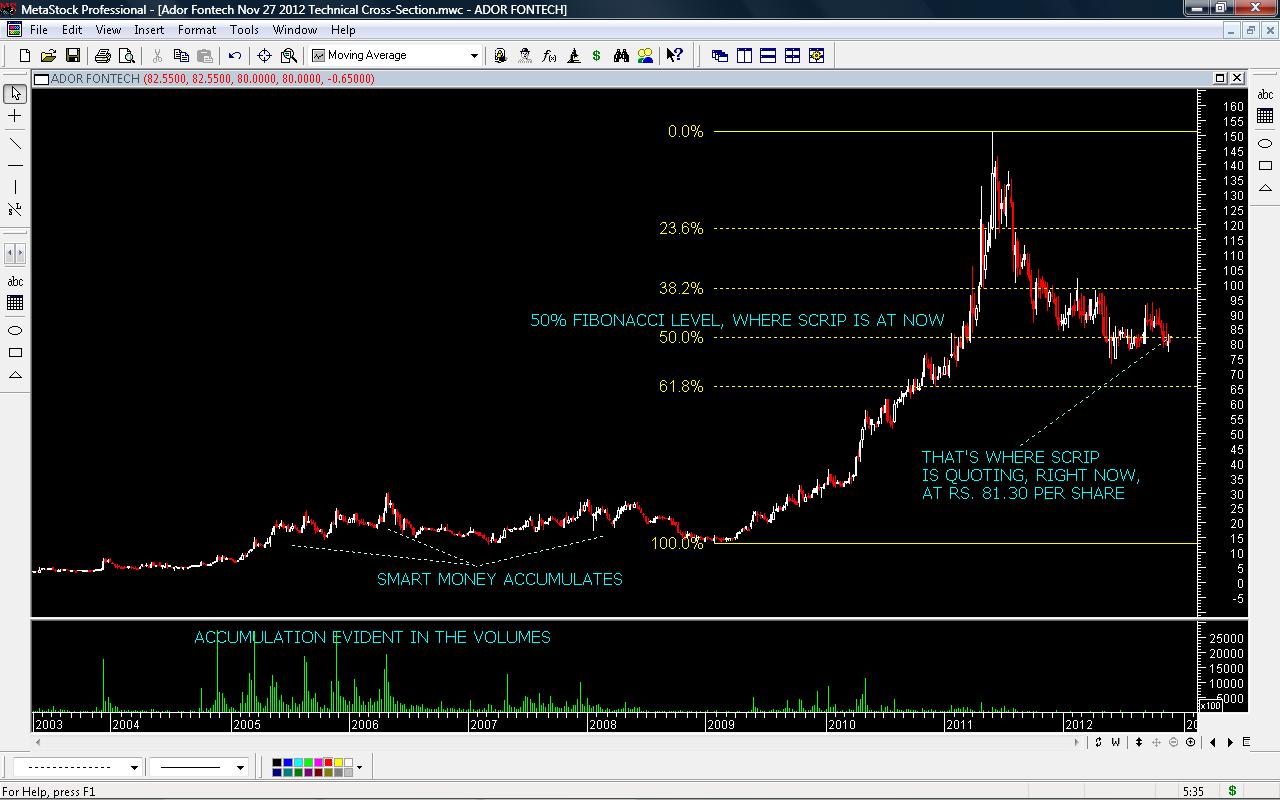
Due Diligence Snapshot + Technical Cross-Section — Ador Fontech Limited — Nov 27 2012

Image

Price – Rs. 81.30 per share

Earnings Per Share projected on the basis of quarter ended Sep 30 2012 – Rs. 12.62

Price to Earnings Ratio (thus, also projected) – 6.44

Price to Book Value Ratio – the stock is selling at approximately 2 x book value currently

Debt : Equity Ratio – Nil

Current Ratio – 2.73

Profit After Tax Margin – 12.51%

Return on Networth – 32.54 %

Pledged Shares %age – Nil

Face Value – Rs. 2.00

Dividend Payout – 50% -150% of face-value.

Average Daily Volumes – around 5 – 6 k / day on BSE.

Product – Reclamation of alloys, fusion surfacing (preventive welding), spraying and environmental solutions.

Promoters – JB Advani & Company Pvt Ltd (of Advani-Oerlikon fame) + a group of other Sindhi business-people.

Share-holding Pattern – Promoters (35.4%), Public (58.9%), Institutions (2.0%), NICBs (3.7%).

Technicals (see chart below) – This is a very low volume scrip, so there could be slippage. The scrip has corrected from its June 2011 peak of Rs. 150.90 to a pivot of Rs. 73.25 within about one year. This low pivot lies bang in between the 50% and the 61.8% Fibonacci levels of correction on the weekly chart. Currently, the scrip is quoting at Rs. 81.30, just below the Fib. 50% level. Volumes are average, with one high volume peak every 7 odd trading days. The scrip is trading in a broad band between Rs. 73.25 and Rs. 93.90. Perhaps it is trying to establish a base.

Comments – Fundamentals are good, and the company’s corporate governance is considered clean. Market for the company’s niche is considered small, and people view that as a long-term growth concern. Technically, correction has taken place, and thus value shines out fundamentally. Debt is nil. Dividend is excellent. Projected PE is low, though P/BV is a bit high. Cushion is there, and profitability and returns are exemplary. Future investment would be required to keep niche-segment status alive.

Buy? – I like the theme – reclamation and preventive welding. Contrary to what others say, I feel the market is going to grow phenomenally, as earth and rare-earth metals become difficult to source, and need to be reclaimed. Valuations are excellent, governance is great, payouts are great too, and a technical buying level has presented itself. Yes, it’s a long-term buy right now. Remember, this is not a trade we are speaking about, so we are not going to talk in terms of a stop-loss. This is a long-term investment, and we’ve been speaking in terms of margin of safety, which I’m sure you’ve noticed. Also, while buying, one needs to show caution regarding slippage, which is invariably going to occur owing to the low-volume nature of the scrip.

Disclaimer and Disclosure – Opinions given here are mine only. You are free to build your own view on the stock. I have bought a miniscule stake in Ador Fontech today. Data given here has been compiled from motilaloswal.com, moneycontrol.com and equitymaster.com. Technicals have been gauged and shown using Metastock Professional version 9.1 by Equis International.

A Tool By The Name of “Barrier”

Come into some money?

Just don’t say you’re going to spend it all.

Have the decency to at least save something.

And all of a sudden, our focus turns to the portion you’ve managed to save.

If you don’t fetch out your rule-book now, you’ll probably bungle up with whatever’s left too.

Have some discipline in life, pal.

The first thing you want to do is to set a barrier.

Barrier? Huh? What kind of barrier?

And why?

The barrier will cut off immediate and direct access to your saved funds. You’ll get time to think, when hit by the whim and fancy to spend your funds.

For example, a barrier can be constructed by simply putting your funds in a money-market scheme. With that, you’ll have put 18 hours between you and access, because even the best of money market schemes take at least 18 hours to transfer your funds back into your bank account.

Why am I so against spending, you ask?

Well, I’m not.

Here, we are focusing on the portion that you’ve managed to save.

Without savings, there’s nothing. There can be no talk about an investment corpus, if there are no savings. Something cannot grow out of nothing. For your money to grow, a base corpus needs to exist first.

Then, your basic corpus needs a growth strategy.

If you’ve chalked out your strategy already, great, go ahead and implement it.

You might find, that the implemetation opportunities you thought about are not there yet.

Appropriately, your corpus will wait for these opportunities in a safe money market fund. Here, it is totally fine to accept a low return as long as you are liquid when the opportunity comes. There is no point blocking your money in lieu of a slightly higher return, only to be illiquid when your investment opportunity comes along. Thus, you’ve used your barrier to park your funds. Well done!

Primarily, this barrier analogy is for these who don’t have a strategy. These individuals leave themselves open to be swept away into spending all their money. That’s why such individuals need a barrier.

An online 7-day lock-in fixed deposit can be a barrier.

A stingy spouse can be a barrier.

Use your imagination, people, and you’ll come up with a (safe) barrier. All the best! 🙂

Isn’t This Other Party Getting Too Loud?

We in India have decided to go for gold after the Olympics.

I mean, there’s a whole parallel party going on in gold.

What’s with gold?

Can it tackle inflation?

No.

Is there any human capital behind it?

No.

Meaning, gold has no brains of its own, right?

Correct.

Is there a storage risk associated with gold?

Yes.

Storage volume?

Yes.

Transport inconvenience?

Yes.

Price at an all time high?

Yes, at least for us in India. We’d be fools to consult the USD vs time chart for gold. For us, the INR vs time chart is the more valid one for gold, because we pay for gold in INR.

Getting unaffordable?

Yes.

No parameter to judge its price by, like a price to earning ratio for example?

No.

Then how am I comfortable with gold, you ask?

Right, I’m not.

Can I elaborate, is that what you are requesting?

Sure, it’s exorbitance knocks out its value as a hedge. A hedge is supposed to balance and stabilize a portfolio. Gold’s current level is in a trading zone. It is not functioning as an investor’s hedge anymore.

Why?

Because from a huge height, things can fall big. Law of gravity. And gold’s fallen big before. It doesn’t need to begin it’s fall immediately, just because it is too high. That alone is not a valid reason for a big fall, but the moment you couple the height with factors like improvement in world economics, turnaround in equities (if these factors occur) etc., then the height becomes a reason for a big fall. Something that can fall very big knocks out stability and peace of mind from an investor’s portfolio. The investor needs to bring these conditions back into the portfolio by redefining and redesigning the portfolio’s dynamics.

How?

By selling the gold, for example, amongst other things.

What’s a good time to sell?

Well, Diwali’s a trigger.

Right.

Then, there are round numbers, like 35k.

What about 40k?

Are you not getting greedy?

Yeah – but what about 40k?

Nothing about 40k. Let 35k come first. I like it. It’s round. It’s got a mid-section, as in the 5. It’s a trigger, the more valid one, as of now.

Fine, anything else?

Keep looking at interest rates and equities. Any fall in the former coupled with a turnaround in the latter spells the start of a down-cycle in gold.

Is that it?

That’s a lot, don’t you think?

I was wondering if you were missing anything?

No, I just want to forget about gold max by Diwali, and focus on equities.

Why’s that?

There are much bigger gains to be had in equities. History has shown us that time and again. Plus, there is human capital behind equities. Human capital helps fight inflation. What more do you want? Meanwhile, gold is going to go back to its mean, as soon as a sense of security returns, whenever it does.

And what is gold’s mean?

A 1 % return per annum, adjusted for inflation, as seen over the last 100 years.

That’s it?

Yeah.

And what about equities?

If you take all equities, incuding companies that don’t exist anymore, this category has returned 6% per annum over the last 100 years, adjusted for inflation.

And what if one leaves out loser companies, including those that don’t exist anymore.

Then, equity has returned anything between 12 -15% per annum over the last 100 years, adjusted for inflation.

Wow!

Yeah, isn’t it?

Getting Too Comfy For Our Boots, Are We?

What a party we are having in the debt-market, aren’t we?

Exceptional payouts, day after day, week after week, month after month, it’s almost going to be year after year.

Are you getting too comfortable? Lazy, perhaps?

Meaning to say, that when you can get a 10 % return after tax without having to move your behind for it, it is a very welcome scenario, right?

People, scenarios change.

It isn’t always going to be like it is at the moment.

Are you flexible enough to change with the scenario?

Or will you be lost in the current moment, so lost, that you will not recognize the signs of change?

What would be these signs? (Man, this is like spoon-feeding….grrrrrr&#*!).

Inflation begins to fall.

The country’s central bank announces back to back interest rate cuts.

Too lazy to read the paper? Or watch the news? Ok, if nothing else, your online liquid mutual fund statement should tip you off.

How?

The payout, dammit, it will have decreased.

Also, something else starts performing.

What?

Equity.

Smart investors don’t like the debt payout anymore. They start moving their smart money into value equity picks.

Slowly, media stops reporting about a gloomy economy. The buzz gets around. Reforms are on the way.

Foreign direct investment picks up. The media latches on to it. It starts speaking about inflows as if the world begins and ends with inflows.

Now, the cauldron is hot and is getting hotter.

Debt payouts are getting lesser and lesser. Equity is already trending upwards, and has entered the meat of the move.

If the trend contnues, a medium to long-term bull market can result.

There you have it, the chronology played out till just before the start of a bull market of sorts.

Be alert. Recognize the signs early. Be mentally in a position to move out of the debt market, if the prevailing scenario changes.

Otherwise…

… you miss a first run in equity. Boo-hoo. When stocks cool at a peak, and start falling, you make multiple wrong entries into them.

You get hammered by equity, having caught it on the down-swing.

You missed the correct entry time-point in equity because the debt-market made you too comfortable. You were late to act. When you acted, finally, you caught a correction, and took a hammering.

One or two more hammerings like that, and you’ll be off equity for the rest of your life.

And that, my dear friend, would be a pity.

Why?

Because, in mankind’s history, it is stocks that have given the best long-term returns. Not gold, not debt, not bonds, but stocks.

You need to approach them properly, and timing is key.

The Cat that Survives Curiosity

So, what are the Joneses upto?

Or the Smiths?

Naths?

You know something, who cares?

You’re trading, right?

Fine, then just mind your own business, and focus on your return.

I mean, people, let’s just go beyond poking our noses into others’ businesses.

Don’t we have our own businesses to take care of?

Isn’t that enough for us?

If not, and if we start poking around, seeing what kind of return XYZ has made, or for that matter how many winning trades ABC has pulled off, well, we are doing ourselves a great disservice.

For starters, we don’t seem to have much confidence in our own trading system, if we’re poking around like that.

You should be pulling off the winning trades, you.

And XYZ’s or ABC’s performances should have no meaning for you.

They are trading according to their system. Let them be. What’s good for them is not necessarily good for you.

You are trading according to your system. Period.

Not minding your own business can seriously affect even a successful system which has temporarily hit a string of losing trades.

Random losses in a row happen. A winning system can well yield ten losses in a row, for example. Improbable, but not impossible.

Ask a coin, which functons at 50:50. On average, you’re flipping heads and tails equally. Nevertheless, you could land heads (or tails) ten times in a row over many, many coin-flips. Part of the game. Accept it.

Since you have a system, you’re functioning well beyond 50:50, right?

Thus, chances of a large number of losses in a row are even lesser for you.

Tweak at your system if you feel it’s lost its market-edge.

To remind you, an edge starts occurring when one functions beyond 50:50.

After a while, one gets bored, and tells oneself, that from now on, one wants to function at 55:45 and beyond (for example), come what may.

One then tweaks at one’s system, and raises the bar.

Tweak at your system if you feel the urgent need to raise the bar.

Keep raising the bar to your comfort level.

Leave other people alone. Don’t bother with their systems. Focus on your own trading.

Be the cat that survives curiosity.

Coin-Flipping in the Marketplace

Are you good at darts?

Actually, I’m not.

I’ve even removed all darts from our home. Hazard. Children might hurt themselves. Yeah, yeah, I know, I’m paranoid. Tell me something new.

Well, just in case you fancy playing darts, here’s a market exercise for your consideration.

Take a newspaper section, and pin it on the wall.

I know, I know, you’d love to take pot shots at your favourite corrupt politician’s picture. Please feel free to do so, let out all your venom. When you’re done, we can resume with the market exercise.

Now substitute whatever picture you’re shooting darts at with the equity portion of your newspaper’s market segment.

Take a dart. Shoot.

You hit some stock or the other. Let’s say you hit XLME Systems.

Now take a coin. Flip it.

Go long XLME Systems if you flip heads. Short it if you flip tails.

You have a 50:50 chance of choosing the correct trade direction here.

This is still a winning system, if you manage your trades with common-sense.

Cut your losers short, quite short, yeah, nip them in the bud. Let your winners ride for as long as you’re comfortable.

These two sentences will turn your little darts cum coin exercise into a winning market system.

Try out a 100 such trades, coupled with proper, common-sensical trade management. You’ll see that you are in the money.

Now, whoever turns towards me and starts to talk about trading systems, well, that person needs to be very crystal clear about one thing.

He or she needn’t bother discussing any trading system with worse results than the above-described trading system.

I mean, come on, people, here’s nature, already presenting something to us which doesn’t require any formal education, just an average ability to aim, fire, flip, trade, and manage with common-sense. This small and natural system is enough to keep us in the money.

So, if we want to spend any time discussing trading systems with an edge, we need to be sure that these systems are functioning at beyond 50:50. At par or below is a waste of time.

Good trading systems with a market-edge function at 60:40.

In the Zone, you maneuver your evolving edge to function at 70:30 and beyond.

Frankly, you don’t need more. You don’t need to function at 80:20 or 90:10. Life at 70:30 is good enough to yield you a fortune.

Getting to 70:30 is not as difficult as it sounds. First, get to a 60:40 trading system. Out of every 100 trades, get the trade direction of 60 right. Comes, takes a bit, but comes eventually.

Now you’ve got your good trading system with a decent edge, it’s working at 60:40, what next? How do you extract that extra edge.

Well, tweak. Adapt. Fine-tune. Till your edge becomes that something extra.

Still want more?

If yes, the game becomes a story about you. How disciplined are you? Are you with the markets regularly, as a matter of routine? Are you with the flow? Can you sense the next move? Are you slipping into the Zone? Can you stay in the Zone for long periods? Once you slip out, can you get back into the Zone soon?

The answers to these questions lead you to 70:30 and beyond.

So, When Does One Attack Here?

Ammunition.

Your game revolves around it.

We’re not talking war over here.

Or are we?

The marketplace is a war-zone, come to think of it.

Question is, how do you use you ammo?

Do you fire the bulk right away?

Who are you trying to scare?

This is the marketplace, people, overall, it’s not scared of your few rounds. There are just too many players, with varied interests and ideologies. Your few rounds might cause a mini-spike in the underlying concerned, but that’s about it. That mini-spike is not going to make it to tomorrow’s paper.

So, why bother? You don’t need to attack here. Straight away, that is. You can attack when the time is ripe, and when you are ripe too.

What does being ripe for an attack mean?

It means that your defences are fully in place and on auto-pilot. Your basic income is taken care of and suffices your family’s needs. Actually, let’s go a little further and say that your family is able to live comfortably on income generated by you which is independent from any of your speculative / risky activities. This is the first step. You need to work yourself into such a position, even if it takes you a long time. Without knowing that your family is safe, no matter how you fare in the marketplace, you will not be able to trade freely.

Then comes the second step in setting up your best defence. You need to have access to an emergency fund. Meaning, this kind of a fund needs to be salted away first. It then needs to be made accessible when required, and otherwise, it is to remain unused. Don’t let your emergency fund’s miniscule return bother you. In lieu of that, you are getting safety. Your emergency fund needs to remain safe, sound, and there, when you need it. This way, if and when something happens, and funds are required, a). you won’t have to tap into your family’s basic income, and b). you won’t have to tap into your trading corpus. You’ll access your emergency fund. Your family will remain financially undisturbed, and so will your trading, despite the emergency.

Now comes the final step, before you can get on with your trading, yes, even aggressively. In this step, the focus is on you. While setting up your family’s basic income and your emergency fund, you have struggled. Your health could have taken a knock. Your mind could be in a whirl. Normalize, my friend. Take time off. Stare at the wall. Get your body-chemistry back to equilibrium. Take a vacation. Take many vacations. Finally, when you are in shape, go for it.

Ok, so you’re in shape, and ripe for attack.

Now, the time needs to be ripe for attack too.

Mrs. Market has three basic modes of movement. She trends, moves in a range and then, she just plain goes nowhere, i.e. she’s flat.

Your aggression needs to be implemented only when she’s trending. Period.

That’s when it’ll yield mind-blowing returns.

Fire away when she’s flat or moving in a range, and you’ll keep getting stopped out.

How can you tell when she’s trending?

Through technical analysis.

So, study. Learn to differentiate between her three basic modes of movement.

Then, when she trends, and only then, use your ammo aggressively.

Deductions – Aren’t They Making You Sick?

The human being likes it easy.

Well, most do.

That’s why, many of us like to give out our hard-earned savings to be managed by a third party.

We like to believe that our full energies are required for our mainstream profession. We don’t want to get into the nitty-gritty of managing our savings.

In fact, we want to know as little as possible about the way our savings are being managed by the third party.

The third party starts from where we left off, and takes it to the Goldman level. Believe me, today, a Goldman attitude is the norm. Wealth manangers are looking to make the maximum out of you. They talk more about ways to squeeze fees out of you than about ways to make your corpus grow.

Chew this, digest it, and when you’re ready, please say the magic words.

All right, all right, I’ll spell it out for you. The magic words are “Enough! Enough! I’ve had enough of fee deductions! I’m ready to manage my savings on my own!”

See, that was simple. Say it, and then do it.

Deductions are a pain. Many strike behind your back. You feel you didn’t know about them. Well, it was all in the fine-print. Did you bother to read the fine-print?

Who reads fine-prints? Wealth managers know the answer to this question. That’s why, all the nasty stuff is put in fine-print. The sugary stuff is saved for the pitch. When an investment is pitched to you, it sounds so sweet, that you feel like jumping into it. Careful. The people, who have prepared the pitch campaign, have spent many days deliberating over it. The person pitching the investment to you has spent long hours practising the pitch. No jumping please. Tell the pitcher to buzz off, and that you’ll call him or her back if and when you’re ready for the investment. Meanwhile, read the fine-print.

This is when the pitcher takes out his last and most deadly weapon. “But Sir, deadline is till tomorrow noon,” is the sound of this time-weapon. Earlier failings have prepared you for this. You have learnt to ignore the time-bomb. You are going to take your own sweet time to decide. It’s your hard-earned money, and the least it deserves is thorough due diligence on your part.

Meanwhile, you’re reading the fine-print. You’re realizing that the game is stacked against you. There’s a monthly mortality / cover deduction in the insurance policy being pitched to you. Then there are administration charges to cover day to day expenses. Don’t forget fund management charges. Now, there’s probably even some adjustment for short-term capital gains tax. Also, there are upfront deductions on the first few premiums, pretty sizable ones. There’s a 3 to 5 year lock-in. Switching charges. Hey, where was all this in the pitch? And remember when they spoke about how you could take a loan against your policy. Did you hear anything about the huge loan disbursement fee, or whether or not service-tax and education cess charges would be passed on to you? And may heaven help you find solace if you surrender your policy prematurely. Premature surrender charges were conceived by the descendants of Shylock himself. Such surrender charges carve out chunks of flesh from your investment’s corpus.

For the company pitching the investment to you, accountability has been made very easy. All they have to do is to deduct all background charges from the daily NAV, and then publish the NAV after these deductions. You will be sent an yearly statement (if you don’t ask for a statement sooner), where stuff like mortality and cover charges will be shown in small-print. Take all this into account while calculating your returns on the investment, before wondering where a chunk of your profits went.

That’s a common scenario in unit-linked insurance policies. The market goes up so much, but your ULIP only yields you this much. Where did the rest go? To answer this question partly, look at the deductions.

The classic counter-argument (made by fund-managers) to above discrepancy is this. The market went up so much, fine, but the scrips in the mutual funds, to which the policy was linked, didn’t move up so much.

Maybe, maybe not. To find out, you’ll have to dig even deeper. Most of us don’t want so much hassle, and we resign ourselves to the dictates of the investment’s deduction policies.

Meanwhile, here’s an alternative. Learn. Study. One hour a day. Your savings deserve this from you. Every learning resource is available online, and most of what is available is free of cost. Make use of this unique opportunity. In a few years you’ll be savvy enough to manage your own funds. Thus, you’ll save yourself from the scourge of deductions.

Connect to market forces by playing with your own money, yourself. Learning solidifies in your system when you put your own money on the line. Play small for many years. Make all your mistakes in these years. Get mistakes out of the way. Learn from them. Don’t repeat them.

Soon, you’ll realize that you are ready to scale it up. Your system will sense that you have now gone beyond making big blunders, and will send you the appropriate signals telling you to scale up.

Welcome to the world of applied finance. May yours be a long and lucrative tenure.

This is Getting Murky

Have you actually seen China’s account books?

Has anyone, for that matter?

How does the US pay for its imports from China?

With treasury-note IOUs?

Are Chinese GDP numbers doctored?

If yes, for how many years have the Chinese cooked their books?

How many more bailouts is Greece going to require?

Isn’t the amount of financial maneuvering increasing from bailout to bailout?

It feels as if real debt is being made to “go away” synthetically.

Things are getting murky in the financial world.

When that happens, the stage is set for tricky synthetic products to be offered.

It’s time to go on high alert.

You see, for the longest time, banks in the “developed” world have not been clocking actual business growth. However, their balance sheets are growing on the basis of trading profits. In almost all cases, the “float” is not increasing significantly from clients’ savings, or from new business. Instead it is increasing from good trading.

However, trading can go wrong for a bank. All that is required is one rogue trader. Blow-ups keep happening. For banks, good trading is at best a bonus. It is not something solid and everlasting to fall back on for eternity.

Well, that’s what most or all “developed” international banks are doing. They are relying on their international trading operations to see them through these times. (((Compare this to an emerging market like India, where an HDFC Bank generates 30%+ QoQ growth, for the last 8 quarters and counting, on the basis of actual business profits from new accounts, savings and fresh real money that increases the float))).

While the scenario lasts, what kind of synthetic products can one expect from the plastic composers of financial products?

And we are going to get something plasticky soon, since “developed” international banks have gotten into the groove of trading, and since trading is their ultimate bread and butter now.

So what’s it gonna be?

The conceivers of plastic in the ’80s still had a conscience. For example, Michael Milken’s “Junk Bonds” still had actual underlying companies to the investment. That the companies were ailing, and could probably go bust, was a different issue. In lieu of that, junk bonds were giving returns that beat the cr#p out of inflation twice over, and then some. Though investors knew that these underlying companies were ailing, greed closed their eyes, as crowds lapped up the product. We know how the story ended.

In the ’90s, anything with the flavour of IT ran like an Usain Bolt. The conceivers of plastic products here were tech enterpreneurs, coupled with bankers that pushed through their IPOs. One had a lot of shady dotcoms with zero or minus balance-sheets clocking huge IPOs, apart from being driven up to dizzy heights by greedy public, from where their fall began.

By the ’00s, whatever 2 pennies of conscience that remained were now out the window. Products like CDOs did the rounds. These had no actual underlying entity, like a bond or a debenture. They were totally synthetic, mathematical products, assembled by bundling together toxic debt. The investment bankers that conceived these products knew that the debt was toxic, and were cleverly holding the other end of the line, i.e. they sold these products to their clients as AAA, and then shorted these very products, knowing that they were bound to go down in value because of their toxic contents.

We are well into the ’10s.

What’s it gonna be?

I think it’s probably going to be a “Structure”.

There is going to be an underlying. The world is wary about “no underlyings”.

The catch is going to come from the quality of the underlying, as in when it’s ailing badly and the world thinks otherwise (in the ’80s, the junk value of the underlying was no secret. Here, it probably will be).

Where is the product going to be unleashed?

Emerging markets. That’s where money has moved to. Also, investors there are not as savvy, since they’ve not been properly hit.

Why is the time ripe?

Interest rates are kinda peaking. Investors have gotten used to sitting back and raking in 10%+ returns, doing nothing. When interest rates start to move down, that would be the stage for the unleashing of the product in question.

Lazy, spoilt investors would probably lap up such products offering something like 13%+ returns, with “certified” AAA underlying entities to the investment.

So watch out. Don’t be lazy or greedy. As and when interest rates start to move down, move your money into appropriate products that are not shady and that have safe underlyings. From knowledge, not from hearsay.

Be very selective about who you let in to give investment advice. Even someone you trust could be pushed by his or her employer institution to aggressively sell you something synthetic with a shady underlying.

Be very, very careful. Do your due diligence.

Don’t get into the wrong product, specifically one with a lock-in.

A Matter of Pride

Eurozone this, Eurozone that…

Man, it’s getting irritating.

Can we, for one moment, imagine a world without the Euro? Yes. Why is it so difficult? What would the cost of that scenario be?

Deleveraging, people, that will be required. All of those nations that leveraged themselves into quasi financial extinction will need to deleverage massively, once the Euro is discontinued, for as long as it takes to pay off their debts.

What does deleveraging mean? It means not using leverage for as long as it takes. It means paying off one’s debts by working overtime and saving.

Do you think the Italians or the Greeks et al. are liking such suggestions. Of course not. That’s the thing with debt. If you can’t pay it off, you’re in deep sh*t. Nobody thinks of that while taking on debt.

When the Eurozone was formed, sovereign debt of financially weaker countries was sold worldwide using the Eurozone tag. As in “C’mon, it’s all Eurozone now, and these Greek bonds give a premium return as compared to German ones!” Ingenious way to market junk bonds. Meanwhile, citizens of these financially weaker Eurozone countries borrowed left, right and centre to build houses and to consume. As 2008 approached, many lost the earning power to pay back their monthly installments. Now, as more and more of this debt matures, these financially weaker Eurozone countries need to conjure up billions of Euros they do not have.

You’ve got to hand it to the marketeers. Pure genius. They always get you, don’t they.

The reason things are not really working is the looming idea of uncalled for hard work that the process of deleveraging requires. Even if one wants to put in hard work, where does one put it in, if there’s no work.

Thus, the only option remaining involves massive cutbacks, like you’re seeing in Greece just now. Consumer spending down to zero. Pension cuts. Medicare cuts. All-round cuts. To one level above slowdown, till the deleveraging process is over. Scenario will take long to smoothen.

After enjoying a penthouse suite, a 1-BHK feels pathetic.

Eurozone wants to remain alive financially, but are they willing to pay the harsh price?

What you’ve been seeing since this crisis exploded is infinite artificial maneuvering. This might stall the situation. The goal is to stall long enough so that the deleveraging process is over before the stalling process can be weaned off. And that’s a fatal error. Nobody understands deleveraging properly, because the world has never done it properly before, at least in modern financial times. Correct me if I’m wrong.

Deleveraging is going to take longer than all the stalling moves put together. That is my opinion. Stalling results in a false sense of security because of all the maneuvering to show that the economy is doing well. Owing to this false sense of security, people continue to consume. Instead of deleveraging, people leverage. Instead of decreasing, debt increases.

What’s the deal here? You see, pride and egos are at stake. Eurozone doesn’t want to become the laughing stock of the world, the focus of all jokes. Thus, for the sake of their pride, and to fan their egos, European leaders feel the need to keep the Euro alive, even if it costs them their elections, and their financial survival.

Learning to Be

Mrs. Market becomes an enigma, at times.

At such times, she’s very difficult to understand. She’s erratic and jumps around in an exaggerated fashion. She defies all logic, and flushes all analyses down the toilet.

I like such times.

Mrs. Market is not the only one who knows how to dump others. Over the years, she’s taught me the art of dumping. So, during incomprehensible stretches, I dump Mrs. Market.

The key to dumping her is learning to be. You need to be comfortable in just being. You roll out a few novels, or surf around, or even catch a few movies on your laptop. Or, you can close your eyes, envision something beautiful, focus on your breath, and listen to some music. At these times, there’s no need for any market- activity, and you’re not going to give her any.

Mostly, during these stretches, the rate of return in the debt segment is great. So, you identify safe debt instruments, park your funds, and go into hibernation mode. She’ll come around soon enough. Remember, you’re calling the shots and are not going to let her get into control mode. Otherwise, you’re fried.

Hibernation mode is a beautiful time. Your system recuperates. You even, perhaps, go on a holiday. Your off-spring enjoy the extra attention from you. And just because you’re not pushing Mrs. Market’s buttons for a bit does not mean you can bug your spouse that much more!

So, market people, learn to be. Nobody made a rule saying that one has to be market-active all the time. Do away with the norms, as long as you don’t injure anyone’s fundamental rights. Norms were made for average citizens. Are you satisfied being average?

The enemy of just being is boredom. You’re not going to get market-active just out of boredom. You’d rather wait for a conducive time to enter the market again.

In today’s world, there’s so much happening, that there’s no room for boredom. Thousands of hobbies are waiting to be tapped. Do something good for society. Help other people. Live life in a manner that you feel good about yourself. There are many ways to “just be”.

Or, just get acquainted with your inner-self and you’ll be amazed at the kind of avenues that open up.

Get with it people, dump your 24x7x365 market-activity compulsion, and just learn to be.

As Ponzi as it Gets

Charles Ponzi didn’t dream that he’d become one of the most copied villains in the History of mankind.

Ponzi was a financial villain. His ideology was so simple, that it was brilliant.

Lure the first set of investors with promises of huge returns. Transfer the first few return payouts. Lure more and more investors as the news spreads about the scheme with great returns. Transfer few more return payouts to old investors from the investment principal of new investors. Lure a peak level of investors ultimately. Then vanish with all the collections.

As Ponzi as it gets.

I hardly read the financial newspapers. Technical trading finds news to be more of a burden. Earlier, I used to gauge sentiment from the news. Now, my Twitter-feed is an excellent gauge for sentiment. Also, with time, one starts to gauge sentiment in the technicals. Candlesticks are a great help here.

Yesterday, in a loose moment, I picked up the Economic Times. Normally, it’s not delivered to our house. Yesterday, a supplement of the ET was included in our normal newspaper. Probably a sales gimmick. Anyways, I glanced through it. Was shocked to find that 25 recent Ponzi schemes had been unearthed in India alone.

What is it about us? Can we not understand what greed means?

The sad fact was that all the investors who were trapped were retail small timers.

Education, people, education. Are you financially literate? If not, please don’t enter the markets. No amount of regulation can save you from being duped if you are financially illiterate.

When you’re putting your money on the line for the long term, you’re looking for quality of management. A track record is something you want to see. Average returns are great returns if they promise safety of the principal.

Where there’s promise of huge rewards, there are also proportionate risks. If you really want the thrill of very high returns, all right, fine, go ahead and risk a miniscule percentage of your portfolio size in a risky, high yielding scheme. Tell yourself that the principal might or might not come back, and for heavens sake, don’t bet the farm here.

These financial times are as Ponzi as it gets, people, so TREAD CAREFULLY.