Loneliness of the Successful Investor

Walked alone?

No?

Please try.

Success needs original ideas. Original ideas need solitude.

Successful investors walk alone.

Sometimes, they’re lonely.

Investing is more about sitting than action.

Sitting around inactively breeds loneliness.

The antidote is activity – other activity. Not market-related.

Successful investors do other stuff to tackle this loneliness.

Buffett plays poker.

Branson is breaking into some virgin territory or the other.

Gates is busy souping up his home.

Trump trumps.

Jindal plays polo.

Mallya’s sole focus has been other stuff, so much so, that he’s become unsuccessful.

Mahindra loves to tweet.

Tata walks his dog.

Sachin watches Wimbledon live.

Mr. Bean is seen on the F1 circuit.

You get the gist.

These people follow one or more “other” activity / activities so passionately, that they forget about their main activity for a while.

Their system recuperates. Time is bridged to the next instance of main-frame action. While traversing this bridge, body, mind and soul have recuperated. System is fresh, ready and waiting for new action.

When you’re walking alone next time, you’ll be able to deal easily with any loneliness on the path.

One might make moderate returns, investing with the masses.

To outperform, though, one needs to walk alone.

The successful investor realizes that he can’t get out of this one.

Therefore, the successful investor creates a way to still come out winning.

This is human capital at peak performance!

Taking the Pan out of Panic

Panic – Pan = ic = i see = I SEE.

Times are unprecedented.

We’re breaking new lows of evil everyday.

Ours looks to be a hopeless nation.
Is it over for us?

Shall we pack up our bags and migrate?

Just take a deep breath. Bear with me for a moment. Try and cast your panic aside. Try and think clearly.

I’ll share with you an observation. Take any Indian. Doesn’t have to be an outperformer. Take an under-averagely performing Indian, for all I care. Weed him or her out of our pathetic system, and place him or her in a nation with good governance.

Lo and behold, our candidate will start performing. Not only that, soon, he or she will be outperforming. After a decade or so, he or she will probably have mastered the system and punctuated it with innovative short-cuts.

Get my point?

We are a resilient race. We might look fickle, frail and harmless superficially, but we can struggle, bear, survive, and finally break out. Just give us good governance.
Don’t panic. We’re not going down that easily.

What’s happening currently is a purge. Yeah, it’s a catharsis with a big C. While it continues, asset classes across the board will probably get hammered.

What does that mean for you?

Only one thing.

Stay in cash. Accumulate it. Learn to sit on cash. Sit on it as long as the purge lasts. Let its value depreciate, doesn’t matter. Park it safely with a conservative private bank. Fixed deposits would be the instruments of choice. Yeah, you don’t want to leave unattached cash lying around. Potentially, unattached cash could be susceptible to online fraud. Attach your cash, safely, and keep it before your eyes. Put some watch-dogs in place, as in sms and email alerts. Password-change attempt? You are immediately alerted. New payee added? You are immediately alerted. Watch-dogs bark.

As per my instinct, though we probably won’t go bankrupt as a nation, we might just go a long way down before the purge is over. After the purge, there will be tremendous bargains on offer, across the board, in all asset-classes. Cash will be king. Save your cash and sit on it – for that day.

Meanwhile, your wealth-manager will try to push you into panic purchases with your cash. As in, buying gold at 32k, and the USD at 65. Don’t listen. These are crazy levels. One doesn’t invest at crazy levels. These are not even normal trading levels. Yes, they are institutional trading levels. One does not invest at institutional trading levels.

It’s time to use your common-sense and maintain a cool head.

You can only do that by refusing to panic.

Organic is In

Is your institution “organic”?

What could organic mean?

Let’s try and answer this based on sheer intuition, without surfing the net or getting biased by other opinions. It doesn’t matter if we’re wrong. At least we’re thinking independently, and that is invaluable.

So, what kind of an institution is organic?

A non-synthetic one? Hmm.

One that’s alive? Not bad.

In sync? Better.

One whose left hand knows what its right hand is doing? Good.

One that tugs at the same string at the same time in the same direction. Yeah!

One that’s devoted to a holistic boss. You got it.

Are you part of such an institution?

Yes? God bless you.

No?

Why?

Never looked?

Looked and never found?

Looked, found, and then couldn’t fit in? Keep trying. If you don’t fit in fully into any such institution, firstly, don’t get worried. It’s ok. Found your own organic institution. On the other hand, maybe you are your own institution, but don’t know it yet. When you do discover it, try and be an organic one.

Organic growth is digestible. It sustains.

Short cuts are big in our world.

Why do we try and cut others short?

As investments, look for institutions where employees are not cut short. When talent is rewarded, it starts to perform beyond boundaries.

Apart from good valuations, corporate governance criteria and organic growth are critical factors that one must look for in an investment.

Organic is in, and will remain in.

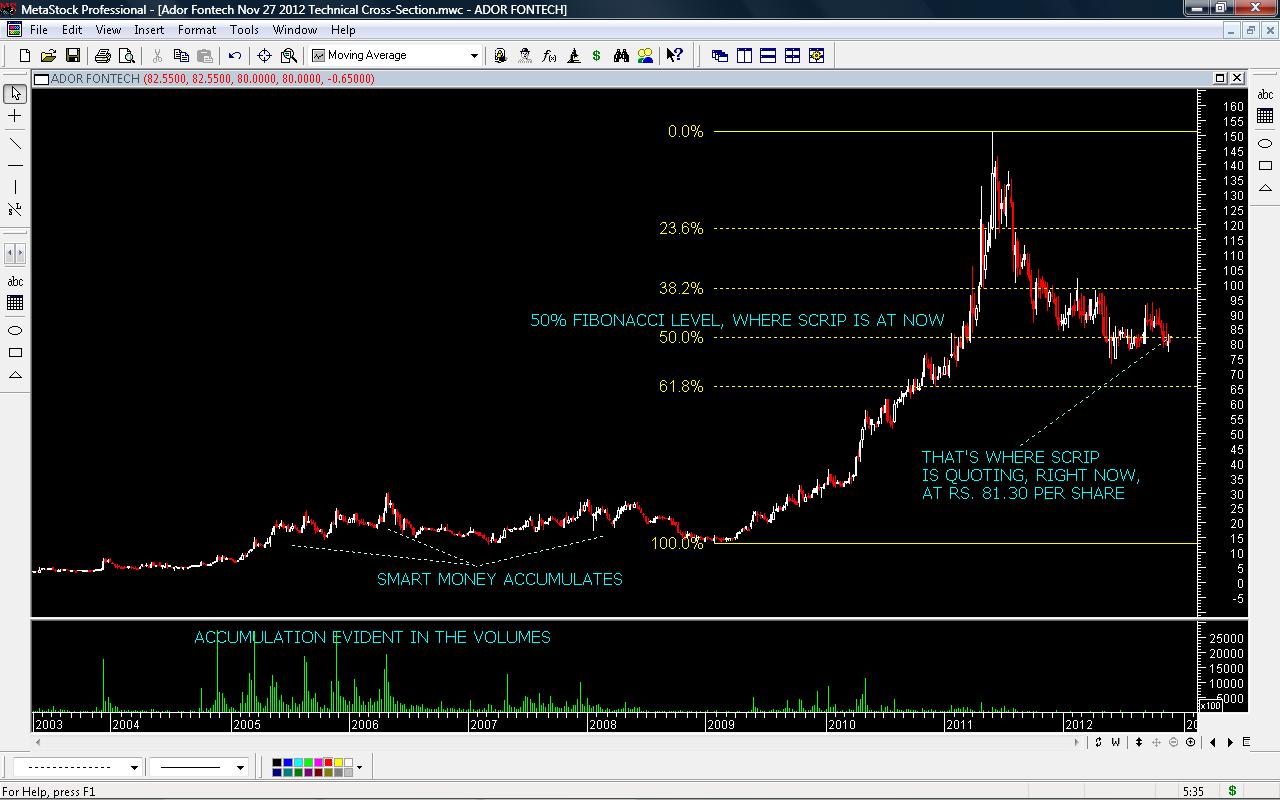
Due Diligence Snapshot + Technical Cross-Section — Ador Fontech Limited — Nov 27 2012

Image

Price – Rs. 81.30 per share

Earnings Per Share projected on the basis of quarter ended Sep 30 2012 – Rs. 12.62

Price to Earnings Ratio (thus, also projected) – 6.44

Price to Book Value Ratio – the stock is selling at approximately 2 x book value currently

Debt : Equity Ratio – Nil

Current Ratio – 2.73

Profit After Tax Margin – 12.51%

Return on Networth – 32.54 %

Pledged Shares %age – Nil

Face Value – Rs. 2.00

Dividend Payout – 50% -150% of face-value.

Average Daily Volumes – around 5 – 6 k / day on BSE.

Product – Reclamation of alloys, fusion surfacing (preventive welding), spraying and environmental solutions.

Promoters – JB Advani & Company Pvt Ltd (of Advani-Oerlikon fame) + a group of other Sindhi business-people.

Share-holding Pattern – Promoters (35.4%), Public (58.9%), Institutions (2.0%), NICBs (3.7%).

Technicals (see chart below) – This is a very low volume scrip, so there could be slippage. The scrip has corrected from its June 2011 peak of Rs. 150.90 to a pivot of Rs. 73.25 within about one year. This low pivot lies bang in between the 50% and the 61.8% Fibonacci levels of correction on the weekly chart. Currently, the scrip is quoting at Rs. 81.30, just below the Fib. 50% level. Volumes are average, with one high volume peak every 7 odd trading days. The scrip is trading in a broad band between Rs. 73.25 and Rs. 93.90. Perhaps it is trying to establish a base.

Comments – Fundamentals are good, and the company’s corporate governance is considered clean. Market for the company’s niche is considered small, and people view that as a long-term growth concern. Technically, correction has taken place, and thus value shines out fundamentally. Debt is nil. Dividend is excellent. Projected PE is low, though P/BV is a bit high. Cushion is there, and profitability and returns are exemplary. Future investment would be required to keep niche-segment status alive.

Buy? – I like the theme – reclamation and preventive welding. Contrary to what others say, I feel the market is going to grow phenomenally, as earth and rare-earth metals become difficult to source, and need to be reclaimed. Valuations are excellent, governance is great, payouts are great too, and a technical buying level has presented itself. Yes, it’s a long-term buy right now. Remember, this is not a trade we are speaking about, so we are not going to talk in terms of a stop-loss. This is a long-term investment, and we’ve been speaking in terms of margin of safety, which I’m sure you’ve noticed. Also, while buying, one needs to show caution regarding slippage, which is invariably going to occur owing to the low-volume nature of the scrip.

Disclaimer and Disclosure – Opinions given here are mine only. You are free to build your own view on the stock. I have bought a miniscule stake in Ador Fontech today. Data given here has been compiled from motilaloswal.com, moneycontrol.com and equitymaster.com. Technicals have been gauged and shown using Metastock Professional version 9.1 by Equis International.

A Tool By The Name of “Barrier”

Come into some money?

Just don’t say you’re going to spend it all.

Have the decency to at least save something.

And all of a sudden, our focus turns to the portion you’ve managed to save.

If you don’t fetch out your rule-book now, you’ll probably bungle up with whatever’s left too.

Have some discipline in life, pal.

The first thing you want to do is to set a barrier.

Barrier? Huh? What kind of barrier?

And why?

The barrier will cut off immediate and direct access to your saved funds. You’ll get time to think, when hit by the whim and fancy to spend your funds.

For example, a barrier can be constructed by simply putting your funds in a money-market scheme. With that, you’ll have put 18 hours between you and access, because even the best of money market schemes take at least 18 hours to transfer your funds back into your bank account.

Why am I so against spending, you ask?

Well, I’m not.

Here, we are focusing on the portion that you’ve managed to save.

Without savings, there’s nothing. There can be no talk about an investment corpus, if there are no savings. Something cannot grow out of nothing. For your money to grow, a base corpus needs to exist first.

Then, your basic corpus needs a growth strategy.

If you’ve chalked out your strategy already, great, go ahead and implement it.

You might find, that the implemetation opportunities you thought about are not there yet.

Appropriately, your corpus will wait for these opportunities in a safe money market fund. Here, it is totally fine to accept a low return as long as you are liquid when the opportunity comes. There is no point blocking your money in lieu of a slightly higher return, only to be illiquid when your investment opportunity comes along. Thus, you’ve used your barrier to park your funds. Well done!

Primarily, this barrier analogy is for these who don’t have a strategy. These individuals leave themselves open to be swept away into spending all their money. That’s why such individuals need a barrier.

An online 7-day lock-in fixed deposit can be a barrier.

A stingy spouse can be a barrier.

Use your imagination, people, and you’ll come up with a (safe) barrier. All the best! 🙂

I know a guy who knows another guy who knows this guy…

Well, congratulations.

So you’re well connected.

You probably play golf with the CEO of Big Balls Incorporated.

We’re not even going into how you wangled the slot.

You probably feel, that because of your connectedness, you can get away with anything in life.

Well, almost anything.

That’s the bottom-line.

You can get away with almost anything in life.

Here are two areas where your connectivity counts jack. As in El Zero. Nadda.

One is before the Almighty (presuming that God exists). Buying a slot with God using connections isn’t gonna cut it with the big guy. You can’t buy personal time with deities using money and / or connections, even if you think you can. Also, that “bought” time, when you shoved everyone else out of line, well, that time’s not going to make your life any better, or richer. You’ve just established yourself as someone who shoves others out of line using connections….that’s how your deity is going to view your performance. So, what you’re going to understand from this space is that before deities – the Almighty – God – the Metaphysical – or whatever you might want to call what I’m talking about, connections don’t work. You only end up scoring negative in your deity’s books.

Which brings us to the more relevant matter – where else do connections not work?

In the marketplace of course, my friend.

Don’t believe me? Fine, find it out for yourself, the hard way. Or, read on.

You see, in the marketplace, insiders have an agenda. All insiders. They have an agenda.

That agenda is personal. It includes them. It doesn’t include you … … if you’re not connected to the insider. Once you are, and you use that connection to fish for “lucrative” inside information, that’s where the insider’s agenda starts to include you. The information you get is as per the agenda of the insider. If a promoter wishes to off-load huge quantities of stock, you will be told that the stock’s a good buy, because blah-blah-blah-blah-blah. On the other hand, if the promoter wishes to buy back large quantities of stock, because of attractive valuations, you’ll be told to sell the stock owing to tricky prospects in the future. You are not getting quality information when you fish for tips. You’ll only find yourself getting trapped if you follow insider tips.

There are good insiders too … is that what you are saying? Ok, fine, some insiders are good human beings. They are not vicious, and they wish you well. They might even want to do you a favour, wishing that you make some money from the information they are letting out. All true. Question is, does it really work?

No.

Why?

You see, an insider never functions alone. When a company experiences a turnaround or a great quarter comes along with excellent earnings, white-collared people connected to the functioning of the company obviously know this, and they leak this information out (for a price) to smart researchers and investors. These smarties (along with their entire intimate circle of connectivity) buy into the company’s prospects. The money moved is called smart money. Smart money registers / reflects on the traders’ charts. The scrip might show a bounce-back from a low with huge volume, or a resistance might be broken, or a new high could even be made (all coupled with large volume). Traders latch on. Price movers higher. All this is happening before the CEO has announced quarterly results, mind you. Finally, a few days before the results, the corresponding results-file lands on the CEO’s desk. He or she congratulates his or her staff on the spectacular performance, and over a round of golf, the information is shared with you. The CEO is obviously thinking that the market is going to react positively to the earnings surprise that’s going to be announced.

Well, the earnings are not going to be a surprise. The market already knows, and earnings have thus already been factored into the price, before results are announced. Announcement time is generally selling time for traders, who tend to sell all stock upon the first spike after announcement. With no more buying pressure (since traders are out of the scrip), the inflated scrip tanks despite the good news, leaving you stuck with a peak-price buy. Well done, well done indeed.

See, that’s why. Don’t listen to insiders, even if they mean well.

In the marketplace, you really are on your own. Isn’t that exciting? As in challenging?

All the best, my friend. Learn to rely on your own judgement.

An Elliott-Wave Cross-Section through a Crowd Build-Up

At first, there’s smart money.

Behind this white-collared term are pioneering investors who believe in thorough research, and who are willing to take risks.

Smart money goes into an underlying, and the price of this underlying moves up. Wave 1.

At the sidelines, there are those who have been stuck in this underlying. As the price moves above their entry level, they begin to off-load. There’s a small correction. Wave 2.

By now, news of the smart money has perforated through the markets. Where is it moving? What did it pick up? Who is behind it? Thus, more investors following news or fundamentals (or both) enter. The price moves past the very recent short-term high of Wave 1, accompanied by a surge in volume.

This is picked up on the charts by those following technicals, who enter too. By now, there are analysts speaking in the media about the turn-around in company so and so, and a large chunk of people following the media do the honours by entering. Wave 3 is under way.

Technical trend-followers latch on, and soon, we are at the meat of Wave 3, i.e. the middle off the trend.

Analysts on the media then speak about buying on dips. All dips are cut short by a surge of entrants seeking to be part of the crowd.

The first feelings of missing the bus register. The pangs of these cause more people to enter.

Meanwhile, the short community has been getting active. Large short positions have been in place for a while, and they are bleeding. Eventually, the short community throws in the towel, and there’s massive short-covering, causing a further surge in price.

Short-covering is sensed by gauging buying pressure despite very high price levels. It is the ideal time for smart money to exit. That’s exactly what it does, without any dip in the price of the underlying whatsoever.

Short-covering is over. Smart money starts boasting about its returns of X% in Y days, openly, at parties, in the media, everywhere. This causes pangs of jealousy and intense feelings of missing the bus in those still left out. Some enter, throwing caution to the wind.

The price has reached a level at which no one has the guts to enter. Demand dries up. With no buying pressure, the price dips automatically. Bargain hunters emerge, and so do shorters. The shorters sell to the bargain hunters right through a sizable dip. This dip happens so fast, that most of the crowd still remains trapped. Wave 3 has ended, and we are now looking at the correcting Wave 4 in progress.

At this stage, technical analysts start advising reentry upon Fibonacci correction levels. Position traders buying upon dips with margin of safety enter, and so does the second-last chunk of those feeling they’d missed the bus. The price edges up to the peak of Wave 3 and past it. That’s the trigger for technical traders to enter.

We now see a mini-repeat of Wave 3. This is called Wave 5. Once Wave 5 crosses its meat, the last chunk of those still feeling they’d missed the bus makes a grand entry with a sharp spike in the price. These are your Uncle Georges, Aunt Marthas and Mr. Cools who know nothing about the underlying. They cannot discern a price to earnings ratio from an orangutan. They desperately want to be a part of the action, since everyone is, at whatever the price. And these are the very people that traders sell to as they exit. With that, the crowd is at its peak, and so is the price. There are no more buyers.

What’s now required is a pin-prick to burst the bubble. It can be bad news in the media, the emergence of a scandal, a negative earnings report, anything.

The rest, they say, is History.

The Funny Things about Technicals

There’s something uncanny about technical analysis.

More often than not, just before an apparent market turning point, technical analysis tends to position the trader appropriately.

Now that’s saying a lot.

Why could this be so?

At the base of every big move in the market, there are always “insiders”. These are people “in the know”, i.e. the smart money. These people pre-empt a market move with their smart money, because they possess certain market-moving information that most others don’t have.

Fortunately for us, their market behaviour registers on our charts. Today our data-feed is as good as any institution’s data-feed, and with that the face of this whole game has changed. I would go on to say that today our personal data-feed with all its paraphernalia (including social-networking sites) is so fine-tuned to the individual it is servicing, that it is better for that individual than any institution’s data-feed.

And that’s saying everything. When a big trend starts out, its seeds first register on a Twitter timeline. Simultaneously, its initial behaviour registers on one’s laptop in the form of charts. This enables one to position oneself as per the move. Also, even the potential intensity of an upcoming move can be indicated in the charts, so that one can decide the trade size based upon this if one wishes.

Thus, by the time the public latches on to the information, the technical analyst has already entered the trend.

Same goes for exits. As smart-money exits, technicals push one to enter exit orders that are to be triggered by a falling market. If the market then actually falls, the trading platform pushes one out of the market automatically.

In a choppy market, technicals stop you out a couple of times, and then you need to read the cue and take a break. Go on a holiday or read a book. Yes, technicals are telling you here to lay off the market for a while.

The bottom-line here is that a serious market player cannot afford to ignore technicals.

So give it a shot. Learn technicals. All resources are available on the web, and most of them are free of cost.

Anatomy of a Ponzi Scheme

Charles Ponzi came up with the brilliant idea of paying early investors dividends from the investment money put in by later investors.

It’s as simple as that, and it’s called a Ponzi scheme.

After the first few dividends, promoter disappears, having lured many investors into a fake scheme with no underlying business.

Latest famous example of a Ponzi schemer – Bernie Maddoff.

Or, if you’ve not seen Damages – Season III, that’s about a Ponzi scheme too.

So what lures the common investor into a Ponzi scheme?

Simple. It’s called greed.

What triggers the greed?

The Ponzi schemer concocts a scheme that promises a rather too lucrative return. This return does not look unrealistic, so the average investor’s alarm signals don’t go off. Nevertheless, it’s more than high enough to make the average investor’s mouth water.

And what’s normally promised is a quick return, mind you. The average investor buys smoothly into the idea of doubling his or her money fast.

Then there’s lots of advertisment. Billboards everywhere. The Ponzi schemer wants to hit the public with ads about the tremendous returns.

The sales-people who sell the scheme are glib-talkers. They are smart, wear expensive stuff, basically exuding sophistication. They want to rub it in that they’ve made it big in life.

A Ponzi scheme’s documentation generally cracks under close scrutiny. I mean, when something is being sold to you without any underlying business, all you have to do is your dose of due diligence. Just pick up the phone and start asking questions.

What works for the Ponzi schemer is human nature. The first investors (who get paid dividends from newbie investor money) start talking. Actually, they start bragging. The human being likes to show off. And, the human being hates missing the boat, even if the boatman is a disciple of Charles Ponzi.