Dealing with Noise…the Old-Fashioned Way

There’s a sure-shot way to deal with noise…

…just shut your ears. 

Yeah, the best ideas in the world are – simple. 

Let’s not complicate things, ok?

So, what kinda noise are we talking about here?

We’re not talking about audio, you got that right…!

The concept is related, though. 

If you’re charting, you’ve dealt with noise. 

Yeah, we’re talking about minute to minute, hour to hour or day to day fluctuations in a chart of any underlying.

Markets fluctuate. 

While discussing noise, we are pointing towards relatively small fluctuations which generally don’t affect the long-term trend. 

However, noise has the capability of deceiving our minds into believing that the long-term trend is turning, or is over. 

Don’t let noise fool you.

When has the long-term trend changed?

When the chart proves it to you through pre-defined fashion. That’s it. You don’t let noise to get you to believe that the long-term trend has changed, or is changing. Ever. 

You believe your chart. 

Moving averages crossing over? Support broken? Resistance pierced? Trend-line shattered? ADX below 15? Fine, fine, FINE.

Take your pick. You have many avenues giving decent signals that the long-term trend has changed or is changing. 

How about eyeballing? Works for some. Like I said, let’s keep this simple. 

So let’s get noise out of the way. 

Random numbers generate trends – you knew that, right?

You don’t need more. 

Once you’ve identified a trend, that’s your cue to latch on to it. 

We’re not talking about predicting here. We don’t need to predict. We just need to identify a trend, and latch on. That’s all. No predictions. Not required. 

From this point on, two things can happen.

Further random numbers deepen the trend you’ve latched on to. You make money. Good. 

Or, the next set of random numbers make your trade go against you, and your stop gets hit. 

If your stop is getting hit, please let it get hit. Even that qualifies as a good trade. 

You move on to the next trade setup, without even blinking. 

What you’re not doing is letting noise throw you out of the trade by deceiving your mind. 

So, here’s what you do. 

You’ve id’d your trend. You’ve latched on. Your stop is in place. Now, don’t look at your trade. 

Till when?

That’s your call. 

Don’t look at your trade till you’ve decided not to look at it. For the day-trader, this could be a couple of hours. For the positional trader, it could be days, or weeks. 

By not looking, you won’t let noise deceive you. 

If the trend doesn’t deepen, or goes against you, you lose the risked small amount. 

Just remember one thing. 

A loss has immense informational value. It teaches you about market behaviour patterns. It also highlights your trading errors. Many times, losses occur without any mistakes made by you. 

That’s the nature of trading. 

Ultimately, if the trend deepens, you’ll have made good money, and can then further manage your trade after the stipulated period of not looking.

This is the sweet spot.

This is where you want to be, again, and again and again.

Sitting on a large profit gives you room to play for more profit by lifting your stop and your target simultaneously.

To reach this sweet spot again, and again and again, you have to position yourself out there and appropriately, again, and again and again. 

This is also the nature of trading.

Wishing you happy and lucrative trading!

🙂

So… Where do Options Fit in?

I’m on the move.

I play the markets.

How do I combine these two facts?

Life didn’t give me a desk job.

It did give me an appetite for risk, though.

Another two facts to be combined…

I like doing new stuff.

I don’t like following old norms.

You got it, another two facts…

I like breathing easy.

I want to participate, though.

I don’t mind losing… small…

… as long as I can win big too…

… without risking too much…

… facts, facts, facts.

What’s the one common denominator?

Options.

What do options mean to me?

– an auto-stop that doesn’t need to be fed in daily.

– low risk market participation.

– freedom to be on the move.

– freedom to not look at the markets for many days in a row.

– implementation of new poker-like strategies with huge reward : risk ratios…

– … for which the price is time-component corrosion of the option premium.

– peace of mind.

– the satisfaction that markets don’t rule my day.

– a very challenging arena that pushes my faculties to the maximum.

– an avenue that teaches me about singular stocks, their nuances, how they move, basically their nervous system… this is invaluable knowledge, which no university is capable of teaching.

I could go on.

Explore your options.

Discover Options.

So…What Does Trade Selection Hang Upon?

Feeling.

Feeling first, feeling last. 

Math in the middle. 

That’s my recipe for trade selection. 

For me, trading is an art. 

I rely a lot on gut. 

Many people tell me that’s wrong. 

Everyone’s got a right to their opinion. 

What works for Jill might not work for Jack.

People tell me to get emotion out of the way.

Emotion can be an ally too. 

Just try and get the hang of your gut feel. 

Let the trade speak out to you. 

You’re looking at a chart, and the chart should shout out to you – “Trade me!!”

That’s what I call “Feeling First”.

There’s something about first impressions. 

I mean, whoever made that proverb about first impressions sure knew what he or she was talking about. 

So, after your first impression tells you that a chart is tradeable, you then need to see some kind of a mathematical fit going for you. 

You plan your trade.

You try and fit some mathematical model into the underlying’s previous behaviour, and plan the trade into the near future based upon the future-play which your model spits out. 

You calculate a stop according to your money-management rules. Just more math. 

Now comes “Feeling Last”. You look at your chart, which contains the entire map of your trade.

At this stage, your gut must speak to you. 

Yes or no. 

Nothing else. 

Are you pulling the trigger or are you not pulling the trigger.

If not, then no whys. It’s a no. Learn to take a no. Look for another trade setup, elsewhere. 

If yes, then again – no more whys. It’s a go-ahead. Have the guts to follow through. 

Keep it simple. 

The best ideas in the world are – simple. 

Options Strategy – Entry, Stop and Exit

What are we doing with options anyways?

We are trying to play a market without needing to be with the market the whole time. Also, we are defining our risk quite exactly. The option premium is the money that’s at risk. You don’t have to lose all of it if the trade goes against you. You can bail out anytime and save whatever option premium is left. The option premium is the total you can lose in the trade. With that, you’ve done one great thing. You’ve installed a stop which will stay with you during the entire trade. Is that possible in any other segment in India? Nope. If my info is correct, stops have to be installed everywhere on a day to day basis. Not so the case with options. You have your stop with you, always. 

That allows you to do other stuff. You can have an alternate profession, and still play options. 

You don’t need to be afraid of the time element in options. You can trade them in a manner where the time element is rendered useless. I’ll tell you how.

Though you try and go with the overall long-term trend, you try and pick up an option during a retracement. That’s when you’ll get it cheap. 

The idea is to buy cheap and sell expensive, right?

Secondly, give yourself breathing space. If the current month is well under way, pick up the corresponding option for the next series month. Give the trade 4-5 weeks to pan out in your favour.

A lot can happen over 4-5 weeks. 

Thirdly, you’re trying to pick up out-of-the-money options, which seem to have gotten out-of-the-money as an aberration. These will be even cheaper. Like what happened to Tata Motors the other day. For no apparent reason, the stock drifted towards what was formerly seeming to be an unlikely support to be hit, around the Rs. 430 level. On the previous day, it was nowhere near this level, and didn’t look like reaching it in a hurry at all. An event in the US occurred, and Asia opened down, with the scrip in question falling to the support and bouncing off. At the market price of Rs. 430 – Rs. 435, if you’d have picked up the out-of-the-money option of Tata Motors for the strike price of Rs. 450, which was going very cheap, that would have resulted in a good trade. 

Basically you are looking for such predefined setups – buying off a support / selling off a resistance, buying / selling at a defined retracement level, buying / selling upon piercing of a bar etc. etc. etc. 

Let’s say you’ve identified a setup. 

You’ve seen buying pressure, or selling pressure. Chances of repetition are high, you feel. You try and enter into the option at a time when the buying or selling pressure is off, and everyone thinks that this buying or selling pressure is not coming back. 

In this manner you’ll get some cheap entries. 

Now you have to wait, to see if your analysis is correct. If not, you’ll probably lose most or all of your option premium. Don’t be afraid of loss. It’s a chance you have to take. Without taking the risk, there is no chance of reward. You have to put yourself in line for the reward by going out there and entering into the option.

It’s possible that the scenario you imagined actually plays out. Let it play out even more.

You can exit in two ways. You could trail the market with a manual stop. This way you’ll be in the trade to perhaps see another day of even more profits. The downside is, that during lulls in the day, your stop could well be hit. The second exit possibility is to calculate an unusually high price, which is slightly unlikely to be reached. You feed in the limit order at this price. If this price is reached, you’re out after having made good money. Now, the scrip can go down for all you care. The downside is that the scrip can go deeper in your trade direction after you’ve exited, and that’s a little painful. The reason this latter scenario is often used is that the time-element keeps getting scraped off the selling price for the option as the series month approaches its end, and your exit on that very day at an unusually high price is more lucrative than you might think. You see, buying or selling pressure in your direction might or might not make itself felt again in the current month. If not, you’ve lost a prime opportunity to cash out at a high. Is it the high? You’ll never know. Therefore, you’ll need to try both exit scenarios and see which suits you more. Sooner or later, you’ll get a feel for both exit scenarios, and will be able to implement either, depending upon the situation. 

That’s it for today. 

Heavy?

It’s not. 

Options are easy. 

Playing options is like playing poker. it’s fun!

🙂

And What’s so Special about Forex?

Imagine in your mind …

… the freedom to trade exactly like you want to.

Is there any market in the world which allows you complete freedom?

Equity? Naehhh. Lots of issues. Liquidity. Closes late-afternoon, leaving you hanging till the next open, unless you’re day-trading. Who wants to watch the terminal all day? Next open is without your stop. Then there’s rigging. Syndicates. Inside info. Tips. Equity comes with lot of baggage. I still like it, and am in it. It doesn’t give me complete freedom, though. I live with what I get, because equity does give me is a kick.

Debt market? A little boring, perhaps. Lock-ins.

Commodities? You wanna take delivery? What if you forget to square-off a contract? Will you be buying the kilo of Gold? Ha, ha, ha…

Arbitrage? Glued to screen all day. No like. Same goes for any other form of day-trading.

Mutual Funds. Issues. Fees. Sometimes, lock-ins. MFs can’t hold on to investments if investors want to cash out. Similarly, MFs can’t exit properly if investors want to hang on. And, you know how the public is. It wants to enter at the peak and cash out at the bottom. 

Private Equity? Do you like black boxes? You drive your car? Do you know how it functions? You still drive it, right? So why can’t you play PE? Some can. Those who are uncomfortable with black boxes can’t. 

CDOs? @#$!*()_&&%##@.

Real Estate? Hassles. Slimy market. Sleaze. Black money. Government officials. Bribery. No like.

Venture Cap? Extreme due diligence required. Visits. Traveling. The need to dig very deep. Deep pockets. Extreme risk. No. 

Forex? 24 hr market. Order feed is good till cancelled. Stops don’t vanish over weekends. Stops can be pin-pointedly defined, and you can even get them to move up or down with the underlying, in tandem or in spurts. You can feed in profit-booking mechanisms too, and that too pin-pointedly. You watch about 10-11 currency pairs; you can watch more if you want to. 10-11 is good, though. You can watch 4, or even 2 or 1, up to you. Platforms are stupendous, versatile, malleable, and absolutely free of charge. You can trade off the chart. Liquidity? So much liquidity, that you’ll redefine the word. No rigging – market’s just too large. The large numbers make natural algorithms like Fibonacci work. Technicals? Man, paradise for technicals. Spreads? So wafer thin, that you barely lose anything on commissions. Oh, btw, spreads are treated as commissions in forex; there’s no other commission. Money management? As defined as you want it to be. Magnitude? As small or as large as you want to play? Comfort? You make your morning tea, sip it, open your platform, feed in orders with trigger-entry, stop and limit, and then forget about the forex market for the rest of the day, or till you want to see what’s happening. Yeah, comfort. Challenge? You’re playing with the biggest institutions in the world. What could be more challenging? I could go on. You’re getting the gist. 

Yeah.

Forex is a very special market. 

Also, the forex market is absolutely accessible to you, online. 

If you decide to enter it one day, play on a practice account till you feel you’re ready for a real account. 

If and when you do start with a real account, for heaven’s sake start with a micro account, where 1 pip is equal to 0.1 USD. 

🙂


Who’s Responsible for that Last Technical Bit?

Planning a technical trade?

You’ve got your chart open. Scrip’s been falling.

You plan to initiate a buy on that last support. Still a few percentage points to go. 

Your buy point seems a bit off, right? 

Scrip might not reach it, huh?

It might just take off before reaching your buy point, hmmm?

What you need to understand is this – for nothing comes nothing.

You don’t want to risk a buy at current market price. That’s a fact. An acceptable one. Fine … as long as you are willing to pay the price for this fact. 

The price is that you might not be in the trade as the scrip might take off without your stop-type trigger entry price being hit. 

The up-side is that the scrip might correct to your buy price, triggering your entry, and thereby giving you a perfect technical entry point, along with a great margin of safety, since you’ll then have bought low as compared to current market price. 

Yeah, that’s the trade-off.

Is this trade-off acceptable to you?

Yes?

Fine. In my opinion, you would not be doing anything wrong in going ahead with your planned course of action, as long as you have mentally accepted the trade-off. 

What’s the other guy at? You know, the fellow who’s entering at current market price. Well, he’s taking a risk. He’s buying a little high, without margin of safety. What’s his trade-off? For starters, he’s in the trade. Scrip can take off immediately for all he cares, leaving you behind. He’ll be most happy. What’s his down-side? Scrip can correct to technical support, your buy-point. He’ll already be in a losing trade, and you’ll be just entering. In his worst-case scenario, his stop will already be hit as you are just entering. If the scrip takes off on him now, he’ll probably be puking. Yeah, that’s his trade-off. He’s accepted it mentally. After such acceptance, in my opinion, he’s doing nothing wrong by entering at current market price. 

What’s going to happen?

No one knows. Either of the outlined scenarios can play out.

Who’s that last technical correction left for? Yeah, who or what exactly will be responsible for that last technical correction?

An event. A negative one.

At this point, a negative event can happen. On the other hand, it may not happen. 

If it happens, the scrip will very probably open at the technical buy point the next day, and your buy will be triggered. 

If there’s no negative event, and buying pressure goes up, the scrip will take off without you.

Why is that last bit left to an event?

Events give prices a push or a pull, depending upon their positivity or negativity. 

That last support was made a bit low, right? You were wondering how the scrip reached so low, huh? In high probability, an event pushed it low for a few hours, and a low was made. If this low coincided with a past low, one started to speak of a lowish support, which was a little low considering current market price, and for which the scrip needed a pull-back to reach. 

Like this morning’s pull-back. The US decides to allow air-strikes in Iraq. Japan opens 3% down. India opens 1% down. 

A lot of scrips open really down this morning. 

Some of them even open at lowish supports they were not (at all) intending to touch yesterday. 

Connection & Disconnection

Sizzling hot stuff is best kept at an arm’s length … … something I learnt along the path … …

You reach for it at a conducive time, do what you need to do, and then you let it be. This way it doesn’t burn you. 

When you’ve let it be, you’re not thinking about it. Your mind has switched off from it. It is utilising its resources to do other stuff … … till it’s time to work with your sizzling hot stuff again. 

Now replace sizzling hot stuff with Mrs. Market.

There’s no doubt in my mind that Mrs. Market can burn you. You need to work with it in a manner that it doesn’t. 

You’ve understood that whole deal about the establishment of an emergency fund. Such a fund will render any burns only temporary. You have to have an emergency fund going first up, before you enter Mrs. Market. The income generated from this fund needs to cater for the basic requirements of your core family. Period.

Ok, good, so now you’ve got your protective gear on. Till you’re getting it on, you are absolutely disconnected from Mrs. Market.

Now let’s talk constant connection and disconnection. 

Why allow something or someone to control your moods?

No!

You are absolutely not giving Mrs. M that much power. 

Therefore, play small. 

How small?

Small enough to not lose any sleep over Mrs. M. 

Play with stops. These allow you to disconnect from Mrs. M and focus on other work. Other work is as important as Mrs. M, or perhaps more important. Yeah, show Mrs. M her place in your life. This way she’ll behave herself. Giver her any more leeway, and she’ll take over your life, and you don’t want that, right?

So, connect to Mr. M, do your work, place your stops, and disconnect. 

Don’t think about Mrs. M till you connect to her again. 

The period in between connection and disconnection is your time. Use it for any activity that has nothing to do with Mrs. M.

Day in, day out.


We Like to Move it Move it

We do our home-work.

We know our risk-profile.

Our systems are in place. 

We know the exact market-segments we are tapping into, and those we are leaving alone. 

Our fund-allocation profile is at the back of our palms. We know where what is, and when. We know how to move it. 

In our identified segment of activity, we have a feel for the underlying. We can sense it. We don’t need to preempt the underlying, but we can if we want to. 

We are not afraid of small loss. It can happen again, and again, and again, as far as we are concerned. 

We use stops. Definition of risk is our abc. 

We try not to follow news. It gives us a bias. We trade the setup we are observing on the chart of the underlying. Everything else is “egal”, as they say in German, as far as the trade is concerned. We are not going to be biased while trading. We are going to take the setup, in whichever direction it presents itself. 

We are nice to our families. We gel with them, and have enough time for them. We are happy in their company. They are not a distraction to our work, but a welcome change. We’ve got a substantial-sized emergency fund going for them, which more than takes care of their needs. This fund generates regular incomes for our families, and we don’t touch the emergency fund, come what may. We might keep adding to it, though. 

We take high risks with a very small size of our networths, everyday. Our risks are calculated, and can generate high returns. They can also result in total losses. We practise sound money-management, and put ourselves in line for big profits, again, and again and again. 

Yeah, we like to move it move it …

… from one trade setup to another, to another, to yet another, an so on and so forth. 

Learning to be Blunt

Don’t like something? Is it causing you harm? Is someone bothering you? Is something draining your energy? Are you unhappy with a situation?

Get a grip. 

Get that something or someone out of your way. Now. Be blunt about it.

It pays to be blunt. I’m really learning this the hard way, but today I feel there is a lot of truth in this. 

I’ll tell you how I’ve benefited. 

All uselessly energy-depleting people and situations are now out of my life. With the surplus energy saved, I am able to create. 

Stonewalling is for bankers, private investigators, cops, crooks and what have you. 

Diplomacy is for diplomats. Let them do their jobs. 

I’ll do my job. I wish to conserve maximum energy for activities I enjoy and which are beneficial to my surroundings. To achieve this, I have learnt to be blunt. 

Who was my teacher?

Ever wondered?

I mean, do you ask such questions?

Do you use your imagination?

Do you grow?

Are you doing justice to your incarnation as a human?

Ok, enough provocation. Who was my teacher?

None other than…

… Mrs. Market.

I take my stops.

I’m blunt about taking small hits. Very, very often. 

So often that…I’m numb to their pain. 

This puts me in line for…

… fill in the blanks…

… big wins …

… provided …

… fill in the blanks …

… what, you thought this would be a spoon-feed… ? …

… well, … provided…

… provided I let my profits run. 

How to Swallow Small Losses…

… as if nothing has happened … is one of my biggest trading goals.

You see, our society teaches us not to lose. 

It doesn’t teach us that we can lose a bit 5 times, and after that we can win big, recovering all our losses and making money overall.

No. 

It teaches us to try and win all the time. 

That’s the exact reason 90%+ of all society members actually lose in the markets. They’ve not learnt how to lose small, move on, and take the next trade.

Mrs. Market won’t budge an inch for you. You’ll have to make the adjustment. 

So how does one take a loss in one’s stride?

Only one type of loss is immediately digestible – a small one. Therefore, define your risk in the market. Cut and scoot when required. Don’t get married to your trade.

Then, once the small loss has happened, and has been taken, it will nag you. 

It’ll be there, trying to bite your brain in the background. 

Focus on your next trade. 

Identification – Implementation – Entry – Management – Exit – Next Trade Identification – Implementation – Entry – Management – Exit – Next Trade Identification – Implementation – Entry – Management – Exit – … … [what’s the difference between implementation and entry? Well, you could be implementing the trade through a trigger, which is not equivalent to entry yet].

Don’t let the nagging bother you by keeping yourself busy with Identification – Implementation – Entry – Management – Exit – Next Trade Identification – Implementation – Entry – Management – Exit – Next Trade Identification – Implementation – Entry – Management – Exit – … … 

Ultimately the nagging will die out, as your mind starts to revolve around your current trades. 

If you give in to the nagging, it will grow, and will slow you down. You might snap at a family member. You might go into depression. You might freeze. DON’T. Don’t give in to the nagging. Don’t let it grow. Don’t let it slow you down. Maintain your family equilibrium at all costs. Move on. 

The nagging is worst if there’s been a close below your stop, and the market is to open the next day, or after the weekend. You have to deal with this one. If you’re not able to deal with this particular situation, you’ll either need to expose your mental stop prematurely and feed it in intraday (before there’s been a close under it), or you’ll need to follow the progress of your trade from half an hour before next market open onwards.

Yes, this last one’s tough, and you need to absolutely work your way around it. 

You can do it with a bit of practise. 

🙂

Dynamics of a Long-Long System

What if your system doesn’t allow you to second-guess yourself?

Wouldn’t that be a wonderful situation?

And you’d be right there, in the middle of it all.

What would such a system look like?

Right, it would only go one way.

Long-long. “A-la-la-la-la-long”, to quote Inner Circle!

Why aren’t we talking about a short-short system?

Theoretically, we could. Theoretically, everything is possible.

Well, a short-short system would have no limits on your potential loss, if the trade went against you. That’s the fundametal problem I have against a short-short system, without even having gone into the whole leverage discussion.

You could bring the stop argument.

Fine.

Just take a deep breath.

Think clearly.

Take a look at the average price-speeds of both directions, long and short.

The average price-speed in the short direction is far higher. Price-jumps are greater. The probability of your stop getting high-jumped over is much higher in the short direction. Frankly, that doesn’t work for me.

Also, which market allows you to set an overnight stop, barring the international forex market?. None that I know of, at least in India. No stops overnight means potential exposure to a large drawdown upon next market-opening, and here I’d like to be in a long-situation, because loss is capped.

Therefore, when we’re discussing a system that doesn’t allow us to second-guess ourselves, I will only discuss a long-long system.

What does long-long mean?

Yeah, we’re talking about a system, where you’re looking for long trades all the time. You don’t look for trades to go short in-between. There’s no shorting in the equation whatsoever. The moment you start thinking about shorting, you start second-guessing your long-approach.

What does that mean for someone applying such a system?

It means that the whole world might be crumbling apart, and one is still looking for long-trades. Yes, one could take some hits here. One just needs to make sure, that one’s consecutive drawdown doesn’t exceed a bearable level. Also, as losses might pile up, one position-sizes one’s way through. The concept ot position-sizing has been pioneered and elucidated by Dr. Van K. Tharp @ www.iitm.com.

It also means that when your underlyings start to run, you’ll be piling up winning trade upon winning trade.

The thing is, nobody knows when what is going to run. If you’ve taken all second-guessing out of your equation, you’re aligning yourself with the correct direction once things start to run. Going the other way now would mean further losses.

Then, it further means that if you lock in a big winner in a running market, your paper profits can now be used to harness even greater profits in the same trade. Such big winners provide a big boost to your trading corpus, and, in my opinion, are the difference between winning and losing in the markets. One needs to keep oneself aligned correctly when such opportunities come along. A long-long system will keep you aligned, no matter what.

You could argue about dry spells.

In any dry spell, or when markets are tanking, there are still underlyings that are going up. You just have to identify them. Today, such identification is not difficult at all.

For such identification, you need market software, a data feed, and an algorithm which defines what you are looking for. Your software then scans the entire breadth of the market you’re in to try and find what you’re looking for, and opens corresponding charts for you for underlyings that are still going up, or where there is buying interest, buying pressure, unusual increment in volume or what have you.

Don’t let the word algorithm scare you. You don’t have to learn a new programming language to put an algorithm together. Common-sense is enough. You know what you’re looking for. Let’s say what you’re looking for involves volume and price. You look inside your market software. Then you couple two algorithms together into a new algorithm which defines what you are looking for. You see, a typical market software like Metastock already uses algorithms for volume moving average, price etc., and these are visible to you. Just copy-paste and make a new algorithm that suits your purpose.

Lastly for today, decouple yourself from the market during trading hours, except when you’re feeding in the trade. Analyze your current trades when the market is closed. Intuitively, you will probably feel that your decisions during off-market hours will be better than when you’re coupled to a live market. Find out for yourself. More on this some other day.

Emotion in the Marketplace – Enemy or Ally?

Either or…

… choice is yours baby.

I’m not going to pretend we don’t have emotions.

We do.

We need to make these work for us.

Everyone feels exhilaration upon winning.

We’re down after a loss. 

Before you enter the marketplace again, dump all this somewhere …

… which, btw, is the most difficult thing in the world.

Didn’t anyone tell you that? What about your professor in financial college? Oh, I forgot, he or she never had his or her own money on the line, so he or she didn’t know this one. 

Arghhhhhhhhhhh@#$%^!

Don’t learn anything about finance from anyone who doesn’t have his or her own money on the line, and that too regularly on the line (((financial theory is worth mud unless it is realistic, applicable, and ultimately…profitable). 

So, what is this “line”? [More about “The Line” here – https://magicalbull.wordpress.com/2012/01/13/the-line/ ].

The line is an invisible connection between the vicissitudes of the marketplace and our emotional centres in the brain. 

The line gets activated once one is in a trade, or once one has initiated an investment. 

Once the line has been activated, we need to deal with its effects upon our systems. For optimal efficiency, we need to nullify the effects of the line on our systems. After that, we enter the marketplace again. 

So, acknowledge whatever emotion you are experiencing. Then deal with it. 

Dump the emotion of a loss in a safe place, to be nullified by a big future win. 

Dump the emotion of a big win in another safe place, lest it causes you to exit improperly and prematurely. 

How does one nullify this particular emotion? 

You see, your next activity in the marketplace can make you blow up, if there is any remnant hubris from a previous big win. 

You close your eyes, tell yourself that under no circumstances are you going to suffer the humiliation of blowing up, you centre, focus, you identify the next trade, and then you just take the next trade, as if nothing has happened. 

You have to work yourself around your own emotions. In the marketplace, emotions are your allies only if and when they are properly dealt with before the next market activity. 

Otherwise, they become your enemy. 

Loss can lead to depression and ultimate exit from the marketplace. One needs to understand and accept the concept of taking small losses. Why small? Why not small? You can define your loss. You can cut it when it’s small. Once one has understood and accepted the idea of taking small losses, these won’t bother you any more. That’s how you set yourself up to win big. Big wins, unless dealt with properly, lead to hubris, which can cause one to blow up permanently. We work ourselves around the negative potential of big wins through visualisation. 

Once you’ve sorted out the emotional angle…well, just take the next trade. Don’t wait. Just take it. 

Why work for less than 1:1?

It’s a funny world.

In this funny world, many people work for less than 1:1.

Many of these people don’t have a choice. Their circumstances are such.

Some do, and they still choose losing odds.

What are we talking about?

The reward : risk ratio.

In the marketplace, our risk needs to be defined by default.

If we’re not thinking about defining our risk pinpointedly before entering the marketplace, let’s just pack our bags and study music instead, or biochemistry, if you please, with no disrespect to either music or biochemistry.

Define your risk! Set a stop!

Nobody plays to lose, right?

Once the risk is understood, one starts looking at reward.

Reward potential must be at least equal to or greater than the defined risk. This statement, coupled with a large sample size and more than 50 trades moving your way out of every 100 is already a winning combination.

Anyone can pick 50:50. All you need is a coin-flip.

60:40 is definitely achievable with research.

You don’t need more to win big.

Now make the 1:1 work for you. In 40 out of  100 trades, you’re stopped out at – 1 (minus being for trade going against you, and 1 being your defined unit of risk). I know it’s difficult to do, but take the next trade with a smile. When a trade starts to run, don’t cut your profit at the  +1 level. Let your profit run.

At +1, lift your stop to 0. At +2 lift your stop to +1. So on, so forth.

Don’t exit manually.

Let the market throw you and your profit out.

That’s called a proper exit.

I had promised that I would be speaking about proper exits.

Well, there you have it.

Cheers!

Three Ways to Double Down

To win big as a trader, one needs to understand and implement a strategy of doubling down when things are looking good.

The difference between mediocre success and mega-success as a trader is linked to a trader’s ability to double down at the proper time.

We’ve discussed position-sizing. That’s one way to double down.

A day-trader, or a very short-term trader has the luxury of seeing one trade culminate and the next trade start off after the first one culminates at its logical conclusion. For most longer-term traders, many trades can be occurring simultaneously, because started trades have not yet come to their logical end, and new opportunities have cropped up before trades commenced have come to their logical end.

What do such traders do? I mean, they do not know the final outcome of the preceeding trades.

Yeah, how could such traders position-size properly?

Well, a trade might not have come to its logical conclusion, but you do know how much profit or loss you are sitting on at any given point of time. The calculation of the traded value for the next trade is simply a function of this profit or loss you are sitting on. Simple, right?

Well, what if you don’t like to position-size in that manner?

What if you say, that here I am, and I’ve finally identified a scrip that is moving, and that I’m invested in it, and am sitting on a profit. Now that I know that this scrip is moving, I’d like to invest more in this very scrip.

Good thinking. Nothing wrong at all with the thinking process.

You now pinpoint a technical level for second entry into the scrip. Once your level is there, you go in. No heavy or deep thinking required. As a trader, you are now accustomed to plunging after trade identification and upon setup arrival.

Question is, how much do you go in with?

Is your second entry a position-sized new trade? Or, do you see how much profit you are sitting on, and enter with the exact amount of profit you are sitting on? The latter approach is called pyramiding, by the way. Pyramiding is a close cousin of position-sizing. Normally, one speaks about pyramiding into one very scrip, when the trader buys more of that very scrip after showing a profit in that scrip. Once could, however, also pyramid one’s profits into different scrips.

When you’re pyramiding into one very scrip, you’re putting many eggs in one basket. Right, the risk of loss is higher. The thing going for you is that this risk for loss is higher at a time when your profits are up in a scrip that’s on its way up. Therefore, the risk during a downslide is higher, but the probability of that risk’s ability to result in an overall loss for you is lower than normal. You understand that you have balanced your risk equation, and with that understanding, you don’t have a problem putting many eggs in the same basket. After all, it’s a basket you are watching closely. Yeah, you know your basket inside out. You are mentally and strategically prepared to take that higher risk.

There’s yet another way to double down. I’d like to call this the “stubborn-bull trading approach”.

Let’s say you are sitting on a profitable trade. Yeah, let’s say you are deep in the money.

Now, a safe player would start raising the stop as the scrip in question keeps going higher and higher.

On the other hand, a trader with an appetite for risk could risk more and more in the scrip as it keeps going higher and higher – by not raising the stop, till a multibagger is captured. On the other hand, this trader would also be setting him- or herself up to give back hard-earned profits. Yeah, no risk – no gain.

What’s the difference between the stubborn-bull trading approach (SBTA) and investing?

When you’re adopting the SBTA, you’ll cut the trade once it loses more than your stop. You’ll sit on it stubbornly only after it has shown you multibagger-potential, let’s say by being up 20-50% in a very short time. You’ll keep sitting on it stubbornly till your pre-determined two-bagger, three-bagger or x-bagger target-level is reached. After that, you’ll start raising the stop aggressively, as the scrip goes still higher. Eventually, the market will throw you out of your big winning trade. You see, the SBTA strategy is very different from an investment strategy. For starters, your entry into this scrip has been at a trading level, not at an undervalued investment level. Undervalued scrips normally don’t start dancing about like that immediately.

Let’s be very clear – to reap big profits in the long run, you, as a trader, will need to adopt at least one of these doubling down strategies – position-sizing, pyramiding and / or the stubborn-bull trading approach.

Have a profitable trading day / week / month / career! 🙂

How Does One Position-Size?

What is the singular most lucrative aspect of trading?

Any ideas?

Want a hint?

Ok, here’s the hint. It is also the safest aspect of trading.

Give up?

Here’s the answer. It’s called position-sizing. (The pioneer of position-sizing is Dr. Van K. Tharp, @ www.iitm.com, and I have learnt this concept through him).

Surprised? I would be surprised if you weren’t surprised.

Yeah, trade selection is important too, but other things are more important while trading.

For example, trade management is more important than trade selection. So is exit. Entry might be paramount to an investor, but to the trader, entry is run of the mill. It happens day in, day out. The trader … just enters a selected trade. There’s no deep thinking involved. The trader knows this. Crux issues are to follow. The trader is saving his or her energies for the crux issues.

So far, we’ve spoken about the chronology of a trade, i.e. entry – management – exit.

Before entry, you decide how much you want to trade with, and how much you want to risk. That’s the size of your position, or your position-size. Remember, for the concept of position-sizing to make any sense, your stop-loss percentage must remain constant from trade to trade. Only your traded value goes up or down.

What does the level of your traded value depend upon?

It depends upon HOW WELL YOU ARE DOING.

If you’re on a roll, your traded value for the next trade goes up. The increment is proportional to the profits you are sitting on. Since the stop is a constant percentage, the amount risked is also higher. Return is proportional to the amount at risk, and the long-term net return of such a trade will also be higher. All this means, that the more you make, the more you set yourself up to make even more…!

Take a coin. Flip it millions of times. There will be a stretch, where you’ll flip tails 5 times in a row, or six times in a row, or maybe even ten times in a row. The 50:50 trade called “coin flip” can well result in a series of back to back losses. You are an experienced trader. Your trade selection ratio could be 60 winning trades to 40 losing trades, or perhaps a little better, let’s say 65:35. Even a trade selection ratio of 65:35 will result in back to back losses. As a trader, you need to take large drawdowns in your stride, as long as you are confident, that in the long run,  your system is working. What’s working in your favour during the large drawdown?

Your position-size is.

You see, as trade after trade goes against you, and your losses pile up, your position-size KEEPS GOING DOWN. Your stop percentage remains constant. This means, that the more you lose, the more you set yourself up to lose lesser and lesser, trade after trade. Yeah, position-sizing gives you the safety of losing less. Nevertheless, because of this safety assurance from your position-sizing strategy, you keep yourself in the market by just taking the next trade without too much deep thinking (and with no melancholy whatsoever), because your next trade could be the one decent trade that you are looking for. Yeah, your very next trade could cover all losses and then some. TAKE IT.

Now, two things can happen.

Firstly, if you keep losing, and hit your loss cut-off level for the month, well, then, you just stop trading for the rest of your month. You then spend the rest of the month reviewing your losses and your system. You tweak at whatever needs tweaking, and come back fresh and rested the following month. Position-sizing kept you in the market, ready to take the next opportunity to earn big. The auto-cut takes you out of the market for a while. That’s why, in my opinion, while position-size is still activated, it provides more safety, because it keeps you in the market to recover everything and then some, starting with your VERY NEXT trade. Having said that, auto-cut is auto-cut. It overrides position-sizing.

The second thing that can happen is that your losing streak ends before your month’s cut-off is reached. Yayyy, position-sizing is still activated! You’ve lost lesser and lesser on each losing trade as long as you were in the losing streak, and now that you are winning again, each win sets you up to win more in the trade that follows.

After many, many trades, just cast a glance at your trading corpus. It will boggle your mind!

Your position-sizing strategy has kept raising your corpus, because your system is 60:40+, and you win more than you lose. Ultimately, your corpus has become substantial. Its size exceeds your expectations BY FAR.

All thanks to position-sizing.

Stock-Picking for Dummies – Welcome to the Triangle of Safety

Growth is not uniform – it is hap-hazard.

We need to accept this anomaly. It is a signature of the times we live in.

Growth happens in spurts, at unexpected times, in unexpected sectors.

What our economic studies do is that they pinpoint a large area where growth is happening. That’s all.

Inside that area – you got it – growth is hap-hazard.

To take advantage of growth, one can do many things. One such activity is to pick stocks.

For some, stock-picking is a science. For others. it is an art. Another part of the stock-picking population believes that it is a combination of both. There are people who write PhD theses on the subject, or even reference manuals. One can delve into the subject, and take it to the nth-level. On the other hand, one can (safely) approach the subject casually, using just one indicator (for example the price to earnings ratio [PE]) to pick stocks. Question is, how do we approach this topic in a safe cum lucrative manner in today’s times, especially when we are newbies, or dummies?

Before we plunge into the stock-picking formula for dummies that I’m just about to delineate, let me clarify that it’s absolutely normal to be a dummy at some stage and some field in life. There is nothing humiliating about it. Albert Einstein wasn’t at his Nobel-winning best in his early schooldays. It is rumoured that he lost a large chunk of his 1921 Nobel Prize money in the crash of ’29. Abraham Lincoln had huge problems getting elected, and lost several elections before finally becoming president of the US. Did Bill Gates complete college? Did Sachin Tendulkar finish school? Weren’t some of Steve Jobs’ other launches total losses? What about Sir Issac Newton? Didn’t I read somewhere that he lost really big in the markets, and subsequently prohibited anyone from mentioning the markets in his presence? On a personal note, I flunked a Physical Chemistry exam in college, and if you read some of my initial posts at Traderji.com, when I’d just entered the markets, you would realize what a dummy I was at investing. At that stage, I even thought that the National Stock Exchange was in Delhi!

Thing is, people – we don’t have to remain dummies. The human brain is the most sophisticated super-computer known to mankind. All of us are easily able to rise above the dummy stage in topics of our choice.

Enough said. If you’ve identified yourself as a dummy stock-picker, read on. Even if you are not a dummy stock-picker, please still read on. Words can be very powerful. You don’t know which word, phrase or sentence might trigger off what kind of catharsis inside of you. So please, read on.

We are going to take three vital pieces of information about a stock, and are going to imagine that these three pieces of information form a triangle. We are going to call this triangle the triangle of safety. At all given times, we want to remain inside this triangle. When we are inside the triangle, we can consider ourselves (relatively) safe. The moment we find ourselves outside the triangle, we are going to try and get back in. If we can’t, then the picked stock needs to go. Once it exits our portfolio, we look for another stock that functions from within the triangle of safety.

The first vital stat that we are going to work with is – you guessed it – the ubiquitous price to earnings ratio, or the PE ratio. If we’re buying into a stock, the PE ratio needs to be well under the sector average. Period. Let’s say that we’ve bought into a stock, and after a while the price increases, or the earnings decrease. Both these events will cause the PE ratio to rise, perhaps to a level where it is then above sector average. We are now positioned outside of our triangle of safety with regards to the stock. We’re happy with a price rise, because that gives us a profit. What we won’t be happy with is an earnings decrease. Earnings now need to increase to lower the PE ratio to well below sector average, and back into the triangle. If this doesn’t happen for a few quarters, we get rid of the stock, because it is delaying its entry back into our safety zone. We are not comfortable outside of our safety zone for too long, and we thus boot the stock out of our portfolio.

The second vital stat that we are going to work with is the debt to equity ratio (DER). We want to pick stocks that are poised to take maximum advantage of growth, whenever it happens. If a company’s debt is manageable, then interest payouts don’t wipe off a chunk of the profits, and the same profits can get directly translated into earnings per share. We want to pick companies that are able to keep their total debt at a manageable level, so that whenever growth occurs, the company is able to benefit from it fully. We would like the DER to be smaller than 1.0. Personally, I like to pick stocks where it is smaller than 0.5. In the bargain, I do lose out on some outperformers, since they have a higher DER than the level I maximally want to see in a stock. You can decide for yourself whether you want to function closer to 0.5 or to 1.0. Sometimes, we pick a stock, and all goes well for a while, and then suddenly the management decides to borrow big. The DER shoots up to outside of our triangle of safety. What is the management saying? By when are they going to repay their debt? Is it a matter of 4 to 6 quarters? Can you wait outside your safety zone for that long? If you can, then you need to see the DER most definitely decreasing after the stipulated period. If it doesn’t, for example because the company’s gone in for a debt-restructuring, then we can no longer bear to exist outside our triangle of safety any more, and we boot the stock out of our portfolio. If, on the other hand, the management stays true to its word, and manages to reduce the DER to below 1.0 (or 0.5) within the stipulated period, simultaneously pushing us back into our safety zone, well, then, we remain invested in the stock, provided that our two other vital stats are inside the triangle too.

The third vital stat that we are going to work with is the dividend yield (DY). We want to pick companies that pay out a dividend yield that is more than 2% per annum. Willingness to share substantial profits with the shareholder – that is a trait we want to see in the management we’re buying into. Let’s say we’ve picked a stock, and that in the first year the management pays out 3% per annum as dividend. In the second year, we are surprised to see no dividends coming our way, and the financial year ends with the stock yielding a paltry 0.5% as dividend. Well, then, we give the stock another year to get its DY back to 2% plus. If it does, putting us back into our triangle of safety, we stay invested, provided the other two vital stats are also positioned inside our safety zone. If the DY is not getting back to above 2%, we need to seriously have a look as to why the management is sharing less profits with the shareholders. If we don’t see excessive value being created for the shareholder in lieu of the missing dividend payout, we need to exit the stock, because we are getting uncomfortable outside our safety zone.

When we go about picking a stock for the long term as newbies, we want to buy into managements that are benevolent and shareholder-friendly, and perhaps a little risk-averse / conservative too. Managements that like to play on their own money practise this conservatism we are looking for. Let’s say that the company we are invested in hits a heavy growth phase. If there’s no debt to service, then it’ll grow much more than if there is debt to service. Do you see what’s happening here? Our vital stat number 2 is automatically making us buy into risk-averse managements heading companies that are poised to take maximum advantage of growth, whenever it occurs. We are also automatically buying into managements with largesse. Our third vital stat is ensuring that. This stat insinuates, that if the management creates extra value, a proportional extra value will be shared with the shareholder. That is exactly the kind of management we want – benevolent and shareholder-friendly. Our first vital stat ensures that we pick up the company at a time when others are ignoring the value at hand. Discovery has not happened yet, and when it does, the share price shall zoom. We are getting in well before discovery happens, because we buy when the PE is well below sector average.

Another point you need to take away from all this is the automation of our stop-loss. When we are outside our safety zone, our eyes are peeled. We are looking for signs that will confirm to us that we are poised to re-enter our triangle of safety. If these signs are not coming for a time-frame that is not bearable, we sell the stock. If we’ve sold at a loss, then this is an automatic stop-loss mechanism. Also, please note, that no matter how much profit we are making in a stock – if the stock still manages to stay within our triangle of safety, we don’t sell it. Thus, our system allows us to even capture multibaggers – safely. One more thing – we don’t need to bother with targets here either. If our heavily in-the-money stock doesn’t come back into our safety zone within our stipulated and bearable time-frame, we book full profits in that stock.

PHEW!

There we have it – the triangle of safety – a connection of the dots between our troika PE…DER…DY.

As you move beyond the dummy stage, you can discard this simplistic formula, and use something that suits your level of evolution in the field.

Till then, your triangle of safety will keep you safe. You might even make good money.

PE details are available in financial newspapers. DER and DY can be found on all leading equity websites, for all stocks that are listed.

Here’s wishing you peaceful and lucrative investing in 2013 and always!

Be safe! Money will follow! 🙂

Can We Please Get This One Basic Thing Right? (Part III)

Yeah, we’re digging deeper.

How does an investor arrive at an investment decision?

It’s pretty obvious to us by now that traders and investors have their own rationales for entry and exit, and that these rationales are pretty much diametrically opposite to each other.

So, what’s the exact story here?

The seasoned investor will look at FUNDAMENTALS, and will exhibit PATIENCE before entering into an investment.

The versatile trader will look at TECHNICALS, and will NOT BE AFRAID of entry or exit, any time, any place. He or she will be in a hurry to cut a loss, and will allow a profit to blossom with patience.

What are fundamentals?

Well, fundamentals are vital pieces of information about a company. When one checks them out, one gets a fair idea about the valuation and the functioning of the company, and whether it would be a good idea to be part of the story or not.

A good portion of a company’s fundamental information is propagated in terms of key ratios, like the Price to Earnings Ratio, or the Debt to Equity Ratio, the Price to Book Value ratio, the Enterprise Value to EBITDA Ratio, the Price to Cash-flow Ratio, the Price to Sales ratio, etc. etc. etc.

What a ratio does for you is that in one shot, it delivers vital info to you about the company’s performance over the past one year. If it’s not a trailing ratio, but a projected one, then the info being given to you is a projection into the future.

What kind of a promotership / management does a company have? Are these people share-holder friendly, or are they crooks? Do they create value for their investors? Do they give decent dividend payouts? Do they like to borrow big, and not pay back on time? Do they juggle their finances, and tweak them around, to make them look good? Do they use company funds for their personal purposes? Researching the management is a paramount fundamental exercise.

Then, the company’s product profile needs to be looked into. The multibagger-seeking investor looks to avoid a cyclical product, like steel, or automobiles. For a long-term investment to pan out into a multibagger, the product of a company needs to have non-cyclical scalability.

After that, one needs to see if one is able to pick up stock of the particular company at a decent discount to its actual value. If not, then the investor earmarks the company as a prospective investment candidate, and waits for circumstances to allow him or her to pick up the stock at a discount.

There are number-crunching investors too, who use cash-flow, cash allocation and other balance-sheet details to gauge whether a coveted company with an expensive earnings multiple can still be picked up. For example, such growth-based investors would not have problems picking up a company like Tata Global Beverages at an earnings multiple of 28, because for them, Tata Global’s balance-sheet projects future earnings that will soon lessen the current multiple to below sector average, for example.

Value-based investors like to buy really cheap. Growth-based investors don’t mind spending an extra buck where they see growth. Value-based investors buy upon the prospect of growth. Growth-based investors buy upon actual growth.

The trader doesn’t bother with fundamentals. He or she wants a management to be flashy, with lots of media hype. That’s how the trader will get volatility. The scrips that the trader tracks will rise and fall big, and that’s sugar and honey for the trader, because he or she will trade them both ways, up and down. Most of the scrips that the trader tracks have lousy fundamentals. They’ve caught the public’s attention, and the masses have sprung upon them, causing them to generate large spikes and crashes. That’s exactly what the trader needs.

So, how does a trader track these scrips? Well, he or she uses charts. Specifically, price versus time charts. The trader doesn’t need to do much here. There’s no manual plotting involved. I mean, this is 2012, almost 2013, and we stand upon the shoulders of giants, if I’m allowed to borrow that quote. Market data is downloaded from the data-provider, via the internet and onto one’s computer, and one’s charting software uses the data to spit out charts. These charts can be modified to the nth degree, and transformed into that particular form which one finds convenient for viewing. Modern charting software is very versatile. What exactly is the trader looking for in these charts?

Technicals – the nitty-gritty that emerges upon close chart scrutiny.

How does price behave with regard to time?

What is the slope of a fall, or the gradient of a rise? What’s the momentum like?

What patterns are emerging?

How many people are latching on? What’s the volume like?

There are hundreds of chart-studies that can be performed on a chart. Some are named after their creators, like Bollinger bands. Others have a mathematical name, like stochastics. Names get sophisticated too, like Williams %R, Parabolic SAR and Andrew’s Pitchfork. There’s no end to chart  studies. One can look for and at Elliott Waves. Or, one can gauge a fall, using Fibonacci Retracement. One can use momentum to set targets. One can see where the public supports a stock, or where it supplies the stock, causing resistance. One can join points on a chart to form a trendline. The chart’s bars / candle-sticks will give an idea about existing volatility. Trading strategy can be formulated after studying these and many more factors.

Where do stops need to be set? Where does one enter? Exit? All these questions and more are answered after going through the technicals that a chart is exhibiting.

One needs to adhere to a couple of logical studies, and then move on. One shouldn’t get too caught up in the world of studies, since the scrip will still manage to behave in a peculiar fashion, despite all the studies in the world. If the markets were predictable, we’d all be millionaires.

How does the trader decide upon which scrips to trade? I mean, today’s exchanges have five to ten thousand scrips that quote.

Simple. Scans.

The trader has a set of scan criteria. He or she feeds these into the charting software, and starts the scan. Within five minutes, the software spits out fifty odd tradable scrips as per the scan criteria. The trader quickly goes through all fifty charts, and selects five to six scrips that he or she finds best to trade on a particular day. Within all of fifteen minutes, the trader has singled out his or her trading scrips.

Do you now see how different both games are?

I’m glad you do!

🙂

Can We Please Get This One Basic Thing Right? (Part II)

Now that we’ve laid the foundation, we need to build on it.

The most important aspect of investing is the entry. For a trader, entry is the least important aspect of the trade.

An investor enters after a thorough study. That’s the one and only time the investor is calling the shots regarding the investment. The right entry point needs to be waited for. After entry, the investor is no longer in control. Therefore, the entry must be right, if the investor is required to sit for long. If the entry is not right, then one will not be able to sit quietly, and will jump up and down, to eventually exit at a huge loss.

The trader can even take potshots at the morning newspaper, and enter the scrip hit by a dart at current market price (cmp). There’s a 50:50 chance of the scrip going up or down. If, after entry, the trade is managed properly, the trader will make money in the long run. A loss will need to be nipped in the bud. A profit will be allowed to grow into a larger profit. Once the target is met, the trader will not just exit slam-bam-boom, but will keep raising the stop as the scrip soars higher, and will eventually want the market to throw him or her out of the trade. If the scrip is sizzling, and closes above the stop, the trader will be happy that the market has allowed him or her to remain in the trade, because chances are very high that the scrip will open up with a gap the next morning. Then the trader will take the median of the gap for example as a stop, and will continue to raise this stop, should the scrip go even higher. Eventually, the correcting scrip will throw the trader out of the trade. One or two big winning trades like this one will give the trader a fat cushion for future trades. Now, the trader will position-size. He or she will again take his or her dart, and will select the next scrip. The amount traded will be more, because the trader is winning, and because the pre-decided stop percentage level now amounts to a larger sum. The trader’s position will be sized as per his or her trading networth. So, you see here how unimportant entry is for trading, when one compares it to trade management and exit.

For the investor, there’s no investment management in the interim period between entry and exit, unless the investor goes for a staggered entry or exit. That again falls under entry and exit, so let’s not speak about interim investment management at all. If anything, the investor needs to manage him or herself. The market is not to be followed real-time. One’s investment-threshold should be low enough so as to not have the portfolio on one’s mind all day. You got the gist. Also, exit happens when no value is seen. The investor just loses interest. He or she just tells his or her broker to sell the ABC or XYZ stake entirely. Frankly, that’s not right. Proper exits are what the trader does, and the investor can learn a trick or two here. Then, again, the investor would be following the market real-time in the process, and will get into the trader’s mind-set, and that would be dangerous for the rest of the portfolio. On second thoughts, it’s ok for the true investor to just go in for an ad-hoc exit.

You see, the investor likes it straight-forward. A scrip will be bought, and then sold for a profit, years later. That’s how a typical investment should unfold.

The trader, on the other hand, likes to think in a warped manner. He or she has no problems selling first and buying later. It’s called shorting followed by short-covering. The market can be shorted with specific instruments, like futures, or options. In seasoned markets, one can even borrow common stock and short it, while one pays interest on the borrowed stock to the person it was borrowed from. Yeah, many traders like to go in for all these weird-seeming permutations and combinations in their market-play.

A person who trades and invests runs the danger of confusing one for the other and ruining both. We’ve spoken about how proper segregation avoids confusion. Another piece of advice is to specialize in one and do the other for kicks. Specializing in both will require a good amount of mind-control, and one will be running a higher risk of ruining both games. At the same time, doing both will give you a good taste of both fields, so that you don’t keep yearning for that activity which you aren’t doing.

You see, sometimes the trader has it good, and sometimes, the investor is king.

When there’s a bull-run, the fully invested investor is the envy of all traders. Mr. Trader Golightly has gone light all his life, and now that the market has shot up, he is crying because he’s hardly got anything in the market, and is scared to enter at such high levels.

During a bear-market, Mr. Investor Heavypants wishes he were Mr.Trader Golightly. Heavy’s large and heavy portfolio has been bludgeoned, whereas Lightly’s money-market fund is burgeoning from his winnings through shorting the market. Lightly doesn’t hold a single stock, parties every night, and sleeps till late. Upon waking up, he shorts a 100 lots of the sensory index, and covers in the early evening to rake in a solid profit.

When Mrs. Market goes nowhere in the middle, Lightly gets stopped out again and again, and loses small amounts on many trades. He’s frustrated, and wishes he were Mr. Heavypants, who entered much lower, when margin of safety was there, and whose winning positions allow him to stay invested without him having to bother about his portfolio.

Such are the two worlds of trading and investing, and I wish for you that you understand what you are doing.

When you trade, you TRADE. The rules of trading need to apply to your actions.

When you invest, you INVEST. The rules of investing need to apply to your actions.

Intermingling and confusion will burn you.

Either burn and learn, or read this post and the last one.

Choice is yours.

Cheers.  🙂

Can We Please Get This One Basic Thing Right?

Pop-quiz, people – how many of us know the basic difference between investing and trading?

The logical follow-up question would be – why is it so important that one is aware of this difference?

When you buy into deep value cheaply, you are investing. Your idea is to sell high, after everyone else discovers the value which you saw, and acted upon, before everyone.

When you’re not getting deep value, and you still buy – high – you are trading. Your idea is to sell even higher, to the next idiot standing, and to get out before becoming the last pig holding the red-hot scrip, which would by now have become so hot, that no one else would want to take it off you.

The above two paras need to be understood thoroughly.

Why?

So that you don’t get confused while managing a long-term portfolio. Many of us actually start trading with it. Mistake.

Also, so that you don’t start treating your trades as investments. Even bigger mistake.

You see, investing and trading both involve diametrically opposite strategies. What’s good for the goose is poison for the gander. And vice-versa.

For example, while trading, you do not average down. Period. Averaging down in a trade is like committing hara-kiri. What if the scrip goes down further? How big a notional loss will you sit upon, as a trader? Don’t ignore the mental tension being caused. The thumb rule is, that a scrip can refuse to turn in your direction longer than you can remain solvent, so if you’re leveraged, get the hell out even faster. If you’re not leveraged, still get the hell out and put the money pulled out into a new trade. Have some stamina left for the new trade. Don’t subject yourself to anguish by sitting on a huge notional loss. Just move to the next trade. Something or the other will move in your direction.

On the other hand, a seasoned investor has no problems averaging down. He or she has researched his or her scrip well, is seeing  deep-value as clearly as anything, is acting with long-term conviction, and is following a staggered buying strategy. If on the second, third or fourth buy the stock is available cheaper, the seasoned investor will feel that he or she is getting the stock at an even bigger discount, and will go for it.

Then, you invest with money you don’t need for the next two to three years. If you don’t have funds to spare for so long, you don’t invest …

… but nobody’s going to stop you from trading with funds you don’t need for the next two to three months. Of course you’re trading with a strict stop-loss with a clear-cut numerical value. Furthermore, you’ve also set your bail-out level. If your total loss exceeds a certain percentage, you’re absolutely gonna stop trading for the next two to three months, and are probably gonna get an extra part-time job to earn back the lost funds, so that your financial planning for the coming months doesn’t go awry. Yeah, while trading, you’ve got your worst-case strategies sorted out.

The investor doesn’t look at a stop-loss number. He or she is happy if he or she continues to see deep-value, or even value. When the investor fails to see value, it’s like a bail-out signal, and the investor exits. For example, Mr. Rakesh Jhunjhunwala continues to see growth-based value in Titan Industries at 42 times earnings, and Titan constitutes about 30% of his billion dollar portfolio. On the other hand, Mr. Warren Buffett could well decide to dump Goldman Sachs at 11 – 12 times earnings if he were to consider it over-valued.

Then there’s taxes.

In India, short-term capital gains tax amounts to 15%  of the profits. Losses can be carried forward for eight years, and within that time, they must be written off against profits. As a trader, if you buy stock and then sell it within one year, you must pay short term capital gains tax. Investors have it good here. Long-term capital gains tax is nil (!!). Also, all the dividends you receive are tax-free for you.

Of course we are not going to forget brokerage.

Traders are brokerage-generating dynamos. Investors hardly take a hit here.

What about the paper-work?

An active trader generates lots of paper-work, which means head-aches for the accountant. Of course the accountant must be hired and paid for, and is not going to suffer the headaches for free.

Investing involves much lesser action, and its paper-work can easily be managed on your own, without any head-aches.

Lastly, we come to frame of mind.

Sheer activity knocks the wind out of the average trader. He or she has problems enjoying other portions of life, because stamina is invariably low. Tomorrow is another trading day, and one needs to prepare for it. Mind is full of tension. Sleep is bad. These are some of the pitfalls that the trader has to iron out of his or her life. It is very possible to do so. One can trade and lead a happy family life. This status is not easy to achieve, though, and involves mental training and discipline.

The average investor who is heavily invested can barely sleep too, during a market down-turn. The mind constantly wanders towards the mayhem being inflicted upon the portfolio. An investor needs to learn to buy with margin of safety, which makes sitting possible. An investor needs to learn to sit. The investor should not be more heavily invested than his or her sleep-threshold. The investor’s portfolio should not be on the investor’s mind all day. It is ideal if the investor does not follow the market in real-time. One can be heavily invested and still lead a happy family life, even during a market down-turn, if one has bought with safety and has even saved buying power for such cheaper times. This status is not easy to achieve either. To have cash when cash is king – that’s the name of the game.

I’m not saying that investing is better than trading, or that trading is better than investing.

Discover what’s good for you.

Many do both. I certainly do both.

If you want to do both, make sure you have segregated portfolios.

Your software should be in a position to make you look at only your trading stocks, or only your investing stocks at one time, in one snapshot. You don’t even need separate holding accounts; your desktop software can sort out the segregation for you.

That’s all it takes to do both – proper segregation – on your computer and in your mind.

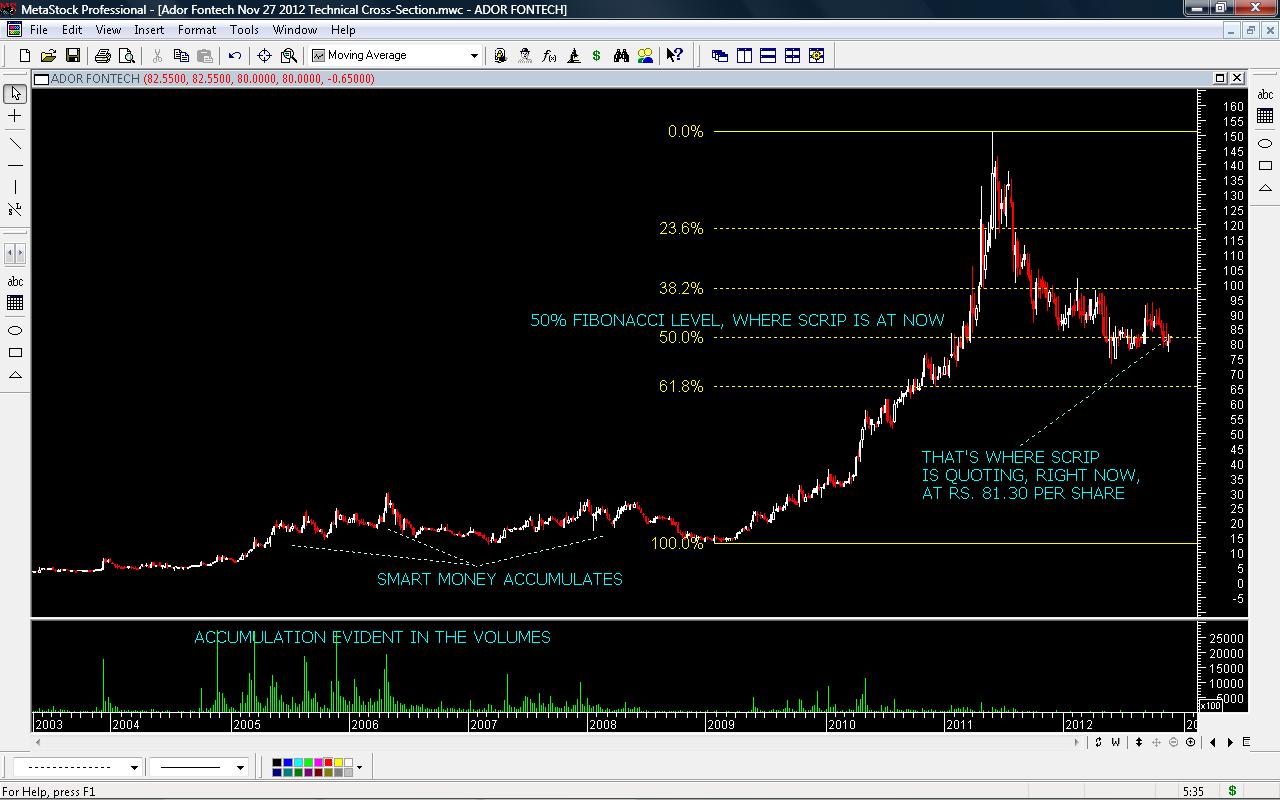
Due Diligence Snapshot + Technical Cross-Section — Ador Fontech Limited — Nov 27 2012

Image

Price – Rs. 81.30 per share

Earnings Per Share projected on the basis of quarter ended Sep 30 2012 – Rs. 12.62

Price to Earnings Ratio (thus, also projected) – 6.44

Price to Book Value Ratio – the stock is selling at approximately 2 x book value currently

Debt : Equity Ratio – Nil

Current Ratio – 2.73

Profit After Tax Margin – 12.51%

Return on Networth – 32.54 %

Pledged Shares %age – Nil

Face Value – Rs. 2.00

Dividend Payout – 50% -150% of face-value.

Average Daily Volumes – around 5 – 6 k / day on BSE.

Product – Reclamation of alloys, fusion surfacing (preventive welding), spraying and environmental solutions.

Promoters – JB Advani & Company Pvt Ltd (of Advani-Oerlikon fame) + a group of other Sindhi business-people.

Share-holding Pattern – Promoters (35.4%), Public (58.9%), Institutions (2.0%), NICBs (3.7%).

Technicals (see chart below) – This is a very low volume scrip, so there could be slippage. The scrip has corrected from its June 2011 peak of Rs. 150.90 to a pivot of Rs. 73.25 within about one year. This low pivot lies bang in between the 50% and the 61.8% Fibonacci levels of correction on the weekly chart. Currently, the scrip is quoting at Rs. 81.30, just below the Fib. 50% level. Volumes are average, with one high volume peak every 7 odd trading days. The scrip is trading in a broad band between Rs. 73.25 and Rs. 93.90. Perhaps it is trying to establish a base.

Comments – Fundamentals are good, and the company’s corporate governance is considered clean. Market for the company’s niche is considered small, and people view that as a long-term growth concern. Technically, correction has taken place, and thus value shines out fundamentally. Debt is nil. Dividend is excellent. Projected PE is low, though P/BV is a bit high. Cushion is there, and profitability and returns are exemplary. Future investment would be required to keep niche-segment status alive.

Buy? – I like the theme – reclamation and preventive welding. Contrary to what others say, I feel the market is going to grow phenomenally, as earth and rare-earth metals become difficult to source, and need to be reclaimed. Valuations are excellent, governance is great, payouts are great too, and a technical buying level has presented itself. Yes, it’s a long-term buy right now. Remember, this is not a trade we are speaking about, so we are not going to talk in terms of a stop-loss. This is a long-term investment, and we’ve been speaking in terms of margin of safety, which I’m sure you’ve noticed. Also, while buying, one needs to show caution regarding slippage, which is invariably going to occur owing to the low-volume nature of the scrip.

Disclaimer and Disclosure – Opinions given here are mine only. You are free to build your own view on the stock. I have bought a miniscule stake in Ador Fontech today. Data given here has been compiled from motilaloswal.com, moneycontrol.com and equitymaster.com. Technicals have been gauged and shown using Metastock Professional version 9.1 by Equis International.