Can We Please Get This One Basic Thing Right?

Pop-quiz, people – how many of us know the basic difference between investing and trading?

The logical follow-up question would be – why is it so important that one is aware of this difference?

When you buy into deep value cheaply, you are investing. Your idea is to sell high, after everyone else discovers the value which you saw, and acted upon, before everyone.

When you’re not getting deep value, and you still buy – high – you are trading. Your idea is to sell even higher, to the next idiot standing, and to get out before becoming the last pig holding the red-hot scrip, which would by now have become so hot, that no one else would want to take it off you.

The above two paras need to be understood thoroughly.

Why?

So that you don’t get confused while managing a long-term portfolio. Many of us actually start trading with it. Mistake.

Also, so that you don’t start treating your trades as investments. Even bigger mistake.

You see, investing and trading both involve diametrically opposite strategies. What’s good for the goose is poison for the gander. And vice-versa.

For example, while trading, you do not average down. Period. Averaging down in a trade is like committing hara-kiri. What if the scrip goes down further? How big a notional loss will you sit upon, as a trader? Don’t ignore the mental tension being caused. The thumb rule is, that a scrip can refuse to turn in your direction longer than you can remain solvent, so if you’re leveraged, get the hell out even faster. If you’re not leveraged, still get the hell out and put the money pulled out into a new trade. Have some stamina left for the new trade. Don’t subject yourself to anguish by sitting on a huge notional loss. Just move to the next trade. Something or the other will move in your direction.

On the other hand, a seasoned investor has no problems averaging down. He or she has researched his or her scrip well, is seeing  deep-value as clearly as anything, is acting with long-term conviction, and is following a staggered buying strategy. If on the second, third or fourth buy the stock is available cheaper, the seasoned investor will feel that he or she is getting the stock at an even bigger discount, and will go for it.

Then, you invest with money you don’t need for the next two to three years. If you don’t have funds to spare for so long, you don’t invest …

… but nobody’s going to stop you from trading with funds you don’t need for the next two to three months. Of course you’re trading with a strict stop-loss with a clear-cut numerical value. Furthermore, you’ve also set your bail-out level. If your total loss exceeds a certain percentage, you’re absolutely gonna stop trading for the next two to three months, and are probably gonna get an extra part-time job to earn back the lost funds, so that your financial planning for the coming months doesn’t go awry. Yeah, while trading, you’ve got your worst-case strategies sorted out.

The investor doesn’t look at a stop-loss number. He or she is happy if he or she continues to see deep-value, or even value. When the investor fails to see value, it’s like a bail-out signal, and the investor exits. For example, Mr. Rakesh Jhunjhunwala continues to see growth-based value in Titan Industries at 42 times earnings, and Titan constitutes about 30% of his billion dollar portfolio. On the other hand, Mr. Warren Buffett could well decide to dump Goldman Sachs at 11 – 12 times earnings if he were to consider it over-valued.

Then there’s taxes.

In India, short-term capital gains tax amounts to 15%  of the profits. Losses can be carried forward for eight years, and within that time, they must be written off against profits. As a trader, if you buy stock and then sell it within one year, you must pay short term capital gains tax. Investors have it good here. Long-term capital gains tax is nil (!!). Also, all the dividends you receive are tax-free for you.

Of course we are not going to forget brokerage.

Traders are brokerage-generating dynamos. Investors hardly take a hit here.

What about the paper-work?

An active trader generates lots of paper-work, which means head-aches for the accountant. Of course the accountant must be hired and paid for, and is not going to suffer the headaches for free.

Investing involves much lesser action, and its paper-work can easily be managed on your own, without any head-aches.

Lastly, we come to frame of mind.

Sheer activity knocks the wind out of the average trader. He or she has problems enjoying other portions of life, because stamina is invariably low. Tomorrow is another trading day, and one needs to prepare for it. Mind is full of tension. Sleep is bad. These are some of the pitfalls that the trader has to iron out of his or her life. It is very possible to do so. One can trade and lead a happy family life. This status is not easy to achieve, though, and involves mental training and discipline.

The average investor who is heavily invested can barely sleep too, during a market down-turn. The mind constantly wanders towards the mayhem being inflicted upon the portfolio. An investor needs to learn to buy with margin of safety, which makes sitting possible. An investor needs to learn to sit. The investor should not be more heavily invested than his or her sleep-threshold. The investor’s portfolio should not be on the investor’s mind all day. It is ideal if the investor does not follow the market in real-time. One can be heavily invested and still lead a happy family life, even during a market down-turn, if one has bought with safety and has even saved buying power for such cheaper times. This status is not easy to achieve either. To have cash when cash is king – that’s the name of the game.

I’m not saying that investing is better than trading, or that trading is better than investing.

Discover what’s good for you.

Many do both. I certainly do both.

If you want to do both, make sure you have segregated portfolios.

Your software should be in a position to make you look at only your trading stocks, or only your investing stocks at one time, in one snapshot. You don’t even need separate holding accounts; your desktop software can sort out the segregation for you.

That’s all it takes to do both – proper segregation – on your computer and in your mind.

Anatomy of a Multibagger

Wouldn’t we all like to rake it in?

A multibagger does just that for you. Over a longish period, its growth defies normalcy.

In the stock markets, a 1000-bagger over 10 years – happens. Don’t be surprised if you currently find more than 20 such stocks in your own native markets.

Furthermore, our goal is to be a part of the story as it unfolds.

Before we can invest in a multibagger, we need to identify it before it breaks loose.

What are we looking for?

Primarily, a dynamic management with integrity. We are looking for signs of honesty while researching a company. Honest people don’t like to impose on others. Look for a manageable debt-equity ratio. Transparency in accounting and disclosure counts big. You don’t want to see any wheelin’-dealin’ or Ponzi behavior. If I’d been in the markets in the early ’80s and I’d heard that Mr. Azim Premji drove a Fiat or an 800, and flew economy class, I’d have picked up a large stake in Wipro. 10k in Wipro in ’79 multiplied to 3 billion by ’04. That can only happen when the management is shareholder-friendly and keeps on creating value for those invested. Wipro coupled physical value-creation with market value-creation. It kept announcing bonus after bonus after bonus. God bless Mr. Premji, he made many common people millionaires, or perhaps even billionaires.

A good management will have a clean balance-sheet. That’s the number two item.

The company you’ re looking at will need to have a scalable business model.

It will need to produce something that has the ability to catch the imagination of the world for a decade or more.

The company you’re looking at will need to come from the micro-cap or the small-cap segment. A market-cap of 1B is not as likely to appreciate to 1000B as a market-cap of 25M is to 25B.

Then, one needs to get in at a price that is low enough to give oneself half a chance of getting such an appreciation multiple.

Needless to say, the low price must invariably be coupled to huge inherent value which the market is not seeing yet, but which you are able to correctly see.

After that, one needs the courage and conviction to act upon what one is seeing and has recognized.

One needs to have learnt how to sit, otherwise one will nip the multibagger in the bud. Two articles on this blog have already been dedicated to “sitting”. Patience is paramount.

The money that goes in needs to be a small amount. It’s magnitude shouldn’t affect your normal functioning.

Once a story has started unfolding, please remember one thing. If a stock has caught the imagination of the public, it can continue to quote at extended valuation multiples for a long time. As long as there is buying pressure, don’t exit. One needs to recognize buying pressure. That’s why, one needs to learn charting basics.

Phew, am I forgetting something here? Please feel welcome to comment and add factors to the above list.

Here’s wishing that you are able to latch on to many multibaggers in your investing career.

🙂

A Critical Look at Debt on the Balance-Sheet

Borrowed money needs to be paid back.

Pray where is a company going to pay it back from?

From current reserves and /or earnings, of course.

Unless you do a Suzlon and restructure your 2 billion dollar debt.

When I hear the word “restructure”, I feel like puking.

By the way, one can even do a “Mallya”, and expect the government to pay off chunks of one’s almost 1.5 billion dollar debt.

By now, I’m really throwing up.

I mean, first, some people borrow. Then comes a spending frenzy. Then these people don’t want to pay back what they borrowed. Oh, sorry, some don’t even want to pay the interest back, let alone the principal.

Frankly, I don’t wish to invest in companies run by people who delay paying back their debt through maneuvering and manipulation.

I detest manipulation. Prefer it straight-forward.

You guessed it – I’m a debt-averse human-being. What pleases me most in a company is a debt-free balance-sheet. It is challenging to find debt-free companies that are able to grow freely and fast, and when one runs into such a company, it’s like a home-run. After that one waits for the right price, but that’s another story.

Most companies borrow. They wish to grow, and funds are not there, while opportunity is.

Fine. Borrow.

Then, show me that you want to pay back. On time. ( = integrity ).

Show me that you haven’t lost your marbles while borrowing, and have borrowed an amount which by no means risks the existence of your company. ( = balance ).

Furthermore, show me that you are creating value with the borrowed amount. ( = shareholder-friendliness ).

Show me, that after payment of interest on borrowings, you can still generate a reasonable earning per share. ( = diligence ).

That would make me want to invest in your company, despite your debt.

Oh, one more thing, I would only stay invested long-term in your company, if I see you decreasing your debt-burden year upon year. ( = like-mindedness, i.e. debt-aversion ).

Also, if any new debt taken on doesn’t fit the above criteria, I would look to exit. ( = over-confidence because of earlier successes ).

Once invested, keep rechecking the story every few months. Times are bad. If you don’t look, it is likely that a CEO will pull a stunt right under your nose. Yes, it’s totally possible that your investment doesn’t meet your criteria anymore, and that you are still invested. Don’t let that happen.

At least with regards to debt, have an exact check-list. If a company doesn’t meet your standards regarding debt, discard the company. During times of high interest-rates, large debt on the balance-sheet is like a raging fire which refuses to be stilled, and which can well terminate the existence of a company.

Your success as a long-term investor depends much on how you react to debt.

Here’s wishing you wary and successful investing!

Cheers!   🙂

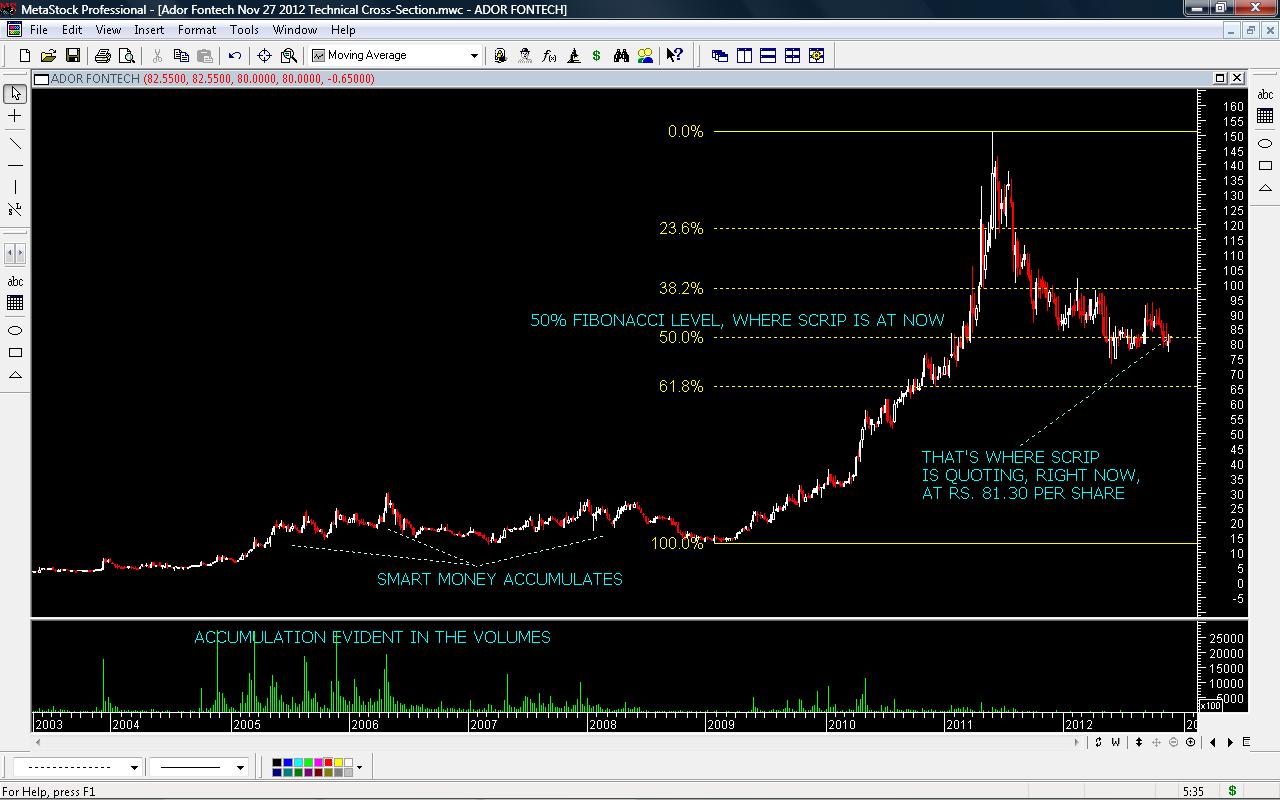
Due Diligence Snapshot + Technical Cross-Section — Ador Fontech Limited — Nov 27 2012

Image

Price – Rs. 81.30 per share

Earnings Per Share projected on the basis of quarter ended Sep 30 2012 – Rs. 12.62

Price to Earnings Ratio (thus, also projected) – 6.44

Price to Book Value Ratio – the stock is selling at approximately 2 x book value currently

Debt : Equity Ratio – Nil

Current Ratio – 2.73

Profit After Tax Margin – 12.51%

Return on Networth – 32.54 %

Pledged Shares %age – Nil

Face Value – Rs. 2.00

Dividend Payout – 50% -150% of face-value.

Average Daily Volumes – around 5 – 6 k / day on BSE.

Product – Reclamation of alloys, fusion surfacing (preventive welding), spraying and environmental solutions.

Promoters – JB Advani & Company Pvt Ltd (of Advani-Oerlikon fame) + a group of other Sindhi business-people.

Share-holding Pattern – Promoters (35.4%), Public (58.9%), Institutions (2.0%), NICBs (3.7%).

Technicals (see chart below) – This is a very low volume scrip, so there could be slippage. The scrip has corrected from its June 2011 peak of Rs. 150.90 to a pivot of Rs. 73.25 within about one year. This low pivot lies bang in between the 50% and the 61.8% Fibonacci levels of correction on the weekly chart. Currently, the scrip is quoting at Rs. 81.30, just below the Fib. 50% level. Volumes are average, with one high volume peak every 7 odd trading days. The scrip is trading in a broad band between Rs. 73.25 and Rs. 93.90. Perhaps it is trying to establish a base.

Comments – Fundamentals are good, and the company’s corporate governance is considered clean. Market for the company’s niche is considered small, and people view that as a long-term growth concern. Technically, correction has taken place, and thus value shines out fundamentally. Debt is nil. Dividend is excellent. Projected PE is low, though P/BV is a bit high. Cushion is there, and profitability and returns are exemplary. Future investment would be required to keep niche-segment status alive.

Buy? – I like the theme – reclamation and preventive welding. Contrary to what others say, I feel the market is going to grow phenomenally, as earth and rare-earth metals become difficult to source, and need to be reclaimed. Valuations are excellent, governance is great, payouts are great too, and a technical buying level has presented itself. Yes, it’s a long-term buy right now. Remember, this is not a trade we are speaking about, so we are not going to talk in terms of a stop-loss. This is a long-term investment, and we’ve been speaking in terms of margin of safety, which I’m sure you’ve noticed. Also, while buying, one needs to show caution regarding slippage, which is invariably going to occur owing to the low-volume nature of the scrip.

Disclaimer and Disclosure – Opinions given here are mine only. You are free to build your own view on the stock. I have bought a miniscule stake in Ador Fontech today. Data given here has been compiled from motilaloswal.com, moneycontrol.com and equitymaster.com. Technicals have been gauged and shown using Metastock Professional version 9.1 by Equis International.

Who Told Who So?

Nobody’s in a position to tell anyone so.

That’s the marketplace for you in a nutshell.

There are times when you’re sure a scrip has peaked, and it just keeps on going higher, and higher, and then even higher.

At other times, a scrip might show tremendous valuations, but it just refuses to rise. 9 years in a row. Just refuses to rise.

Welcome to a world where if you’re able to watch your own back, you’re good.

In the world we are speaking about, a Rakesh or a Warren are what they are because that’s what suits them particularly. What suits them might most definitely not suit you. What makes you think you can emulate someone in the marketplace?

That’s the whole point, people.

You need to carve out your own unique niche in the marketplace. Something that suits you, and just you. If you do that, you’ll be happy. Satisfied from within. And that’s when you’ll start doing well.

Your best performances will come when you start being … … yourself.

Playing someone else’s game? Well, try to. Don’t be surprised if you lose your pants.

Your biochemistry is unique. So are your reactions to subtle changes around you. Thus, your interactions and dialogues with Mrs. Market need to be unique. These need to cater to your needs, your queries, your tendencies and your idiosyncrasies.

We try to follow rules. We want to master Mrs. Market. Frankly, what a joke!

Firstly, we need to make our own rules, for ourselves.

Secondly, Mrs. Market needs to be understood, even if for short spans, and she most definitely doesn’t need to be mastered. She’ll master you rather than you her. Be wary of her, win from her, but why do you wish to conquer? Fool’s paradise. Stick to the script, pal. Take your winnings and go. Why do you bet the farm, in an effort to make a killing? You’re not proving any point to anyone. Everyone’s busy doing their own thing with Mrs. M. No one’s looking at you. You don’t need to prove anything to anyone. Don’t bet the farm. Stick to the script. Take your winnings and go.

So, what’s the real learning in this world we speak about?

When you go wrong. That’s when real learning begins. How do you handle yourself? How do you come back? How do you start winning again? How do you then keep winning, again, and again, and again.

That’s the learning.

I didn’t tell you so.

You discovered it for yourself.

Remember that.

Discover it for yourself.

What’re you waiting for?

Getting Too Comfy For Our Boots, Are We?

What a party we are having in the debt-market, aren’t we?

Exceptional payouts, day after day, week after week, month after month, it’s almost going to be year after year.

Are you getting too comfortable? Lazy, perhaps?

Meaning to say, that when you can get a 10 % return after tax without having to move your behind for it, it is a very welcome scenario, right?

People, scenarios change.

It isn’t always going to be like it is at the moment.

Are you flexible enough to change with the scenario?

Or will you be lost in the current moment, so lost, that you will not recognize the signs of change?

What would be these signs? (Man, this is like spoon-feeding….grrrrrr&#*!).

Inflation begins to fall.

The country’s central bank announces back to back interest rate cuts.

Too lazy to read the paper? Or watch the news? Ok, if nothing else, your online liquid mutual fund statement should tip you off.

How?

The payout, dammit, it will have decreased.

Also, something else starts performing.

What?

Equity.

Smart investors don’t like the debt payout anymore. They start moving their smart money into value equity picks.

Slowly, media stops reporting about a gloomy economy. The buzz gets around. Reforms are on the way.

Foreign direct investment picks up. The media latches on to it. It starts speaking about inflows as if the world begins and ends with inflows.

Now, the cauldron is hot and is getting hotter.

Debt payouts are getting lesser and lesser. Equity is already trending upwards, and has entered the meat of the move.

If the trend contnues, a medium to long-term bull market can result.

There you have it, the chronology played out till just before the start of a bull market of sorts.

Be alert. Recognize the signs early. Be mentally in a position to move out of the debt market, if the prevailing scenario changes.

Otherwise…

… you miss a first run in equity. Boo-hoo. When stocks cool at a peak, and start falling, you make multiple wrong entries into them.

You get hammered by equity, having caught it on the down-swing.

You missed the correct entry time-point in equity because the debt-market made you too comfortable. You were late to act. When you acted, finally, you caught a correction, and took a hammering.

One or two more hammerings like that, and you’ll be off equity for the rest of your life.

And that, my dear friend, would be a pity.

Why?

Because, in mankind’s history, it is stocks that have given the best long-term returns. Not gold, not debt, not bonds, but stocks.

You need to approach them properly, and timing is key.

What’s your Value to the Planet?

Nothing’s forever.

That applies to the Dollar too.

Let’s be very clear in our minds, that the Dollar is not going to rule the roost forever.

Nothing has.

Is the US showing the fundamentals that would allow the USD to hold its position for even a decade?

I don’t think so.

The policy to print notes and to throw them from a helicopter on top of any problem or issue is long-term detrimental to the Dollar’s fundamental value.

Eventually, fundamentals shine forth. What’s true is true, and eventually, the truth is recognized.

What then?

Gold-standard?

Possible.

Has been adopted before.

What speaks against it?

Gold’s too bulky. Can’t carry it around.

So what? Store it in a bank, and carry its value on a credit card, ready to be spent.

There could be Gold wars.

Aren’t there Dollar wars? Oil wars? So fine, there will be Gold wars. Tell me something new.

Gold reserves are limited.

Hmmm, after all the world’s Gold has been mined, what then?

Actually, why do we want get into this rigmarole in the first place?

How about this?

What’s your value to the planet?

Can it be translated into a point system at any given time? Can the points be carried around on a credit card, ready to be spent?

Why not?

Your blog gets a hundred clicks today, so big brother adds a hundred value points to your value point (VP) account, redeemable through a carry card, or an iris-check, or finger scan or what-have-you.

You do community service for five hours @ 50 VPs an hour and scoop up a cool 250 veeps (= VPs).

What? You invented a breakthrough technology? You get it patented through big bro, and everytime anyone uses it worldwide, 5 veeps are transferred to you. For life. You’ve made it big.

You manufacture gambols? Every unit sold fetches you 2 veeps. Oh, you’re making wimlets for 5 veeps a piece, are you?. Dragloons for 20? Hamlins for half a veep?

A burger costs one-fourth veep, and a round of groceries can set you back by up to 10 VPs.

You’ve got to keep them VPs going. If you’re clever, you’ll do something that keeps the veeps coming in on auto-pilot, so that you can focus on something new, to achieve another breakthrough elsewhere.

Dr. Dracula charges 2 veeps for a blood-test. He does 10 blood tests a day for free. Big B rewards any pro bono activities with bonus veeps. Doc Dracula doesn’t mind.

Professor Loo Sing Mind delivers lectures at 50 veeps a shot. He also lectures at the community evening school twice a week. Bro wanted to reward him 50 VPs per community lecture. Prof forwarded the reward veeps to the “food for the poor scheme”.

Herr Wasser serves water at the factory all day. He earns an eighth veep for every glass served.

Miss Gour May owns a restaurant. Any food that’s left over is distributed to the hungry. BB is not leaving any form or service unrewarded. Miss May earns an extra 100 veeps a month from the state for being an exemplary citizen.

Mrs. Sprint Fast is a national athlete. For every international race she wins, there are 50,000 VPs waiting. Her olympic gold medal got her a million veeps from benevolent big brother. When she retires, she’ll take up sports journalism @ 50 veeps per two hours of coverage or per article.

Mr. Poo R. Man is a beggar. The state shuns him. There’s no way for anyone to transfer even a single VP to him. He can only be given physical food and clothing by charitable people. He soon decides to quit begging, and joins community school to learn a craft. His studies are funded by the state. Citizens are free to donate veeps to various schemes run by the state. Community school is one such scheme.

Dr. Savio Planeto is a research scientist who works for the Climate Change Foundation. He is paid 1000 VPs for every day of research. Any breakthroughs will be rewarded extra, and befittingly. His summa cum laude on his Ph.D. earned him a million veeps from the state.

Miss Bee Keaney walks the ramp for 2000 veeps a go. 25 assignments a month keep her account flooded.

Mr. Keep D. Law is a government servant in the justice department. For any papers that he pushes through on time, there are 50 veeps waiting for him. Any slacking means no VPs. If a case is closed, he gets 500 veeps if he has a role in the case’s paperwork. Thus, the state encourages him, a small cog in the wheel, to push cases towards closure. Imagine, then, the efficiency of this state. Also, there’s no way any citizen can pass on a VP bribe to Mr. Law. It’s just not possible without anybody noticing. So it’s not done. Result is, that the government servant focuses on efficiency to ramp up his VP account.

SEE?!?

Within a few minutes, we have been able to conjure up a whole new currency system that functions on the basis of one’s value to the planet.

If we can do this within minutes, why can’t the world work towards it in the next twenty odd years?

Of course it can.