A-Gamers

Hey, …

…nowadays, …

…we only play our A-game.

There’s no time for formalities.

It’s late in the day.

All weapons are out.

This is the need of the hour.

So, what are the salient features of our A-game?

A well-forged, multiply-faceted, time-tested road map – our system of systems – our one Strategy. This one’s 360 degrees. It incorporates both trading and investing, and leads to very long holds in cost-free form. Includes more than twenty highly competitive, sharpened, edge-providing Modules, about which I wrote a few articles back. As far as strategies go, we are cruising in a Maybach on the Autobahn. No worries there.

Patience. In the last twenty odd years, we have learnt how to sit. Makes biggest money, said we know who. Patience is ubiquitous, or is it? Many people have developed it. Many are born with it. But then, many are not. And, markets demand their own kind of patience. Over the years, we have learnt and developed market-patience. We wait for our levels before acting. We sit on our Cost-Free-Ness, like, forever. We are not in a hurry. I ‘can behave’ as if this is my own module 🙂 (do allow me the indulgence), but patience is universal and out there for everyone to incorporate and exploit on their own.

Liquidity. This is a module. Am reiterating it here since it is key. Our initial small-entry-quantum strategy (remember, that’s how we started!) allowed us ample liquidity, always. Yes, we were always liquid in situations, when they came, while building up the backbone of our portfolios. Slowly, portfolio-size started to grow. Then came the incorporation of position-sizing, thanks to my learnings from Dr. Van K.Tharp. Subsequently, I instinctively added my own twist to this, making it Non-Linear Position Sizing (NLPS) that we follow. NLPS initially allows for small entry quanta. As portfolio-size increases, so does each entry quantum-size. However, the latter increases more than y = x, i.e. more than linear. This means that over the very long term, entry quanta become remarkably substantial in size. Nevertheless, we still maintain balance by perhaps Fine-Tuning entries and exits to the nth level, i.e. with huge win probabilities, which automatically / mathematically leads to lesser entries. Strategy thus goes on cruise-control. Furthermore, outstanding entry-prices, followed by Quick Generation of cost-free-ness make our very long-term holdings as Anti-Fragile (thanks for the term, Mr. Taleb) as possible.

Talking of cruise-control, our back-end allows for full Automation at button-clicks. All transactional trail-mail is auto-forwarded to every required avenue. It’s a one-time self-setup time-expense, so don’t be afraid of it, since the reward is disproportionately huge. Each avenue allows preview and further transfer / storage after button-clicks. Taxation? Button-clicks. Indexing? Button-clicks. Retrieval? Button-clicks. Viewing in any format? Button-Clicks (baby).

Time. We have all the time in the world. We do our own thing. Income is sorted. Wealth is being generated on auto, and is multiplying. Learn languages. Travel. Pro-bono. I teach kids. To manage their own finances. From a young age. Currently I’m teaching four kids. It’s a give-back, and they can pay it forward.

In a nutshell, that’s my A-game. I’ve taught it forward, so I can talk about a we. You’ve seen it develop in this space over the last 14+ years. I’ve nothing to hide. It’s for everyone to use and benefit from. The act of Giving gives me the most Satisfaction in life.

Obviousness

Knowledge streams…

…at unprecedented speed.

You want it?

You got it.

Lag is negligible.

Everyone has access.

Conclusion? Fazit? Nichor? Bilan?

What seems obvious is likely a trap.

Fundamentals can be fudged, to an extent. A closer look at gaps between fundamentals vs actuals unveils those who fudge. Actuals on the ground will need to match fundamentals, somewhere. For example, if there’s no debt on the balance-sheet, there will well be a surplus which the company in question accumulates, and there will be a path on which this surplus flows. This path should be visible in the annual report. If there’s no surplus, company will show visible signs of stagnation. If something officially declared by a company doesn’t match (visible) actuals, the fudging window opens. We steer clear of companies with even a fudging crack open.

Technicals can be used to set entry and exit traps.

By professionals

For the masses.

Masses act at levels.

Generally, price hovers around an obvious level till the majority has acted. Then, generally, price goes against. When crowds cut entries, institutions enter on their exits. This strategy paves the way for relatively easy and heavy entries.

Moral of the story for us?

We wait for an obvious level.

We don’t act. Yet. However, we are on alert.

We envision an aftermath play in our minds.

Entry pivots are coming quick, nowadays. There’s hardly any time to act, especially if one has an otherwise busy schedule.

Therefore…

…we only deal in GTTs. Period.

Thus we feed in our GTTs, as per mentally outlined situation, and back up these with funding, if entry-trigger is less than 5.2% away. All this we do in a cool moment, after market hours, away from the noise, when we can think clearly.

And, most importantly, …

…we do it away from the obviousness.

Chronology

Pipelines…

…come at a cost.

And, first up, there’s no need to fret about this cost.

I know, it pinches.

Having funds at a 20 second disposal will definitely cost.

Why go this extra, extra mile?

That’s a very befitting question.

We are not mad to create pipelines on call within 20 seconds.

Well, just to give you a heads up about how things can go down, here’s something.

June 4th, India, markets tank in the first hour.

Alerts, GTDs, GTTs, what-have-yous trigger.

I’m busy. Business meeting. Can’t get away.

6 of 7 GTTs in place get hit, and I’m in on these 6 scrips, at my price. 7th gets hit. No entry. No more funds in purchase account reported.

As meeting leader delivers on taxation laws in the country, there’s regret in my mind. Why did I not have enough funds in place?

Idea.

Let’s slimily look busy, and, meanwhile, activate a pipeline, put funds in place, and forcefully enter this particular scrip at CMP.

“Could you please pay attention, Mr. Nath, and put your phone away!”

Yikes.

Meeting ends (phew).

Action stations. Funds in place. Yes.

But what have we here?

Scrip’s showing a huge pin, and live daily candle has become a hammer. Bottomed out and then some, has the scrip. CMP is now 11% above the bottom.

Chickening out.

11% shaved off my margin of safety, in 45 minutes.

Yes people, that’s the window nowadays, for getting dream entries.

45 minutes.

Had it not been for the meeting, I would have been in within a minute or two, after reading the alert that GTT got triggered but no funds were available.

Lost time in this case would have been the interval between reading messages, plus a minute or two to have funds in place and go through with the buy. I’m not very regular about messages, though, perhaps on purpose, and 30 minute plus periods can well elapse. So, window cuts very fine. Idea is, whenever awareness kicks in, one needs to be in within a minute or two, if the GTT option has failed to deliver due to whatever reason.

The case described above was the one time that did not work, despite having everything of the highest quality in place.

What puts salt on the wounds is that the scrip quasi doubled from there within three months, so those lost 11% on margin of safety were peanuts. Yeah, the final fail was my fearful mind.

Painfulllllll….

That’s how it crumbles. One learns from the pain.

No pain, no learning.

My learning from this is that when GTT limit is 5.2% below CMP, we just sheer put funds in place for that GTT…

…now.

Throw-Offs

Hey.

Stumbled upon a concept.

Calling it the throw-off, and…

…sharing it with you.

How many times have you booked too early?

Booked late?

Gotten in early?

Late?

Not risen to required action?

Made a bad decision?

Lost faith in the market?

In yourself?

These are results of throw-offs.

Something has thrown you off your game.

This something is the ongoing market action at the time.

Action has been such, that it has thrown one off one’s track.

It’s not your fault. Action is such.

Price hits a stop, for eg. You take the stop. Price resumes in same direction.

Price hits a target. You get out. Price resumes.

Price falls just short of the stop, resuming. You double down. Price then breaches stop and a down-trend starts.

Price shoots past target, not giving you time to act. You then define a new target. Price nose-dives beneath old target, just as fast, eating up a good portion of your original profits.

Examples can be many. Common factor is market action throwing you off your profits, or throwing you out in loss.

Where do we stand?

Is this cause for alarm?

Is there something we can do about it?

First up, market action is a sum resultant of all market behaviour put together, and is perhaps impossible to defy. Our pockets are not deep enough by miles.

We don’t fight market action.

We use it.

Yes, since we can’t defy it as such, we make it work for us. Also, if market action alarms you, do something else which doesn’t. That’s where we stand.

It’s ok to be thrown off while following one’s trading plan.

It’s not ok to be thrown off, having been psyched into altering one’s trading plan mid-trade.

Meaning that it’s not ok to book below target owing to adverse market action above one’s stop.

Also, when a trade is going against us, again, it’s not ok to exit owing to adverse market action above one’s defined stop.

One exits at stops, not above. Sticking to this one rule will nullify throw-offs above stops. Defining is easy. Doing is difficult. Over time, with practice, we define and do. Period.

Now we tackle targets.

How do we knock-out throw-offs here?

Another day, another defining rule… 🙂 … .

Don’t exit at targets.

If you don’t exit at targets, no one can throw you off before a target.

Ok, so what’s the exit strategy whilst in profit?

Have a target.

When it comes, it triggers your stop into existence, which you have defined x% below this target.

So, we now stop using the word target. We use ‘trigger’ instead.

In other words, your stop gets activated, or triggered into existence, once a certain profit-threshold is crossed.

This stop, which has just come alive, is dynamic in nature, towards the profit-side only.

It moves in the same direction as the price, in a proportion defined by you.

As price keeps moving, your stops keeps locking in more and more profit.

You’ve knocked out the throw-off, since your exit is completely rule based, and no one else knows the parameters (numbers) you are feeding in for exit.

Eventually, price action makes you exit rule-based, when price reverses above the ‘trigger’ and hits your dynamic stop. Market action hasn’t succeeded in throwing you off your game.

Notice one thing?

You’ve been in control of your trade all along.

Your head is sane, your emotions are stable. You have set yourself up to take some very profitable decisions.

Wishing for you lots of profits…

… 🙂

.

Process

In the markets…

… actions are decisions.

No decision taken means no action.

Well, no action is also an action.

Ok.

However…

… eventually …

… to generate wealth …

… or income …

… we are confronted with decisions.

I’m not afraid to act, upon seeing a confluence of supportive indications.

If I were afraid to act, well, I could have just sheer chosen another line, but would have been confronted with the same deficiency, there too.

Acting upon enhanced win probability should do away with any fear.

However, there’s always that thing before trigger-press.

What if I’m wrong?

Let’s not be afraid of being wrong.

We’ll take our stop and then we’re done with this action, now looking at implementing another action.

Our ability to take the decision for this other action, and for all future actions should remain intact.

How do we ensure that?

When we’re wrong, let’s be wrong small.

Then let’s move on to whatever new action is coming our way.

If we let ourselves be wrong big, that, my friends, is crippling.

Let’s not cripple ourselves.

Crippling does away with the capability to act further.

Now, decisions are a fry cry.

The day becomes heavy.

Nights …

… well …

… sleepless.

That’s not going to happen to us.

Why?

As traders, will do everything in our capability to stop a big loss from happening.

How?

Losses are small in the beginning.

Let’s define their limit.

If you want to take it trade by trade, fine. Each trade has its own dynamics. However, small nature of stop remains common. Define what is small for you.

How?

My formula – anything that stops the day from becoming heavy and the night from becoming sleepless. For me, that’s small. You decide your formula. Whatever works for you, take it.

This is called process.

We follow process.

We don’t focus on profit and loss.

We focus on process.

We want to get our process correct, day in, day out, forever.

Losses will follow. They will be taken small.

Profits will follow. We will allow these to become big. Though that is a difficult one, we will need to learn to, because without this one thing working for us, we won’t be long-term profitable.

Here’s a formula regarding letting profits run.

After a profit has touched 3 x your stop, allow 50% breathing space. If this is squeezed completely, exit with small profit. If underlying inches higher, inch your stop upwards, always allowing for breathing space. At 4 x you can allow 40% breathing space, at 5x 30%. Etc. Make your own formula that allows profits to burgeon.

Wishing you lucrative trading and ample wealth creation!

🙂

Pipelines

Replicability of an approach is a pipeline. You can always draw on it for a fresh trade, for example.

Scalability is a pipeline getting broader.

Research sharpens the edges of your pipeline, sustains these well, and founds new paths (pipelines), going forward.

Deep Thought is where one taps the pipelines of the Universe.

Experience builds reflexes, which guard and enhance pipelines. This is intuition in action.

Ability to discern allows judgement to manipulate a pipeline in the correct direction.

Cataloguing provides hindsight, so that the pipeline of foresight is strengthened.

Giving opens up vast positive pipelines for oneself, by creating energy vacuum in one’s immediate environment.

Relaxation allows the pipeline of genius to emerge. Brilliant sparks which have been developing silently, within oneself, burst forward.

Family is a pipeline of joy.

Freedom allows the pipeline of creativity to flow.

Also, detachment allows time for the pipeline of flow to form properly. This is particularly valid in trading. Think of profits being allowed to run, for starters.

If I rack my brains, I’ll come up with more…

…pipelines.

That’s not the point.

The point is to delineate that one’s per saldo self is a net resultant of many pipelines acting in tandem.

These have taken time, effort, fortune, patience, blood, sweat, tears and what have you to create.

I measure my life’s success in seamlessly implemented pipelines on autopilot.

For every long-term, seamless, auto-pipeline functioning optimally and on full, there have probably been fifty discarded efforts.

Whether one is trading, investing or sheerly living a fulfilling life, …

… it’s one ‘s pipelines that provide critical support.

Making Time Stand Still

The buck stops…

…with the entity called time.

Too much hangs on it.

Lack of it makes decisions difficult.

Too much of it defers them.

In the markets, we take it out of the equation…

…and then act.

If not, market forces bog us down.

And, imagine the load if our game is heavy.

After having gotten our basics infallibly into place, we wish to play a heavy game, without the load.

Hence,…

… – time – …

…first we take out of the equation,…

…and then we play.

We stretch the trade duration to a potential infinity. Period.

Trade might resolve in a few days. Or not. Right.

However, potential infinity gives us the wherewithal to focus on the next play.

Then, before action, we make time stand still.

How?

By forgetting that it exists.

By focusing on the one act that we are about to commit.

By encompassing the totality of all connectivities that have led us to the moment of acting, and having them before our mind and on our fingertips, as we act.

By being pinpointedly mindful of our actions whilst shutting out any disturbing noise.

By being…

…in the Zone,…

…such that,…

physically,…

…time might tick,…

…but for us it doesn’t seem to.

And…

…why?

Why are we so interested in making time stand still as we act?

For just one pure reason.

We want our act to have maximum impact.

And that it will, once we act, immersed in the scheme of things.

The chronology is as follows : Time still-stand, identification of market act, entry into scheme of things, action, exit from scheme, time roll-forward.

Timeframe doesn’t register in our minds. Potent action is identified, and happens, fitting into the natural fabric of things, into the timeline of the scheme of events.

Impact, ideally, is maximum.

Imagine the cumulative impact of a lifetime of such actions!

Wishing you lucrative times!

🙂

Tech Bubble please burst

Bubbles burst,…

…like,…

…pendulums swing.

We’ve seen bursts.

We’ve gauged our way through them.

Lucratively.

Why?

We save up…

…for such situations.

Earlier, bursts were rare.

Now, they are common…

…and quick.

That’s great news for us.

What’s the worst that can happen in a tech-bubble burst?

Front-liners can start trading at single-digit valuations.

Mid-tiers can be down 50 to 75%.

Smaller players can lose 90% of their market cap.

When front-liners trade at single digit valuations, we’ll load up on these.

Medium sized tech scrips showed even ten-bagger behaviour lately. Such down-side would be immensely valuable for us, to avail re-entry opportunities.

Coming to small-sized, debt-free tech players with remarkable free cash-flow to market cap ratios, ya, we do own a couple, and ya, we would re-buy.

So, what’s all the hoo-hah?

Bubble bursts, we buy.

Strategy is outlined.

Players are demarcated.

No time for small-talk, chit-chat, or any other non-useful “market-activity”.

Meanwhile, we just keep trading from interim low to interim high in our pursuit for small quanta of cost-free-ness.

Period.

🙂

News from the One-Off Corner

One-off runners emit a lure.

One don’t follow them.

However, one is dazzled by their move, and gets roped in.

What’s the out?

1). Emo-check.

2). Fundamental scrutiny.

Pass or fail.

If pass, go to 3). (if fail, move on in life).

3). Add to watch-list.

4). Watch.

Keep watching…

..till you can take a decision to make the one-off a static, or you just junk the idea of engaging with the one-off.

There’s that word again – static.

It’s possible that I’ll be laughed at for using this word in a market context.

I don’t mind being laughed at.

Others have been laughed at too.

Some of these are called pioneers today.

I’m not saying that I’m one.

However, I like to do things differently, exploring new avenues. It just sheer gives me a kick.

News from the one-off corner is their ability to showcase capability of movement.

You see, we’d like our statics to be able to move freely when the time comes.

When we see a one-off exhibiting free movement readily, we can explore whether this one can one day become part of our statics.

To build a house, one needs bricks.

As long as we desist from trading one-offs upon first movement and without proper fundamental and watch-list scrutiny, we should be safe.

When we convert the one-off into a static, news from the one-off corner translates for us into multiple wins over time.

Wishing you lucrative times in the markets!

🙂

Statics

What are your statics?

What do you follow …

… all the time?

More importantly,…

…why follow something…

…all the time?

There are always new runners on the block.

Changing pursuits regularly should keep one busy, right?

Right.

Busy.

Busy winning?

Not so sure on that one.

Statics allow you to win through them…

…again and again.

Why?

Because you have felt their pulse.

Your fluidity has blended into their being, and you are one with the underlying.

You flow with them.

That’s when you win with them.

Ya…

…that’s when you keep winning with them.

How did you choose your statics?

Choice needs to be fool-proof for you.

Why?

If not, doubt will creep in.

That’s a poisonous crack.

It doesn’t allow you to win with your static.

Replace the static in question, this time without a doubt clouding your mind.

Or, bury your doubt.

Then, go and win.

Statics, is that even a word?

No idea.

It feels right, and I’m using it to channel across a pivotal concept.

That’s all that counts.

🙂

Fearlessness

Hey, 

There’s no hype…

…on Magic Bull.

No business lunches.

Conferences.

Fees.

Advertising.

Liasoning.

Roadshows.

Magic Bull is a no-nonsense, cut-to-the-chase space.

Why?

That’s how I like it.

A strategy that works under any market conditions, …

… is multi-faceted,…

…  adaptable, …

…  self-adjusting, …

… and comprehensive, …

… doesn’t require artificial crutches… 

… because, …

… it makes…

… money …

… on its own.  

Why is the Magic Bull approach successful in any market, under any conditions?

Because it is based on fearlessness. 

We are not born fearless.

Fear is a natural human instinct innate in us. 

It saves us, many a time. 

However, to make money in the markets, one needs to get rid of fear.

How?

Most of our planning revolves around creating circumstances around ourselves that take fear out of the equation. 

You’ll need to make the effort of going through the material in this space, to get a grip on how Magic Bull eliminates this emotion. 

You see, even if there’s a free lunch in life, it’s not that free that the spoon will lift itself and put the meal down another’s throat. 

A certain minimal effort will need to be made. 

Thing is, hardly anyone makes even that kind of effort. 

Result will be, that not more than a handful will actually read this stuff, and one or two might actually implement it.

Sure. 

Growing Magic Bull’s readership is not my objective.

What do I get from the entire exercise?

Evolution. Writing evolves. The strategy just gets better and better.

Blah blah blah. 

Oh, ya, what happens when a strategy gets it right?

I’ll leave you to figure that out, since that’s what I get. 

And why again?

Because of fearlessness.

One’s cycle of winning in the markets, under any conditions, starts with fearlessness.

Wishing you fearless trading and investing!

🙂

From Cost-Free-Ness to a Unified, Singular, Comprehensive, 360° Market-Field-Strategy

So you’re cost-free in the markets…

…and are contemplating your further market-journey ahead.

Yeah, now what?

First-up, let’s grab a hold of what you have in your hands.

You are holding high-quality material which fits your risk- and long-term holding-profile, and, most importantly, this material has now been freed up of its investment-cost.

That’s (very) huge!

So, how does it go from here?

I’ve been here, and have always bungled it up.

This time, I won’t.

Why?

I’ve finally realized the supreme importance of being at this point, and, …

… I wish to keep coming back to this sweet-spot, …

… again, and again and again.

It’s a wonderful feeling.

One feels deep satisfaction, of achieving something big.

Yeah, at Magic Bull, we sheer achieve, write about it, and then achieve more.

We’ll just go on achieving.

We’re not stopping.

The writing part is only to keep a log and to help others on the path.

And of course, it clears one’s thoughts, making one arrive at gems of strategies…

…which all converge and unify into a singular market-approach.

Let’s talk about singular.

At this sweet-spot, the ghost of trading arrives.

One feels like riding the highs by video-gaming through the markets.

And, one falls flat.

It’s not familiar territory, because the approach till now has been one of investing, and investing and trading are diametrically opposite in nature. Meaning that it takes some time to rewire.

Before rewiring properly, …

… one’s already pressing buttons as if buttons are soon going to become extinct, since one is seeking thrills. It’s normal.

One’s achievement-vector points only towards falling flat, such is one’s behaviour.

How do we conquer this pitfall?

We’re going to exhaust this ghost’s potential to our benefit.

We are going to trade, …

… because otherwise, ghost’s not going away.

However, we are going to trade only those scrips that are already inhabiting our cost-free portfolio.

We trade these, as new units, in a different trading account.

Entry is worth one small quantum, whatever small entry-quantum one has defined for oneself.

The objective is to ride a quick run, and make, let’s say, 20% of the traded units cost-free.

That’s would be good, hard, tangible bang for our trading bucks.

Assuming we succeed, we then transfer the cost-free units to our long-term portfolio.

In the event we fail because markets start to reverse, it’s still ok.

It’s a holding we are comfortable holding, into the next market cycle, where we’ll again try and make it cost-free, and we’ll then have cost-averaging on our side, since we’ll have reversed to an investing approach.

It’s win-win everywhere.

Failure comes eventually, because markets ultimately reverse.

No one knows when.

Till them we keep trading and increasing our cost-free-ness.

When failure comes, it’s once, and eventually we hold and try to turn it around.

Because we’re holding quality, the probability of turning the situation around is high.

Before this one failure, we are poised for many possible trading wins, with each win adding to our cost-free-ness.

And there we have it…

…voilà…

… , yes, it’s a unified, singular, comprehensive, 360° Market-field-strategy…

…courtesy your friend and comrade-in-investing. …

… Magic Bull !

🙂

Investors whine, and traders cry, when they try the other’s Art

In a breakaway bull market,…

…one starts to find faults with Trading in general…

since, to make money, one just needs to sit, rather than actively trade. 

Almost everyone is happy with their investing,…

…in a breakaway bull market. 

What kind of factors does one start pointing fingers at?

Timing.

One almost always gets this wrong, specifically with regard to futures and options, which are time-bound.

Not having enough on the table…,

…yeah, yeah, heard that one before. 

While trading, one doesn’t bet the farm. 

When one’s trades run, one makes a bit,…

…which is not, by far, as much as any odd investment portfolio would be appreciating.

Second-guessing.

While investing, one is focused in one direction. 

While trading, one looks at both directions, to initiate trades, and the market-neutral trade is another trade in a category of its own. 

Hence, one is always second-guessing the market, and when one is off, it results in opportunity loss and brokerage generation. 

Time consumed.

Trading consumes almost all of one’s time. 

When markets are closed, one’s mind is not detached. 

It’s exhausting. 

Has many side-effects too. 

One doesn’t have time for many other things, because of trading. 

Whatever one does try to participate in, consists of half-baked efforts, because essentially, one’s mind is on the market simultaneously. 

Leads to a loss in quality of life.

Now, let’s reverse the situation. 

When markets slide downwards, the trader feels light. 

He or she cuts longs and initiates shorts.

It’s a superior feeling versus the investor, who is stuck with large holdings on the table. 

Feel-good factor is huge, and quality of life gets enhanced.

Good traders don’t have a liquidity problem. 

Also, they can shut operations and switch off from the market any time, if they are able to do so, in practice. 

Tappable markets are many for the trader. 

Trading leads to income generation. 

Investing leads to wealth creation.

What do you want from your life?

Both – is a valid answer, but confuses. 

If one wants to dabble in trading, but is basically an investor, one can think about initiating positional trades, which have a investing-like feel, and one’s time is less bound to the market.

If one wants to dabble in investing as a trader, hmm, this one will be markedly tougher, I think.

Don’t know what to say here, since I’m an investor who dabbles in trading…

…, but intuitively, I feel, that this one would take a lot of effort.

Playing Over-hot Underlyings with the Call Butterfly

A call butterfly is a fully hedged options trade …

… with an upwards bias.

It consists of four call options.

2 buys…

…and 2 sells.

One can play any overtly rising underlying with the call butterfly, without batting an eyelid.

Why?

Firstly, and most importantly, one is fully hedged.

Meaning?

At first look, the call butterfly seems market neutral as far as basic mathematics is concerned, that is +1, -2, +1, net net 0.

So, net net, one isn’t looking at a large loss if one is wrong.

When is one wrong here?

If the underlying doesn’t move, or if it falls, in the stipulated period, then one is wrong,…

…and one will incur a loss.

However, the loss will be relatively small, because of the call butterfly’s structural market neutrality.

And that’s magic, at least to my ears.

Method to enter anything flying off the handle with the chance of a small loss?

Will take it.

Then, also very importantly, the margin requirement is relatively less, when one uses the following chronology.

One executes the buys first.

Then come the sells.

Upon the upholding of this chronology, the market regulator is lenient with one on margin requirement, as long as the trade-construct is market neutral.

Typically, for one butterfly, total margin requirement is in the range of 50 to a 100k.

Now let’s talk about what one is looking to make.

5k per single-lot trade-construct, if it’s fast, as in execute today, square-off tomorrow, or even intraday, if expiry is close.

10k if slow, as in 7 to 10 days.

If the butterfly is not yielding because the underlying is not moving, then one is looking to exit, typically with a minus of under 3k.

Just do the math. Numbers are great.

What kind of a maximum loss are we looking at, if things go badly wrong, as in if the underlying sinks?

5k to 10k.

Can the loss be more?

If the trade construct is such that the butterfly can even give 40 odd k till expiry, one could even be looking at a max loss of about 15k too.

Here’s an example of a call butterfly trade that can lose around 15-16k, but has the potential to make upto around 45k till expiry. The graphical representation is courtesy Sensibull.
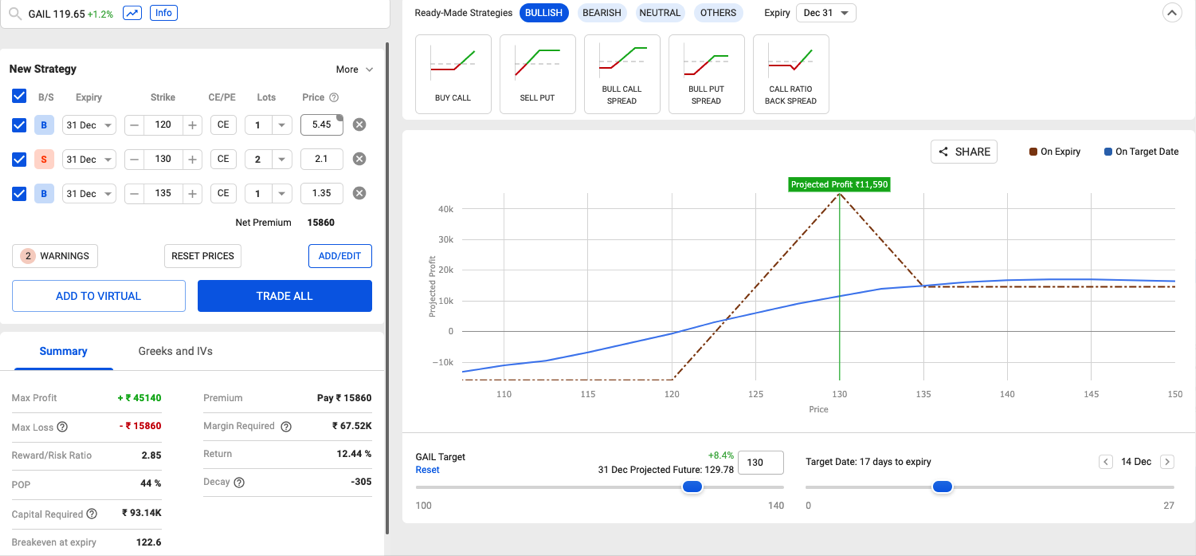
GAIL Call Butterfly Dec 31 2020 Expiry

I mean, it’s all still acceptable.

Tweaks?

Let’s say one is losing.

Sells will be in biggish plus.

Square-off the sells. Yeah, break the hedge.

Margin gets returned. Premium pocketed.

Buys are exposed, though.

They are losing big.

With some time to go till expiry, if the underlying goes back up, the buys gain.

What one makes off the trade is proportional to how much the underlying goes up.

It’s riskier. Correspondingly, profit potential is higher.

Money risked here will be up to double of the fully hedged version of the trade, and one could lose this amount if the underlying does not come back up appropriately and in time. Pocketed premium of the squared-off sells softens the hit.

Therefore, it makes more sense to pull this tweak with at least ten days to go before expiry, giving the underlying time to recoup.

Got another tweak.

This one’s intraday, though.

Underlying’s on a roll, and you want to make the most possible off the opportunity.

Square-off the sells at a huge loss.

Let the buys, which are winning big, run for some part of the day.

Chances of them yielding more are very high.

Square-off the buys before close of trade.

If the underlying promises to close on a high, square-off the out-of-the-money buy before close of trade, and take the in-the-money buy overnight.

Risky, though.

You could lessen your risk, and increase your chances of taking most profits off the table by squaring off the in-the-money buy and taking the out-of-the-money buy overnight.

Square-off the overnight buy next morning on a high, or wherever feasible.

With this particular tweak, the trade becomes somewhat more like a lesser exposed futures transaction, at least for some time, after the hedge is broken.

There’s another thing one can do with the call butterfly.

One can adjust it as per the level of perceived bullishness.

If -1 and -1 are set at the same level, one trades for averagely perceived bullishness.

If one -1 is closer to the lower +1, and the other -1 is above this first -1, then one trades for below average perceived bullishness.

If one -1 is closer to the upper +1, and the other -1 is below this first -1, then one trades for above average perceived bullishness.

Anything else worth mentioning?

Volume. Need it.

Bid-ask spread needs to be narrow.

Scaling up needs to correspond to one’s risk-profile, requirement, temperament and acumen.

One can make it an income thing by scaling up, during bull runs, or generally, just in case an up move is tending to pan out.

One can make the call butterfly do a lot of things.

It’s a very versatile trade to play a rising market, with low risk and low capital requirement.

Happy trading!

🙂

Giving In

I’ve been guilty of giving in…

…to the urge to sell.

However, having kept basic tenets alive, vital underlyings are still a hold…

…for me…

…for as long as they remain vital.

Have been getting rid of stuff I don’t want.

Restructuring / reorganizing.

Consolidating.

These are the activities of choice, when markets are on a roll.

Sure, one’s been buying too, but not in the investing account.

Trading accounts are very active.

These are trading prices.

What’s the definition of a (successful) trade?

Buy high, and sell higher. Or, sell low, and buy back lower.

As opposed to an investment, where one buys low, to sell higher, later.

Are these low prices?

No.

How long has the index remained, percentage-wise, in its History, at 30+ PEs?

Very low single (%age) digits, of the time under consideration.

Thus, times will change.

Nobody knows when.

However, who cares?

Let it roll.

We’ll just go on consolidating, till we can’t consolidate anymore.

That’s the sweet spot we want to be in, before conditions change, where one can’t consolidate anymore.

And, we’ll just sheer go on trading.

That’s what we do with trading prices.

The At-Par Point

One grapples with this one, …

…always.

There’s something about the at-par point.

No matter how much logic we try, when the at-par point arrives, logic fails.

Carrying a loser?

Determined to carry it through till 3x?

Wait till the at-par point arrives.

See how psychology changes.

Watch yourself liquidating the stock, despite all previous planning.

Happens all the time.

Carrying a winner?

Letting your profit run?

Underlying then falls to at-par?

Watch yourself liquidating at the speed of light.

It’s ok.

We’re humans, and aversion to loss is a human trait.

This aversion to loss makes us follow the dictates of the at-par point.

How do we go around this, as traders or investors?

Meaning, as we advance in our professions, we don’t wish to be dictated terms to by a particular “non-technical” and “artificially” psychological price point.

So, let’s try and find a workaround.

Underlying is winning. Raise your stop in a defined fashion.

When underlying starts falling, it will hit your stop.

At-par won’t be touched, so it doesn’t even come into the equation.

Underlying is down. Hmmm. What do we do here?

We really want to meet the at-par point here.

We’re desperate.

Convinced about the stock?

Average down.

The at-par point lowers.

When market conditions change, it arrives early.

Don’t wish to average down?

Not convinced about the stock anymore?

Wait.

At-par might or might not arrive.

Arrives?

Well and good.

Doesn’t arrive?

Look to exit as best as possible, if you’re tired of holding.

As investors, one can think about only getting into stocks where one is confident of averaging down if the stock falls. (Traders are suppose to cut trades at or around their stop).

Tweaking (lowering) the level of at-par helps faster recovery in the markets greatly.

Liqui-Deity

Ammunition. 

Ask the soldier about it.

Running out of it on the battlefield is the soldier’s worst nightmare. 

We’re soldiers too, in our respective fields of work. 

Our liquidity is our ammunition. 

What counts when an opportunity comes is how liquid we are.

When there is a market bottom, most of us are fully invested.

Is that sound strategy?

Putting together ammunition in one place is where it starts.

Holding on to ammunition and using it when most required – that’s sound strategy. 

Saving habits lead to accumulation.

Barriers hold the accumulated liquidity in one place. 

What are barriers?

Welcome to the world of self-created restrictions in an effort to have liquidity ready when one most needs it.

A dedicated bank account is what one requires first. 

Trading?

Link a bank account to your trading account, and use this one for nothing else.

Next, whatever accumulates in this account – take it away from your direct vision.

Meaning?

Block it as a fixed deposit. 

This is a barrier. One don’t see the funds as available. Thus one don’t feel the urge to use them.

When a trade motivates one enough to be taken, one then most need the funds. 

Break the FD.

Transfer the funds. 

Trade.

Has a trade just culminated?

Nothing else coming up?

Again, take the funds away from your direct vision.

Block them, either directly in your trading account, by putting them in overnight funds, or transfer them back to your bank account, if you know that you are not going to be trading for another week plus. 

Both options are valid. Do either. Bottomline is, the funds should not show up as available until you need them.

Investing?

Link a different bank account to your investing-only trading account.

Make multiple fixed deposits in this bank account, each one being one exact entry quantum in value.

Upon identifying an entry opportunity, whenever that happens, break one quantum’s FD, move the funds, and enter into the investment. 

Liquidity needs to be revered.

Unless we don’t give it proper respect, we will not have it at our beck and call when the next opportunity arises, whether we are trading or investing. 

Let’s go, let’s get our ammunition together, and let’s put it to great use.

Fitting 2.0.2

What’s the most basic definition of an investment?

Buy low.

Sell high.

And how does one define a (successful) trade?

Buy high.

Sell higher.

Or…

…sell low…

…and buy back lower. 

As one might see, the ideologies of investing and trading are diametrically opposite to each other.

So, how do we fit one with the other.

Though this might not seem so, it’s a tough one.

One’s success at this hangs on finer points.

Is it even necessary to fit one with the other?

Why should a long-term investor also trade?

Then, why should a trader invest for the long term?

Long-term investing is a very hands-off affair.

There are prolonged bouts of doing nothing. 

Hardly anyone can handle that, and just to satisfy one’s urge to do something, one ends up fiddling unnecessarily with one’s long-term portfolio.

Trading fits in precisely to do away with the urge to unnecessarily fiddle. 

Finer points?

Low quantum.

Tension level becomes low.

Trading then becomes fun. 

Clear the platform of any long-term underlyings. 

When we see our long-term portfolio on the same platform on which we trade, we get mightily confused.

It’s like a short-circuit. 

Avoid.

Trade on a separate platform. Invest on another. 

Now let’s address the second question.

Who should invest?

Everyone.

Even the trader.

Why?

Power of compounding, for starters. 

Actively chancing upon margin of safety, since one is in the game all the time – another big one…

…as a trader, sometimes one comes upon great entry rates, where one can hold the underlying for a long time.

That’s a huge opportunity, so one can go for it. 

Furthermore, trading involves recirculating liquidity. After the trade is closed, one lands up back with liquidity. One doesn’t maintain an asset in hand for a longish period. It might be a good idea to do so, just sheer for the sake of diversification.

Some do only like to trade. They enjoy the lightness.

Others like to only invest for the long-term. They are able to handle long bouts of no activity well.

Suit yourself.

Judge if you need a B-game.

Then fit it to your A-game. 

Who Breathes Easier – The Investor or the Trader?

Sure…

…asset-light…

…going with the flow…

…can strike both ways…

…care-free almost…

…that’s the image that lures one to the trading world.

Especially when the investor’s world has turned upside down, the investor starts wishing that he or she were a trader instead.

Stop.

Get your investing basics right. Your world will not turn upside down once you invest small quanta into quality coupled with margin of safety, again and again and again.

Let’s dig a little deeper into the trader’s world.

No baggage?

Sure baggage.

Emotional baggage for starters.

Cash baggage.

This one will always be there.

The trader will always have one eye on the cash component.

It needs to be safe.

It is a cause of…

…tension.

Reason is, the safest of havens for this cash component, i.e. sovereign debt, is volatile enough to disturb those who are averse to volatility when it comes to one’s cash component.

So, not asset-light.

Cash component is also an asset. It’s not light.

Sure, go with the flow. Strike both ways.

Can one say that this is a recipe for making higher returns?

NO.

Investors strike in one direction.

Investors are perennial bulls.

At least they know where they are going.

Small entry quanta make market falls work in favour of investors, over many, many entries into an underlying, over the long-term.

Do the math. You’ll see.

When one is focused on one direction, i.e. upwards here, chances of capitalising on runs are higher. The trader’s mind is always bi-polar in this regard, and game-changing runs are missed out on, upon corrections larger than the concerned stop-loss.

Care-free?

Who’s watching the screen all day?

The trader.

The investor watches the screen only upon requirement. There are investors who don’t watch the screen at all.

Images are deceptive.

Don’t go by images.

Whatever one chooses, it should ignite one’s passion.

Nothing else counts.

Let’s say you’re an investor, and you feel that you’re missing something by not trading.

Fine. Fill the gap. Sort out the basic folio, and then dabble in trading with small amounts, that don’t throw you out of whack. Do it for the thrill, if nothing else. As long as one is clear that this is not one’s A-game, and expectations are not as high as they are from one’s A-game, one might even enjoy the ride.

Let’s say you are a trader and need an avenue to park.

Yes, Equity is a serious avenue for parking.

Use it.

With one caveat.

This is not a trade.

Trading rules don’t apply to parking.

In fact, trading rules are inverse to investing rules.

You’ll need to figure this one out before moving your bulk into Equity for parking.

The investor is able to take trading with small amounts casually, and use it as an avenue for amusement.

When the trader explores the avenue of Equity for parking, its serious business, and spells doom for the trader if basics of investing are not understood.

So, who breathes easier?

One would know this by now.

Feeling

Who writes the rule-book for your market-life?

You do.

Why do you do it?

Nobody else is qualified enough.

You know yourself better than others.

Don’t you?

Thus, one feels one’s way through the markets, setting up lamp-posts and rules.

For example, I recently discover how to integrate my investing life with my trading life, in one particular market.

It takes me a long, long time to do so.

Nothing has really worked on this front.

Both lives have been getting affected, adversely, because of each other.

It’s outright frustrating and, I just sheer stop trading this market, to allow my investing life to prosper.

Simultaneously, I keep feeling my way through, trying out various permutations and combinations…

…, one of which seems to be working.

How do I know?

I’m trading again.

What have I done that I wasn’t doing before?

I haven’t been using the concept of exhaustion.

I exhaust my ability to invest, opportunity-wise.

Since I follow a small entry-quantum approach, liquidity exhaustion isn’t going to work.

Opportunity exhaustion is.

As opportunities keep coming, I keep going in, each time with small quanta, not changing anything in my investment approach.

One fine day, there is no margin of safety being offered.

I don’t feel like going in.

I am exhausted.

I shut down my investment widow…

…and then {[:-)]}, open my trading window.

Within an hour, I take a trade.

Lo and behold, integration has taken place.

Seamlessly.

All our demons are inside of us.

If one is not dying, exhaust it with feeling, even temporarily, to look after your other vital activities.