Walking the Walk

Hey,

… just made a decision…

… and am going to share it with you. 🙂

From this point onwards,…

…, I’ll exclusively be working with underlyings,…

…, with whom I’m walking the walk with.

So, what does that mean?

As per my understanding, there are two ways of getting to know an underlying, for example a stock.

We can see what it’s done,…

…, landmarks that have been established,…

…, track record,…

…, lineage,…

… etc.

Sure, we can take in the fundamentals ad-nauseam, and that’s absolutely fine.

No one’s investing without appropriate fundamentals in place.

That’s not it all, though.

Will be walking with the stock too.

Where does it go?

What does it do there?

How does it behave?

Is the behaviour off?

We want to know.

And we’ll know…

… by getting a feel for the stock’s movement.

Why all this?

What are we doing with such stocks?

Investing in them, yes.

However, stocks aren’t always in an investing zone.

Then we’ll generate income from the same stocks.

Why from this category?

Why not choose specific trading stocks to trade?

That’s because they’ll contaminate investment mindset.

Trading investment grade stocks that make one’s cut, when these stocks are in a trading zone, is a pursuit with multi-faceted advantages.

Income generation.

Pinpointed stock-specific knowledge, which gets deeper and deeper.

Insurance when stuck. You’re a holder, so do the math.

Huge time-saving in the long run, as patterns become clear.

Minimal tension.

If we wish to mimimize tension further, we can take time out of the equation (meaning, we won’t do derivatives in this case).

We won’t be Johny-on-the-spot with this strategy, probably.

We’ll make money, though.

There’ll be peace of mind.

Enjoyment.

Over time, this strategy can go to the max. Meaning, we’ll outdo all Johnies from their spots with regard to income and wealth generation.

Why?

We’re walking the walk, remember ?

Over time, we’ll become masters of our territory.

We don’t want more.

We’re done already.

Working Backwards

In trying to gauge the markets,…

… we work backwards.

What’s the starting point?

Current state of affairs.

One step back…

…is where the market is coming from. 

One step ahead…

…is the impact being had on the retail investor.

The rest is extrapolation.

Why are we targeting retailers?

This is because we wish to gauge market tops and bottoms. 

These are scripted by retail investors. 

At the top, retailers are left holding the hot pie in their hands, for which there are no further takers at that price. 

At the bottom, retailers rid themselves of stocks as if the world is coming to an end.

If we get a handle on how retailers are reacting to the market at hand, that’s huge.

This is working backwards in action.

We’re not first forming an idea about how the market should behave…

…and then we’re not trying to shove this perception down the market’s throat.

Because we are reacting upon what is happening, and not dreaming up what’s going to happen first, chances of winning are tilted in our favour. 

We’ve not invented this course of action.

Others have done it before, with huge success. 

We stand upon the shoulders of giants.

Here’s Steve Jobs on working backwards : https://youtu.be/oeqPrUmVz-o .

See?

It’s taken a while to get here, and also many knocks. 

However, we’re here now, and we’re here to stay!

Playing Over-hot Underlyings with the Call Butterfly

A call butterfly is a fully hedged options trade …

… with an upwards bias.

It consists of four call options.

2 buys…

…and 2 sells.

One can play any overtly rising underlying with the call butterfly, without batting an eyelid.

Why?

Firstly, and most importantly, one is fully hedged.

Meaning?

At first look, the call butterfly seems market neutral as far as basic mathematics is concerned, that is +1, -2, +1, net net 0.

So, net net, one isn’t looking at a large loss if one is wrong.

When is one wrong here?

If the underlying doesn’t move, or if it falls, in the stipulated period, then one is wrong,…

…and one will incur a loss.

However, the loss will be relatively small, because of the call butterfly’s structural market neutrality.

And that’s magic, at least to my ears.

Method to enter anything flying off the handle with the chance of a small loss?

Will take it.

Then, also very importantly, the margin requirement is relatively less, when one uses the following chronology.

One executes the buys first.

Then come the sells.

Upon the upholding of this chronology, the market regulator is lenient with one on margin requirement, as long as the trade-construct is market neutral.

Typically, for one butterfly, total margin requirement is in the range of 50 to a 100k.

Now let’s talk about what one is looking to make.

5k per single-lot trade-construct, if it’s fast, as in execute today, square-off tomorrow, or even intraday, if expiry is close.

10k if slow, as in 7 to 10 days.

If the butterfly is not yielding because the underlying is not moving, then one is looking to exit, typically with a minus of under 3k.

Just do the math. Numbers are great.

What kind of a maximum loss are we looking at, if things go badly wrong, as in if the underlying sinks?

5k to 10k.

Can the loss be more?

If the trade construct is such that the butterfly can even give 40 odd k till expiry, one could even be looking at a max loss of about 15k too.

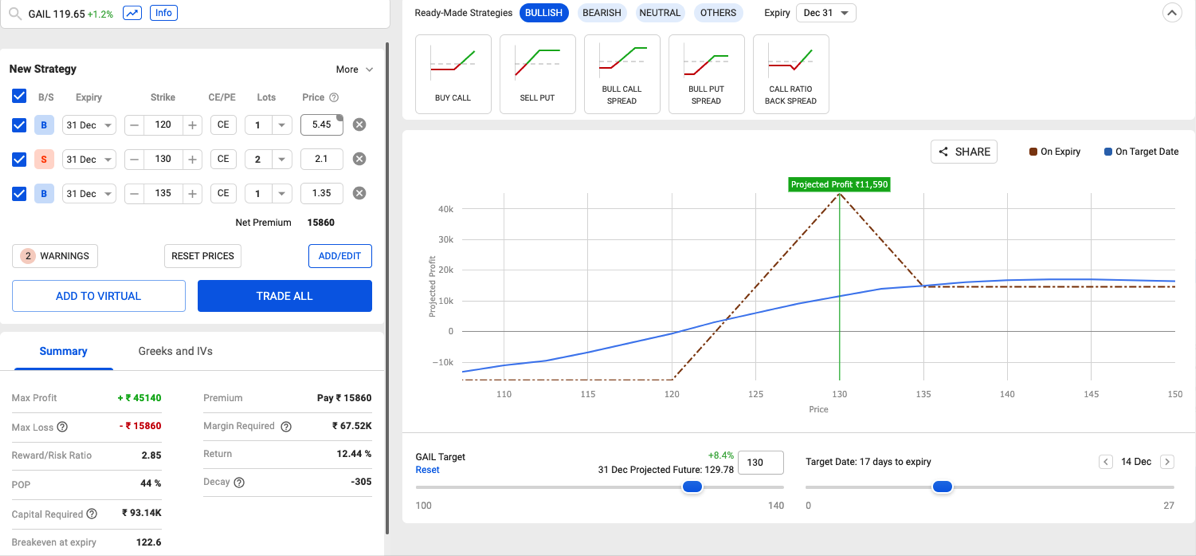
Here’s an example of a call butterfly trade that can lose around 15-16k, but has the potential to make upto around 45k till expiry. The graphical representation is courtesy Sensibull.

GAIL Call Butterfly Dec 31 2020 Expiry

I mean, it’s all still acceptable.

Tweaks?

Let’s say one is losing.

Sells will be in biggish plus.

Square-off the sells. Yeah, break the hedge.

Margin gets returned. Premium pocketed.

Buys are exposed, though.

They are losing big.

With some time to go till expiry, if the underlying goes back up, the buys gain.

What one makes off the trade is proportional to how much the underlying goes up.

It’s riskier. Correspondingly, profit potential is higher.

Money risked here will be up to double of the fully hedged version of the trade, and one could lose this amount if the underlying does not come back up appropriately and in time. Pocketed premium of the squared-off sells softens the hit.

Therefore, it makes more sense to pull this tweak with at least ten days to go before expiry, giving the underlying time to recoup.

Got another tweak.

This one’s intraday, though.

Underlying’s on a roll, and you want to make the most possible off the opportunity.

Square-off the sells at a huge loss.

Let the buys, which are winning big, run for some part of the day.

Chances of them yielding more are very high.

Square-off the buys before close of trade.

If the underlying promises to close on a high, square-off the out-of-the-money buy before close of trade, and take the in-the-money buy overnight.

Risky, though.

You could lessen your risk, and increase your chances of taking most profits off the table by squaring off the in-the-money buy and taking the out-of-the-money buy overnight.

Square-off the overnight buy next morning on a high, or wherever feasible.

With this particular tweak, the trade becomes somewhat more like a lesser exposed futures transaction, at least for some time, after the hedge is broken.

There’s another thing one can do with the call butterfly.

One can adjust it as per the level of perceived bullishness.

If -1 and -1 are set at the same level, one trades for averagely perceived bullishness.

If one -1 is closer to the lower +1, and the other -1 is above this first -1, then one trades for below average perceived bullishness.

If one -1 is closer to the upper +1, and the other -1 is below this first -1, then one trades for above average perceived bullishness.

Anything else worth mentioning?

Volume. Need it.

Bid-ask spread needs to be narrow.

Scaling up needs to correspond to one’s risk-profile, requirement, temperament and acumen.

One can make it an income thing by scaling up, during bull runs, or generally, just in case an up move is tending to pan out.

One can make the call butterfly do a lot of things.

It’s a very versatile trade to play a rising market, with low risk and low capital requirement.

Happy trading!

🙂

The At-Par Point

One grapples with this one, …

…always.

There’s something about the at-par point.

No matter how much logic we try, when the at-par point arrives, logic fails.

Carrying a loser?

Determined to carry it through till 3x?

Wait till the at-par point arrives.

See how psychology changes.

Watch yourself liquidating the stock, despite all previous planning.

Happens all the time.

Carrying a winner?

Letting your profit run?

Underlying then falls to at-par?

Watch yourself liquidating at the speed of light.

It’s ok.

We’re humans, and aversion to loss is a human trait.

This aversion to loss makes us follow the dictates of the at-par point.

How do we go around this, as traders or investors?

Meaning, as we advance in our professions, we don’t wish to be dictated terms to by a particular “non-technical” and “artificially” psychological price point.

So, let’s try and find a workaround.

Underlying is winning. Raise your stop in a defined fashion.

When underlying starts falling, it will hit your stop.

At-par won’t be touched, so it doesn’t even come into the equation.

Underlying is down. Hmmm. What do we do here?

We really want to meet the at-par point here.

We’re desperate.

Convinced about the stock?

Average down.

The at-par point lowers.

When market conditions change, it arrives early.

Don’t wish to average down?

Not convinced about the stock anymore?

Wait.

At-par might or might not arrive.

Arrives?

Well and good.

Doesn’t arrive?

Look to exit as best as possible, if you’re tired of holding.

As investors, one can think about only getting into stocks where one is confident of averaging down if the stock falls. (Traders are suppose to cut trades at or around their stop).

Tweaking (lowering) the level of at-par helps faster recovery in the markets greatly.

Urges

Market forces need to be understood…

…to win in the markets.

When do market forces start affecting us fully?

When we put our own money on the line.

That’s why…

…don’t…

…ever…

learn finance from someone who…

…doesn’t put his or her money regularly on the line.

When we put our money on the line, market forces start changing our psyche.

If we’re holding funds, we develop the urge to buy.

If we’re holding underlyings, we develop the urge to sell.

Early in our career, we give in to these urges at precisely the wrong time, resulting in loss-creation.

As we become more seasoned, we are able to resist such urges, till conditions provide profit.

As our market career continues, this is where fine-tuning matters the most.

How long are we able to resist the urge to sell as the market climbs?

How long are we able to resist the urge to buy as the market crashes?

These are pivotal questions.

One of them is playing out now.

As new highs are made, many have already sold out.

Some have sold partly.

Very few retailers are still holding on to whatever they might have left.

It’s institutions buying and selling.

New entry at these levels are a dizzy proposition.

I won’t hide that as markets climb higher, I experience a very strong urge to sell.

It’s…

…over-compelling.

How do I deal with it?

When such urge is too compelling, one does oblige.

One sells…

…little…

…and that’s the tough one.

One needs to oblige the urge lest some piston bursts, but simultaneously, one needs to hold on to as much as one can…

…since markets are on a roll.

One can’t learn this from a book, or in college.

After selling early many, many times, for more than a decade and a half, one finally learns to hold on to a chunk of one’s underlyings as markets go ballistic.

As heights get higher, this mechanism will make one sell, though, little by little…

…and that’s ok.

Let’s make sure that we do keep holding a chunk of the stuff we really like, though, after having taken the principal out.

Otherwise, how will we allow multibaggers to blossom?

Easier said than done, I know!

Fitting 2.0.2

What’s the most basic definition of an investment?

Buy low.

Sell high.

And how does one define a (successful) trade?

Buy high.

Sell higher.

Or…

…sell low…

…and buy back lower. 

As one might see, the ideologies of investing and trading are diametrically opposite to each other.

So, how do we fit one with the other.

Though this might not seem so, it’s a tough one.

One’s success at this hangs on finer points.

Is it even necessary to fit one with the other?

Why should a long-term investor also trade?

Then, why should a trader invest for the long term?

Long-term investing is a very hands-off affair.

There are prolonged bouts of doing nothing. 

Hardly anyone can handle that, and just to satisfy one’s urge to do something, one ends up fiddling unnecessarily with one’s long-term portfolio.

Trading fits in precisely to do away with the urge to unnecessarily fiddle. 

Finer points?

Low quantum.

Tension level becomes low.

Trading then becomes fun. 

Clear the platform of any long-term underlyings. 

When we see our long-term portfolio on the same platform on which we trade, we get mightily confused.

It’s like a short-circuit. 

Avoid.

Trade on a separate platform. Invest on another. 

Now let’s address the second question.

Who should invest?

Everyone.

Even the trader.

Why?

Power of compounding, for starters. 

Actively chancing upon margin of safety, since one is in the game all the time – another big one…

…as a trader, sometimes one comes upon great entry rates, where one can hold the underlying for a long time.

That’s a huge opportunity, so one can go for it. 

Furthermore, trading involves recirculating liquidity. After the trade is closed, one lands up back with liquidity. One doesn’t maintain an asset in hand for a longish period. It might be a good idea to do so, just sheer for the sake of diversification.

Some do only like to trade. They enjoy the lightness.

Others like to only invest for the long-term. They are able to handle long bouts of no activity well.

Suit yourself.

Judge if you need a B-game.

Then fit it to your A-game. 

Bridging the Gap

How does one bridge the middle overs?

Sure, a blogger who is simultaneously a cricket fan…

…will dish out analogies from cricket… 🙂 … !

We’re in the business of identifying extremes…

…and acting upon such identification.

Whatever is in the middle of these extremes…

…is, for us, an area of…

…inaction.

Do we know how to not act?

There is an impulse for action in all humans.

In these loaded times, this impulse is extreme.

Why do we not want to act when an extreme is not there yet?

During times of complete pessimism, one is able to purchase underlyings for a song.

Similarly, during times of total optimism, one is able to secure good exits for stuff that one wishes to get rid of.

How one behaves in between adds or subtracts significantly to or from one’s market success.

Selling early means lesser profits, and the same goes for buying late.

This is the kind of behavior that lessens our multiple, sometimes greatly.

This kind of behavior would be absolutely ok if one were trading.

We, @ Magic Bull, are in the business of effecting multiples.

Anything coming in the way of that is behavior we wish to avoid.

With markets normally trading between extremes about 95% of the time, this leaves us with a lot of time in which we do not act.

Also, it brings us back to the pivotal question – how do we manage not to act when everything and everyone around us is screaming for action?

We do – everything – else.

Apart form market action, there’s business activity, charity ventures, extra curricular activities, family time, sport, leisure, entertainment … … one’s day is packed.

There are two portions of the day when one is driven to the edge of action, though.

The first is after studying market opening.

This is when one does a half-hour call with one’s broker and just sheer discusses everything one is observing.

Strike 1.

Then, as one studies the close, this situation can arise again.

One writes, for example.

Or, annotates charts.

Observes prices.

Collects impressions…

…and demarcates patterns.

That’s sufficient.

Strike 2.

There’s no room for strike 3 – one just doesn’t let strike 3 happen.

High-Conviction Diaries

Sometimes, we’re convinced. 

Every nerve in our body is rooting for a particular thing.

It’s a go. 

Do one thing – 

– don’t hold back. 

Listen to yourself. 

High conviction doesn’t just dawn just like that. 

We’ve worked our whole lives to arrive at this high-conviction moment. 

On the way, we’ve made many, many bad calls. 

Actually, they weren’t bad calls, because…

…if it weren’t for them,…

…how would we learn?

Is some college professor going to teach us the markets?

Is there a recognised university teaching successful market play?

It pays more to depend on one’s own self, and on one’s common-sense – this being my opinion, of course. 

We learn the ropes – OURSELVES – by making mistakes and learning from these.

Here we are. 

We’ve survived so far. 

Now, our sensors are on full. We’re on high alert. We’ve arrived at a high-conviction moment. 

We know this is the right call. 

It’s going to make money. 

All entry parameters are showing a tick-mark. 

What’s stopping us?

We’re human.

There’s always doubt. 

Negative experiences in the past enhance such feelings. 

What if we’re wrong?

Well, if we never get going, how are we ever going to find out?

Enter. 

With a small quantum. 

Keep entering with small quanta as the opportunity exists, along with high-conviction. 

Assuming that high-conviction continues, but opportunity stops existing – 

– Stop.

Wait for next opportunity. 

Assuming that opportunity continues to exist, but high-conviction wavers –

– Stop.

Wait for high conviction to develop again. 

If it does so, see if opportunity still exists. 

If high conviction doesn’t develop again, discontinue going in any further. 

Revaluate the investment upon a market high.

Who Breathes Easier – The Investor or the Trader?

Sure…

…asset-light…

…going with the flow…

…can strike both ways…

…care-free almost…

…that’s the image that lures one to the trading world.

Especially when the investor’s world has turned upside down, the investor starts wishing that he or she were a trader instead.

Stop.

Get your investing basics right. Your world will not turn upside down once you invest small quanta into quality coupled with margin of safety, again and again and again.

Let’s dig a little deeper into the trader’s world.

No baggage?

Sure baggage.

Emotional baggage for starters.

Cash baggage.

This one will always be there.

The trader will always have one eye on the cash component.

It needs to be safe.

It is a cause of…

…tension.

Reason is, the safest of havens for this cash component, i.e. sovereign debt, is volatile enough to disturb those who are averse to volatility when it comes to one’s cash component.

So, not asset-light.

Cash component is also an asset. It’s not light.

Sure, go with the flow. Strike both ways.

Can one say that this is a recipe for making higher returns?

NO.

Investors strike in one direction.

Investors are perennial bulls.

At least they know where they are going.

Small entry quanta make market falls work in favour of investors, over many, many entries into an underlying, over the long-term.

Do the math. You’ll see.

When one is focused on one direction, i.e. upwards here, chances of capitalising on runs are higher. The trader’s mind is always bi-polar in this regard, and game-changing runs are missed out on, upon corrections larger than the concerned stop-loss.

Care-free?

Who’s watching the screen all day?

The trader.

The investor watches the screen only upon requirement. There are investors who don’t watch the screen at all.

Images are deceptive.

Don’t go by images.

Whatever one chooses, it should ignite one’s passion.

Nothing else counts.

Let’s say you’re an investor, and you feel that you’re missing something by not trading.

Fine. Fill the gap. Sort out the basic folio, and then dabble in trading with small amounts, that don’t throw you out of whack. Do it for the thrill, if nothing else. As long as one is clear that this is not one’s A-game, and expectations are not as high as they are from one’s A-game, one might even enjoy the ride.

Let’s say you are a trader and need an avenue to park.

Yes, Equity is a serious avenue for parking.

Use it.

With one caveat.

This is not a trade.

Trading rules don’t apply to parking.

In fact, trading rules are inverse to investing rules.

You’ll need to figure this one out before moving your bulk into Equity for parking.

The investor is able to take trading with small amounts casually, and use it as an avenue for amusement.

When the trader explores the avenue of Equity for parking, its serious business, and spells doom for the trader if basics of investing are not understood.

So, who breathes easier?

One would know this by now.

Equity – The New Normal for Parking

Who’s the biggest…

…Ponzi…

…of them all?

Insurance companies?

There’s someone bigger.

The government. 

Legit.

Probably not going to go bust…

…at least in a hurry. 

Moves money from A to B…

…with minimum accountability. 

Resurrects skeletons and gives them infinite leases of life…

…with good, clean and fresh funds…

…that flow out of the pockets of helpless citizens. 

So, what about the government’s bond?

Sovereign debt.

The herd is flowing to sovereign debt, and to some extent to 100% AAA max 3 month paper duration liquid funds. 

This is after the johnnies at FT India miscalculated big-time, and had to wind-up six debt mutual fund schemes in their repertoire.

Should one do what the herd is doing?

Let’s break this down. 

First up, the herd exited credit-risk funds en-masse, post FT India’s announcement. Logical? Maybe. Safety and all that. Took a hit on the NAV, due to massive redemptions. I’m guesstimating something to the tune of 3%+. 

This seems fine, given the circumstances. Would have done the same thing, had I been in credit-risk. Perhaps earlier than the herd. Hopefully. No one likes a 3%+ hit on the NAV within a day or two.

Let’s look at the next step.

Sovereign debt is not everyone’s cup of tea. 

Especially the long-term papers, oh, they can move. 3% moves in a day are not unknown. 13-17% moves in a year are also not unknown. A commoner from the herd would go into shock, were he or she to encounter a big move day to the downside in the GILT (Government of India Long Term) bond segment. Then he or she would commit the blunder of cashing out of GILT when 10% down in 6 months, should such a situation arise. This is absolutely conceivable. Has happened. Will happen. Again.

There are a lot of experts advocating GILT smugly, at this time. They’re experts. They can probably deal with the nuances of GILT. The herd individual – very probably – CAN’T. The expert announces. Herd follows. There comes a crisis that affects GILT. Expert has probably exited GILT shortly before the onset of crisis. Herd is left hanging. Let’s say GILT tanks big time. Herd starts exiting GILT, making it fall further. Expert enters GILT, yeah – huge buying opportunity generated for expert.

More savvy and cautious investors who don’t wish to be saddled with the day to day tension of GILT, and who were earlier in credit-risk, are switching to liquid funds holding 100% AAA rated papers.

Sure. 

This is probably not a herd. Or is it?

Returns in the 100% AAA liquid fund category are lesser. Safety is more. How much are the returns lesser by? Around 1.5 to 2% lesser than ultra-short, floating-rate and low-duration funds. 

Ultra-short, floating-rate and low-duration funds all fall under a category of short-term debt which people are simply ignoring and jumping over, because apart from their large size of AAA holdings, a chunk of their holdings are still AA, and a small portion could be only A rated (sometimes along with another smallish portion allocated in – yes – even sovereign debt – for some of the mutual funds in this category).

The question that needs to be asked is this – Are quality funds in the category of ultra-short, floating-rate and low-duration funds carrying dicey papers that could default – to the tune of more than 2%?

There’s been a rejuggling of portfolios. Whatever this number was, it has lessened.

The next question is, if push comes to shove, how differently are 100% AAA holdings going to be treated in comparison to compositions of – let’s say – 60% AAA, 30% AA and 10% A?

I do believe that a shock wave would throw both categories out of whack, since corporate AAA is still not sovereign debt, and the herd is not going to give it the same adulation. 

The impact of such shock wave to 100 % AAA will still be sizeable (though lesser) when compared to its cousin category with some AA and a slice of A. Does the 2% difference in returns now nullify the safety edge of 100% AAA?

Also, not all corporate AAA is “safe”. 

Then, if nobody’s lending to the lower rung in the ratings ladder, should such industry just pack up its bags? If the Government allows this to happen, it probably won’t get re-elected.

The decision to remain in this category encompassing ultra-short, floating-rate and low-duration bond mutual funds, or to switch to 100% AAA short-term liquid funds, is separated by a very thin line

Those who follow holdings and developments on a day to day basis, themselves or through their advisors, can still venture to stay in the former category. The day one feels uncomfortable enough, one can switch to 100% AAA. 

This brings us to the last questions in this piece. 

Why go through the whole rigmarole?

Pack up the bond segment for oneself?

Move completely to fixed deposits?

Fine.

Just a sec.

What happens if the government issues a writ disallowing breaking of FDs above a certain amount, in the future, at a time when you need your money the most?

Please don’t say that such a thing can’t happen.

Remember Yes bank?

What if FD breakage is disallowed for all banks, and you don’t have access to your funds, right when you need them?

Sure, of course it won’t happen. But what if it does?

You could flip the same kind of question towards me. What happens if the debt fund I’m in – whether ultra-short, or floating-rate, or low-duration, or liquid – what happens if the fund packs up?

My answer is – I’ve chosen quality. If quality packs up 100%, it’ll be a doomsday scenario, on which FDs will also be frozen dear (how do you know they won’t be?), and GILTs could well have a 10%+ down-day, and, such doomsday scenario could very probably bring a freeze on further redemptions from GILT too. When the sky is falling, no one’s a VIP.

Parked money needs to be safe-guarded as you would a child,…

…and,…

…there spring up question marks in all debt-market categories,…

…so,…

…as Equity players, where do we stand?

Keep traversing the jungle, avoiding pitfalls to the best of one’s ability. 

How long?

Till one is fully invested in Equity. 

Keep moving on. A few daggers will hit a portion of one’s parked funds. Think of this as slippage, or as opportunity-cost. 

Let’s try and limit the hit to as small a portion of one’s parked funds as possible. Let’s ignore what the herd is doing, make up our own mind, and be comfortable with whatever decision we are taking, before we implement the decision. Let’s use our common-sense. Let’s watch Debt. Watch it more than one would watch one’s Equity. Defeats the purpose of parking in this segment, I know. That’s why we wish to be 100% in Equity, parked or what have you, eventually. 

As we keep dodging and moving ahead, over time, the job will be done already.

We’re comfortable with the concept of being fully parked in Equity. 

Whereas the fear of losing even a very small portion of our principal in the segment of Debt might appear overwhelming to us, the idea of losing all of one’s capital in some stocks is not new for us Equity players. We have experienced it. We can deal with it. Why? Because in other stocks, we are going to make multiples, many multiples, over the long-term.

Equity seems to be the new normal for parking

Making Time Our Friend

Hurry…

…spoils the curry.

Specifically with regard to Equity…

…one should never, never be in a hurry. 

You see…

…there will always be a correction.

You will get an entry. 

Wait for the right entry. 

You will, eventually, get a prime exit. 

Wait for the time. 

Make time your friend. 

How?

Simple.

Take it out of the equation.

Simple?

In the small entry quantum strategy, time is, by default, taken out of the equation. 

It loses its urgency as a defining factor, for us, psychologically.

We don’t have any immediate timelines. 

We go with…

…the flow. 

When opportunities appear…

…we act.

When they don’t…

…we don’t act.

Most of the time…

…we don’t act.

Then there are black swans, and we act many times in a row. Like now.

Action, or lack of it, depends on what’s happening. 

We don’t force action.

Why?

Because we have all the time in the world. We’ve made it our friend, remember.

We know that we’ll get action…

…eventually. 

We conserve liquidity and energy for when action comes.

You see, when the pressure of a time-line is gone, quality of judgement shoots up.

We make superior calls. 

Of course we make numerous mistakes too. 

However, the quantum going into the mistake is small. This is the small entry quantum strategy, remember. 

Once we’ve made a selection mistake in an underlying, and have realised this, we don’t shoot another quantum chasing our error. Instead we let it be, and wait for a prime exit from our error. It will come. 

We keep going into identified underlyings not falling into the error category, with small quanta. 

Many, many times, we make a price-error. Price going against us after entry is a price-error, because the market is always right. It’s us who are wrong when things go against us. 

Never mind. After a price-error, we enter the same underlying with another quantum, and this time we get a better price. Once gain one observes the friendliness of time, even after price has gone against us, all because of our small entry quantum strategy.

When price is going in our favour, we might not enter after a level. Though we’re not getting further entries in the underlying, appreciation is working in our favour. 

It’s a win-win on both sides of the timeline for us…

…because we’ve made time our friend.

Rewiring 3.0.3

We grow up, being taught to win.

Slowly, we learn to expect shocks, but only sometimes, in sparing intervals.

We prepare fancy resumés. 

Life must look five star plus all the time, that’s the standard. 

We see this standard all around us. It encompasses us. We become it, in our minds.

It’s not like that in the markets.

Markets are a world, where loss is our second nature. 

If we’re not accustomed to loss, we die a thousand deaths, in the markets. 

What kind of loss are we taking about?

Small…

…loss. 

Your stock holding going down to 0…

…is a small loss…

…when compared to another holding multiplying 1000x over 10 years. 

Both these scenarios are very possible in the markets. They’ve happened. They will happen again. 

How do we react?

Our stock going down to zero mortifies us. We do something drastic. Some of us quit. 

When our potential 1000x candidate is at a healthy 10x, yeah, we cut it. 

Then we quickly post the win on our resumé. 

We must look great to the world, at any cost. 

We keep reacting like this…

…and, like this, we’ll perish in the markets with very high probability.

We can’t take a hit, and are nipping our saving graces in the bud. 

When does this stop happening?

When we rewire.

Rewiring is a mental process that happens slowly, upon repeated market exposure. 

For successful rewiring to take place, real money needs to be on the line, again and again and again, as we iron out our mistakes and let market forces teach us the tricks of the trade. 

While we’re rewiring, we need to play small. 

When we’re partly rewired, we wake up to the fact that this is the age of shocks. 

High-tower professors who’ve never had a penny on the line and have put together theorems about six-sigma events (black swans) setting on once in blue-moons have led us to believe that black swans are rare. 

They are not. They have become the norm. Our first-hand experience of multiple black-swans in a row teaches us that.

Once we rewire fully, the expectation of black-swans as the norm is engraved in our DNA. Then, we use this fact to our huge advantage.

How?

We realize the value of our ammunition, i.e. our liquidity. 

Whenever we have the chance, we build up liquidity. 

We become savers, and are not taken in by the false shine of the glittery world around us.

Also, when markets are inflated, we sell stuff we don’t want anymore, boosting our ammunition for the next onset of crisis…

…and, we stop preparing fancy resumés.

Markets have humbled us so many times, that we now just don’t have the energy to portray false images. 

Whatever energy we have left, we wish to use for successful market play, i.e. to make actual money. 

When that happens, yeah, we know for sure that we’ve fully rewired. 

Welcome to rewiring three nought three. 

Sophistication-Complicatedness-Overmodelling – REALLY?

The simplest ideas in life…

…go the longest way.

It’s also the simplest ideas that…

…make money in the markets.

As in, buying low, then selling high…

…learning to sit…

…not nipping a multibagger in the bud…

…recognising one’s risk-profile…

…and behaving within its parameters…

…for starters.

Do we even know what our risk-profile is?

What gives us a sleepless night?

Have we identified what?

Do we still do…

…that?

Most of us still haven’t gotten our basics together…

…because we’re too busy handling affairs in more complicated manners.

We like sophistication.

Let it cost.

Let it lose money.

Let it bring in lesser earning than simpler models.

Main thing is…

…it looks (and sounds) good.

It looks (and sounds)…

sophisticated.

It gives others the impression…

…that one is a big shot.

We overmodel.

The nth differentials of our models lose touch with real pictures on the ground.

Why can’t we move within the parameters of time-tested money-making principles?

Markets are not rocket-science.

We try and make them look like rocket-science.

What do we lose out on?

Time.

Money spent on sophistication that doesn’t yield.

Energy.

We lose out on the fun.

When we’re having fun, we will make money.

When we keep things simple, we’ll have fun.

It’s like doing five things at the same time, things which are all fun when done one at a time.

Are we having more fun when we do all five together?

Really?

No.

A little bit of sophistication and modelling, built upon a strong foundation of simplicity does give us an edge though.

Can we maintain the balance?

What is the balance?

Never forget the basics.

Sophistication…

…modelling…

…fine…

…as long as we don’t belly-up into overmodelling.

That’s the thin line that makes us lose sight of our basics.

Can we see it?

Can we steer clear of it?

Yes?

Then we’re going to make money.

FOMO anyone?

Sure, buy…

Where were you some days back?

Buying was a breeze, for quite a while. 

Lately, as in, since Tuesday, it’s not so much a breeze. 

Pharmaceuticals are already up to their pre-crisis prices, and IT needs to recover another 10 – 15% and it’s there. 

If this trend continues for another week, we could be talking about an interim recovery. 

Prices haven’t recovered fully, you would argue, right?

Fine. That’s a valid perspective, in the event that you are a long-term investor.

What’s your compromise?

You won’t be getting full margin of safety at these prices. 

Also, on these up days, there’s so much upwards pressure that the bid-ask spread squeezes you generously to the upside. 

A few days back both these avenues were reversed. 

Still want to buy?

Wait for a big down day.

Margin of safety will be slightly better, and downward pressure will let you buy on limit, lucratively set to harness the downward momentum. 

How do we know that a big down day is coming, in the first place?

We don’t.

What if there aren’t any more big down days in the near future?

Wonderful.

Lock your spare funds away safely, and wait patiently for the next shock. 

Waves operate in shocks. 

This is the age of shocks. 

Buy in the aftermath of a shock. 

What if one isn’t able to buy anymore?

Even better.

Lock in whatever you’ve bought, and divert your attention to other activities.

Like?

Trade.

What?

Currency.

Oil.

Bullion.

Energy.

Industrial metals. 

Do something that takes away your attention from your locked in equity.

Why?

That way you will be able to sit without spoiling your compounding that will happen while you sit. 

Just forget about FOMO. Live in the now. Have your job cut out. Wait for the right conditions to appear. Then act.

Are you Saying These are Small Losses, Mr. Nath?

No. 

Everything is taking a hit. 

Sure. 

Hit’s actually in the “Wealth” segment…

…and not as such in the “Income” segment.

Would you like to elaborate on this one, sounds pivotal?

Yes it is exactly that, pivotal. Because of this one fact, I’m talking to you with a straight face.

I see.

Auto-pilot income-creating avenues are still doing what they’re supposed to do, i.e. creating income. Nothing has changed there, yet.

You mean something could change there?

Sure, if companies start going bust, their bonds won’t create income. Instead, principal will take a hit. It’s not come to that yet, at least in India. You have an odd company going bust here and there now and then, but nothing major as of now. Income is intact, for now. If were done with CoVID in two months, this factor might not change. Let’s focus on this scenario. 

Right. 

Secondly, we’re highly liquid. We try and become as liquid as possible during good times, ideally aiming to be 80% in cash before a crisis appears. 

How do you know a crisis is going to appear?

This is the age of crises. A six sigma event has now become the norm. After Corona it will be something else. This has been going on from the time the stock market started. It’s nothing new. Come good times, we start liquidating all the stuff we don’t want. 

Don’t want?

Ya, one changes one’s mind about an underlying down the line. At this point, one shifts this underlying mentally into the “Don’t Want” category. Come good times, one makes the market exit oneself from this entity on a high.

Makes the market exit oneself?

Yes, through trigger-entry of sell order.

Why not just exit on limit?

Then you’ll just sell on the high of that particular day at best. However, through trigger-exit, your sell order will be triggered after a high has been made and the price starts to fall. It won’t be triggered if the underlying closes on a high. That way, if you’re closing on a high, you might get a good run the next day, and then you try the same strategy again, and again. In market frenzies, you might get a five to seven day run, bettering your exit by 15-20%, for example. Who wouldn’t like that?

You talk of market frenzies at a time like this, my dear Sir…

The market is like a rubber band. What were witnessing currently is the opposite pole of a market frenzy. Humans beings are bipolar. If they’re reacting like this, they sure as hell will react like the opposite pole when conditions reverse. Especially in India. We’re brimming with emotions. 

Which brings us back to the initial question…

Yes, these notional losses look huge. But, who’s translating them into actual losses? Not us. We’re busy enhancing our portfolios as multiples get more and more lucrative for purchase. That’s entirely where our focus is. We are numb to pain from the hit because our focus is so shifted. 

And there’s no worry?

With such high levels of liquidity, shift of focus, income tap on, dividend tap on – yeah, please don’t ignore the extra big incoming dividends, underlyings taking a hit currently are paying out stellar dividends, and these big amounts are entering our accounts, because we’ve bought such quality – – – we’re ok.

Stellar would be?

Many underlying have shared double digit dividend yields with their shareholders! That’s huge!

So no worries?

No! We’ll just keep doing what we’ve been doing, i.e. buying quality. We’ll keep getting extraordinary entries as the fall deepens. 

What if that takes a long-long time?

Well, the year is 2020. We’re all on speed-dial. 18 months in 2020 is like 15 years in 1929. Because we follow the small entry quantum strategy, our liquidity should hold out over such period, providing us entries through and through. 

And what if it’s a four digit bottom on the main benchmark, still no worries?

NO! Look at the STELLAR entry over there. A bluechip bought at that level of the benchmark can be held for life without worries. So yes, NO WORRIES.

Thanks Mr. Nath.

One more thing.

Yes, what’s that?

What’s my maximum downside in an underlying?

100%.

Correct. Now what’s my maximum upside in an underlying?

Ummm, don’t know exactly.

Unlimited. 

Unlimited?

Yes, unlimited. Entries at lucrative levels eventually translate into unreal multiples. Looking at things from this perspective, now, the size of these notional losses pales in comparison to potential return multiples. It’s a combination of psychology, fundamentals, mathematics and what have you. In comparison, these are still small losses. If we can’t take these swings in our side, we shouldn’t be in the markets in the first place, focusing our energies on avenues we’re good at instead.

Right, got it. 

Cheers, here’s wishing you safe and lucrative investing. 

🙂

What’s on your mind, Mr. Nath?

Any questions, Mr. Nath?

Ya, I did have something on my mind. 

Ask.

I want to ask someone else.

Who?

Mrs. Market.

How are you going to do that?

I’ll just imagine that I could.

And, what’s the question, for the sake of discussion?

It’s not so much a question, really…

What is it then?

An observation perhaps…

…or a regret, maybe…

… not able to pinpoint exactly.

Hmmm, why don’t you just say it in words.

It’s about rewiring. 

Rewiring?

Yes. The words coming out are “Couldn’t you rewire us earlier?”

Who’s the you?

Mrs. Market.

Doesn’t your rewiring depend upon you?

Yes, that’s why perhaps it’s more of a regret.

What is this rewiring?

We are taught to win in life, and to hide our losses, if any, under the rug. That’s how we grow up. And that doesn’t work in the markets.

True. That’s what needs to be rewired?

Yes, to win in the markets, we need to get accustomed to loss, small loss, as a way of life. Wins are few, but they are big. So big, that they nullify all losses and then some. We make these wins big by not nipping them in the bud.

How long did it take you to rewire?

Seven years.

What’s your regret? A shorter time-frame would have resulted in half-baked learning. 

You are right, it’s not a regret then. Let’s just call it an observation. 

It’s a very useful observation for someone starting out in the markets. 

Let’s pin-down the bottomline here.

And that would be?

Till one is rewired, one needs to tread lightly. No scaling up…

…till one is rewired. 

And how would one know that one’s rewired?

No sleepless nights despite many small losses in a row, because one has faith in one’s system. Resisting successfully the urge to take a small winner home…

…because it is this small winner that has the potential to grow into a multibagger…

…and a few multibaggers is all that one needs in one’s market-life. 

Secret Ingredients in Times like Corona

Hi,

It’s been a while.

Unprecedented times call for every iota of resilience that’s inherent.

Whatever we’ve learnt in the markets is being tested to beyond all levels.

If our learning is solid, we will emerge victorious.

If there are vital chinks in our armour, we will be broken.

Such are the market forces that are prevailing.

Have we learn’t to sit?

Meaning, over all these years, when over-valuation ruled the roost, did we sit?

Did we accumulate funds?

Did we create a sizeable liquid corpus?

If we did, we are kings in this scenario.

One of the main characteristics of a small entry quantum strategy is that it renders us liquidity, almost through and through.

If we are amply liquid in the times of mayhem, there is absent from our armour the debilitating chink of illiquidity.

Illiquidity at the wrong time makes one make drastic mistakes by succumbing to panic.

We’re not succumbing to any panic.

Why?

Because our minds are focused on the bargains available.

The bargains are so mouth-watering, that they are entirely taking away our focus from existing panic.

To twist our psychology into the correct trajectory in a time like Corona, the secret ingredient that’s required is called (ample) liquidity. This secret ingredient is a direct result of the small entry quantum strategy, which we follow. 

Then, let’s address the other potential chink, and just sheer do away with it.

Having access to ample liquidity, are we now greedy?

What does greed mean?

It’s not greedy to buy when there’s blood on the street, no, it’s actually outright courageous. 

Greed Is defined here as per the quantum of buying.

Are we buying disproportionately vis-à-vis our liquidity-size and our risk-profile?

Yes?

Greedy.

No?

Not greedy.

How will we know the answer without any doubt in our mind that we have the correct answer to this question, since it is vital to our learning curve to answer this question correctly?

The answer will make itself felt.

Are we able to sit optimally even if markets crash another double-digit percentage from here?

50% from here?

No? Greedy. We have bought in a manner that doesn’t gel with our risk-profile. Our liquidity is exhausting, and focus shifts from bargains to panic. Ensuing tension amidst further fall will very probably cause us to commit a grave blunder, with this happening very probably at the bottom of the market. We are poised to lose in the markets like this. 

Yes? Not greedy. We have bought and continue to buy as per our risk-profile. We will win…

…in the markets.

The secret ingredient that locks in great prices and continues to do so as the market keeps falling, is called quantum-control as per the tolerance level of our risk-profile towards further fall. This secret ingredient ensures that liquidity outlasts a longish fall, keeping our focus on the bargains and not on the panic. This secret ingredient provides for the basic mechanism of our small entry quantum strategy.

Dealing with Demotivation

Every now and then…

…we don’t feel like working. 

This…

…happens. 

Let’s not PhD over it. 

After accepting the onset of periodical demotivation, let’s focus on dealing with it. 

Nullify the cause. Let’s at least try.

Hungry? Eat.

Fight? Resolve.

Losing streak? Review, tweak, test, re-implement.

Unhappy? Chant. Then work. 

Let’s say one is not able to nullify the cause. 

Let’s take a stock. It’s down. You hold it. There’s nothing wrong with it. 

If you’re demotivated here, aha, please rewire your psychology. 

When something fundamentally and technically sound is down, we buy more of it. 

However, every bone in our body feels deflated upon an accrued notional loss. 

That’s how we humans are wired. We hate losing. We want to win all the time. The best time to buy good stocks is, though, when they’re losing. 

Therefore, …

… rewire,…

…if you want to survive in the markets. 

Once you’re done rewiring, get back to your desk, and buy more of that something fundamentally and technically sound offering margin of safety. 

Lazy?

Market will finish you. Cut it out. Back to your desk.

Wish to get away from your desk? Fine, take your laptop, ipad and smartphone to your easy-chair. Work.

Nothing’s working? Take a small break. Watch an episode of “Billions”, or of whatever gets you going. 

Done?

Let’s go.

We’ve got stamina.

The One Big Thing That Sticks

We try many things…

…in the markets.

For many years do we labour. 

Strategies come, and they go. 

Some stick. 

After running through many, many plays, we find a handful sticking. 

We take them. 

Some still wither away. 

Others get bigger. 

Eventually, one is the biggest. 

Why?

You enjoy it.

You’re good at it.

It comes naturally. 

Others aren’t fun. 

You’re tense with others. 

This one, oh, this one’s another ball game. 

It just flows. 

And so do you. 

You start to scale it up, unknowingly, at first. 

Eventually, realization sinks in.

This one thing that’s sticking so well…

…yeah, this is your life’s work. 

It’s your one big thing. 

You’ve already scaled it up to a point of no return…

…and that’s ok…

…because you don’t want to turn back. 

You’re now going to toil to make your life’s big work reach its logical conclusion. 

That’s the least that it deserves, and you’re just going to enjoy the ride…

…apart from using its proceeds to see your lot and others soundly through life, and then some.

Sitting – III

Mood-swings…

…happen all the time…

…in the markets.

If we don’t get used to dealing with them, we’re pretty much gone.

When pessimism rules, it’s quite common for one to develop negative thoughts about a holding. 

Research – stands. 

There’s nothing really wrong with the stock. 

However, sentiment is king. 

When sentiment is down, not many underlyings withstand downward pressure.

Eventually, you start feeling otherwise about your stock that is just not performing, as it was supposed to, according to its stellar fundamentals. 

If your conviction is strong enough, this feeling will pass. 

Eventually, pessimism will be replaced by optimism. 

Upwards pressure…

…results in upticks. 

Finally, you say, the market is discovering what your research promised.

You feel vindicated, and your outlook about the stock changes, in the event that negativity had set in.

You’ve not ended up dumping this particular stock.

If your conviction had not been strong enough, you would have gotten swayed. 

Market-forces are very strong. 

They can sweep the rug from under one’s feet, and one can be left reeling. 

In such circumstances, solid due-diligence and solid experience are your pillars of strength, and they allow you footing to hold on to. 

However, if your research isn’t solid enough, you will start doubting it and yourself, soon (and if you’re not experienced enough, make the mistake, learn from it, it’s ok, because your mistake is going to be a small mistake just now, and you’ll never repeat it, which is better than making the same mistake on a larger scale at the peak of your career, right?! We are talking about the mistake of doing shoddy due-diligence and getting into a stock without the confidence needed to traverse downward pressure).

With that, your strategy has failed, because it is not allowing you to sit comfortably. 

Please remember, that the biggest money is made if first one has created circumstances which allow one to sit comfortably. 

Basic income. 

Emergency fund.

Excess liquidity.

Small entry quantum.

Rock solid research work, encompassing fundamentals and technicals both. 

Margin of safety.

Patience for good entries.

Exit strategy. Whichever one suits you. It should be in place, at least in your mind. 

Etc.

Fill in your blanks. 

Make yourself comfy enough to sit and allow compounding to work. 

Weed out what stops you from sitting, and finish it off forever, meaning that don’t go down that road ever again.

Very few know how to sit. 

Very few make good money in the markets.

Make sure that you do. 

Make sure that you learn to sit.